Opinion - (2025) Volume 15, Issue 3
Received: 01-May-2025, Manuscript No. jbpbt-25-178503;
Editor assigned: 05-May-2025, Pre QC No. P-178503;
Reviewed: 19-May-2025, QC No. Q-178503;
Revised: 22-May-2025, Manuscript No. R-178503;
Published:
29-May-2025
, DOI: 10.37421/2155-9821.2025.15.679
Citation: Al-Harbi, Fatima Z.. ”AI Revolutionizing Bioprocess Control And Optimization.” J Bioprocess Biotech 15 (2025):679.
Copyright: © 2025 Al-Harbi Z. Fatima This is an open-access article distributed under the terms of the Creative Commons Attribution License, which permits unrestricted use,
distribution and reproduction in any medium, provided the original author and source are credited.
Artificial intelligence (AI), encompassing machine learning (ML) and deep learning (DL), is fundamentally reshaping the landscape of bioprocess control and optimization. These advanced AI methodologies are instrumental in analyzing the vast and intricate datasets generated throughout bioproduction, enabling precise prediction of process deviations and real-time optimization of operational parameters. This sophisticated data analysis ultimately contributes to enhanced product yield and superior quality, paving the way for more efficient, robust, and economically viable bioprocesses [1].
Deep learning algorithms, in particular, demonstrate considerable potential for dissecting high-dimensional bioprocess data. Their inherent capability to learn complex patterns without the need for explicit feature engineering makes them exceptionally well-suited for the complexities of biological systems. This proficiency facilitates the development of advanced predictive maintenance schedules and adaptive control strategies, further refining bioprocess operations [2].
Reinforcement learning (RL) presents a powerful paradigm for the creation of autonomous control systems within the bioprocessing domain. Through interactive engagement with the process environment, RL agents are capable of discerning optimal control policies. This leads to dynamic and responsive adjustments that significantly augment overall performance and efficiency [3].
The integration of AI with Process Analytical Technology (PAT) marks a significant advancement, enabling continuous, real-time monitoring and control of critical process parameters. This synergy is crucial for ensuring product consistency and substantially reducing the incidence of batch failures, particularly within the demanding environment of biopharmaceutical manufacturing [4].
AI-driven predictive models are proving invaluable for forecasting key aspects of cell culture performance, such as growth dynamics, metabolic activity, and product formation. By proactively predicting these crucial elements, adjustments to feeding strategies and environmental conditions can be made, thereby maximizing product titers and improving the economic feasibility of the production process [5].
Extending its influence to downstream processing, AI offers significant advantages in optimizing purification steps like chromatography and filtration. By fine-tuning parameters such as buffer compositions and flow rates, AI can lead to notable improvements in product purity and recovery rates, essential for efficient biopharmaceutical production [6].
The application of AI for anomaly detection within bioprocesses provides an early warning system, identifying deviations from normal operating conditions swiftly. This early detection allows for timely interventions, mitigating the risk of potential product loss or equipment damage, thereby safeguarding production continuity [7].
In microbial fermentation, AI can systematically optimize media composition and feeding strategies. By predicting optimal nutrient levels based on real-time process data, AI contributes to enhanced biomass production and increased product yield, crucial factors for industrial-scale fermentation processes [8].
Transfer learning, a sophisticated AI technique, allows for the adaptation of models trained on existing bioprocesses to new, related ones. This capability significantly reduces the requirement for extensive new data collection and accelerates the development and deployment of AI solutions for novel bioprocessing applications [9].
AI-powered digital twins offer a virtual replica of bioprocesses, enabling the simulation of diverse operating scenarios and the prediction of changes' impact. This allows for process design and operational optimization in a risk-free virtual environment, leading to substantial cost and time savings in real-world applications [10].
The transformative impact of Artificial Intelligence (AI), particularly its subfields of Machine Learning (ML) and Deep Learning (DL), on bioprocess control and optimization is profound. AI models possess the unique ability to analyze complex, high-volume datasets generated during bioproduction, leading to accurate predictions of process deviations and real-time adjustments of critical parameters. This analytical power directly translates into enhanced product yield and improved quality, ultimately fostering more efficient, stable, and cost-effective bioprocesses [1].
Within the realm of bioprocesses, deep learning algorithms are emerging as powerful tools for the analysis of data characterized by high dimensionality. Their capacity to discern intricate patterns without requiring explicit feature engineering makes them exceptionally suited for the inherent complexities of biological systems. Consequently, they are enabling the implementation of advanced predictive maintenance protocols and adaptive control strategies that significantly enhance operational predictability and performance [2].
Reinforcement learning (RL) offers a distinct and potent methodology for the development of autonomous control systems in bioprocessing. By allowing agents to learn through direct interaction with the process environment, RL facilitates the discovery of optimal control policies. This dynamic learning process results in responsive adjustments that continually refine and improve process efficiency and outcomes [3].
The synergy between AI and Process Analytical Technology (PAT) is a cornerstone of modern biopharmaceutical manufacturing. This integration facilitates continuous, real-time monitoring of essential process parameters, which is vital for maintaining consistent product quality and substantially minimizing batch failures. The application of AI in PAT ensures a higher degree of control and reliability throughout the manufacturing lifecycle [4].
AI-driven predictive models are proving instrumental in forecasting critical aspects of cell culture performance, including growth rates, metabolic activity, and product secretion. This foresight enables proactive interventions in feeding strategies and environmental control, optimizing conditions to maximize product titers and improve overall process economics [5].
The application of AI extends beneficially into downstream processing, a critical stage in biopharmaceutical production. By optimizing purification techniques such as chromatography and filtration through AI-driven adjustments to parameters like buffer compositions and flow rates, significant gains in product purity and recovery rates can be achieved [6].
AI's capability for anomaly detection in bioprocesses serves as an indispensable safeguard. It allows for the prompt identification of any deviations from established norms, empowering operators to take corrective actions swiftly. This proactive approach helps prevent costly product loss or equipment damage, ensuring process integrity [7].
For microbial fermentation, AI plays a pivotal role in refining media composition and feeding strategies. By predicting the optimal nutrient requirements based on real-time process data, AI contributes to enhanced biomass yields and increased product formation, crucial for efficient industrial-scale fermentation [8].
Transfer learning, a sophisticated AI technique, accelerates the application of AI in bioprocessing by enabling models trained on one process to be adapted for similar, yet distinct, processes. This reduces the need for extensive data acquisition and speeds up the deployment of AI solutions for new or modified bioprocesses [9].
AI-powered digital twins are revolutionizing bioprocess development and operation. These virtual models allow for the simulation of various operational scenarios, prediction of the consequences of process modifications, and optimization of design and operational strategies without impacting the physical process, thereby yielding substantial savings in both time and resources [10].
Artificial intelligence (AI), including machine learning and deep learning, is revolutionizing bioprocess control and optimization by analyzing complex data to predict deviations, optimize parameters in real-time, and improve product yield and quality. Deep learning excels in analyzing high-dimensional data for predictive maintenance and adaptive control. Reinforcement learning enables autonomous control systems through interactive learning. The integration of AI with Process Analytical Technology (PAT) ensures continuous monitoring and control, reducing batch failures. AI-driven predictive models forecast cell culture performance and optimize feeding strategies. Downstream processing benefits from AI optimization of purification steps, leading to higher purity and recovery. Anomaly detection using AI allows for early intervention and prevention of product loss. AI also optimizes media composition and feeding in microbial fermentation. Transfer learning accelerates AI deployment for new bioprocesses, and AI-powered digital twins enable virtual simulation and optimization, leading to significant cost and time savings.
None
None
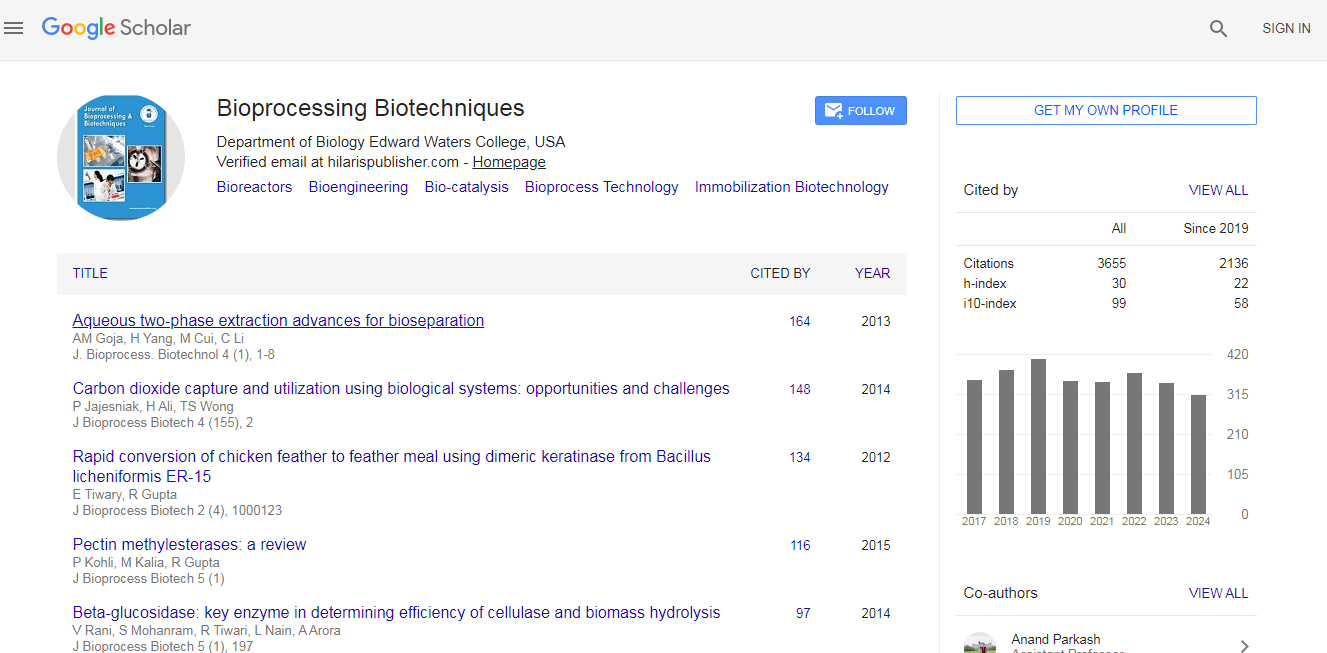
Journal of Bioprocessing & Biotechniques received 3351 citations as per Google Scholar report