Perspective - (2025) Volume 13, Issue 6
Received: 01-Dec-2025, Manuscript No. JGPR-26-190240;
Editor assigned: 01-Feb-2025, Pre QC No. P-190240;
Reviewed: 17-Dec-2025, QC No. Q-190240;
Revised: 22-Dec-2025, Manuscript No. R-190240;
Published:
29-Dec-2025
, DOI: 10.37421/2329-9126.2025.13.650
Citation: Li, Chen. ”AI Revolutionizes Primary Care Diagnosis: Accuracy and Access.” J Gen Pract 13 (2025):650.
Copyright: © 2025 Li C. This is an open-access article distributed under the terms of the Creative Commons Attribution License, which permits unrestricted use, distribution and reproduction in any medium, provided the original author and source are credited.
Artificial intelligence (AI) is emerging as a transformative force in primary care, offering innovative tools to enhance diagnostic capabilities and patient care. The rapid analysis of medical images, patient data, and symptoms by AI presents a significant promise for earlier disease detection and improved diagnostic accuracy. This is particularly beneficial for general practitioners, streamlining their workflows, especially in resource-limited settings such as rural areas where access to specialist expertise may be scarce [1].
The integration of AI-powered diagnostic support systems is poised to address significant challenges in rural primary healthcare. These systems can provide expert-level insights by analyzing electronic health records and imaging data to flag potential conditions, thereby enhancing the timeliness and accuracy of diagnoses, bridging the gap where specialists are less available [2].
Machine learning algorithms are proving to be invaluable tools for primary care physicians. By training these algorithms to identify complex patterns within symptoms and patient histories, they can offer crucial indicators for specific diseases. This capability aids in reducing diagnostic errors and improving patient outcomes, especially for conditions that are often difficult to diagnose in their early stages [3].
The application of AI in analyzing medical images, such as X-rays and CT scans, is significantly assisting primary care physicians. AI can detect subtle abnormalities that might be easily missed by the human eye, thereby improving the diagnostic precision for various conditions, including pneumonia and fractures [4].
Natural language processing (NLP), a key component of AI, plays a crucial role in extracting meaningful diagnostic information from unstructured clinical notes. AI-driven NLP can systematically identify key symptoms, risk factors, and previous diagnoses, presenting this data in a structured and easily digestible format for the physician's review [5].
AI tools are also proving instrumental in assisting with differential diagnosis. By generating a list of possible conditions based on a patient's presented symptoms and medical history, these tools help general practitioners broaden their considerations and avoid diagnostic biases, such as anchoring bias, leading to more comprehensive assessments [6].
Furthermore, AI contributes to the interpretation of diagnostic tests, including ECGs and laboratory results. By identifying critical findings and alerting physicians to potential issues that warrant further investigation, AI effectively streamlines the diagnostic process, making it more efficient and less prone to oversight [7].
However, the implementation of AI in primary care diagnosis necessitates careful consideration of several ethical and practical aspects. Data privacy, the need for robust validation to ensure patient safety, and fostering trust are paramount concerns. Additionally, adequately training healthcare professionals to effectively utilize and interpret AI outputs is essential for successful integration [8].
AI-powered chatbots and virtual assistants are also finding applications in primary care, offering new avenues for patient interaction. These tools can assist with patient triage, gather preliminary symptom information, and provide basic health advice, thereby improving patient access to care and allowing physicians to focus on more complex medical cases [9].
In conclusion, the ongoing development and integration of AI in primary care diagnosis hold the potential to significantly enhance efficiency, accuracy, and accessibility. Ultimately, these advancements are expected to contribute to improved patient care, particularly benefiting underserved rural communities with limited access to specialized diagnostic services [10].
Artificial intelligence (AI) is demonstrating substantial promise in revolutionizing primary care diagnostics through its capacity for rapid analysis of multifaceted patient information. The ability of AI tools to process medical images, patient data, and symptoms swiftly can lead to earlier disease detection and enhanced diagnostic accuracy, benefiting general practitioners, especially in underserved rural regions where resources are often limited [1].
The integration of AI-driven diagnostic support systems is becoming increasingly vital for addressing the diagnostic challenges prevalent in rural primary healthcare settings. These systems offer expert-level insights by analyzing electronic health records and imaging data, effectively flagging potential conditions and thereby improving both the timeliness and accuracy of diagnoses in areas with limited specialist availability [2].
Machine learning algorithms are being effectively utilized to identify intricate patterns within symptomology and patient histories that are indicative of specific diseases. This provides primary care physicians with a powerful tool for reducing diagnostic errors and improving overall patient outcomes, particularly for conditions that are often misdiagnosed or overlooked in their initial stages [3].
The application of AI in the meticulous analysis of medical images, such as X-rays and CT scans, offers significant assistance to primary care physicians. AI's capability to discern subtle abnormalities that might evade human observation enhances diagnostic precision for a range of conditions, including common issues like pneumonia and fractures [4].
Natural language processing (NLP), an advanced AI technique, is critical for extracting clinically relevant diagnostic information from unstructured narrative clinical notes. AI-powered NLP systems can effectively identify key symptoms, patient risk factors, and past diagnoses, presenting this information in a structured format that facilitates physician review and decision-making [5].
AI tools are also playing an important role in the process of differential diagnosis. By suggesting a comprehensive list of potential conditions based on a patient's reported symptoms and medical history, these systems help general practitioners expand their diagnostic considerations and mitigate the impact of cognitive biases, such as anchoring bias, leading to more thorough assessments [6].
Furthermore, AI contributes significantly to the interpretation of various diagnostic tests, including electrocardiograms (ECGs) and laboratory results. By pinpointing critical findings and alerting physicians to potential issues requiring further investigation, AI helps to streamline the diagnostic workflow and improve its overall efficiency [7].
The practical implementation of AI within primary care diagnosis requires careful navigation of ethical considerations. Issues concerning data privacy, the necessity for rigorous validation processes to ensure patient safety, and the cultivation of trust among patients and providers are of utmost importance. Equally crucial is the comprehensive training of healthcare professionals in the effective use and interpretation of AI-generated outputs [8].
AI-driven chatbots and virtual assistants are emerging as valuable tools for patient engagement in primary care. These applications can facilitate patient triage, collect initial symptom information, and deliver basic health guidance, thereby enhancing patient accessibility to care and optimizing physician time for more complex patient needs [9].
In summary, the continuous advancement and integration of AI technologies into primary care diagnosis are set to enhance operational efficiency, diagnostic accuracy, and the overall accessibility of healthcare services. These developments are poised to contribute positively to patient care, especially for populations residing in underserved rural areas where access to specialized diagnostic expertise is often constrained [10].
Artificial intelligence (AI) is significantly enhancing primary care diagnosis through rapid analysis of medical images, patient data, and symptoms, leading to earlier disease detection and improved accuracy. AI-powered systems offer expert-level insights in rural settings, analyzing EHRs and imaging to flag conditions. Machine learning algorithms identify disease patterns from symptoms and history, reducing errors. AI excels in analyzing medical images for subtle abnormalities and uses natural language processing to extract diagnostic information from clinical notes. AI assists in differential diagnosis by suggesting possibilities and helps interpret diagnostic tests like ECGs and lab results. While promising, AI implementation requires addressing ethical concerns, data privacy, and professional training. Chatbots and virtual assistants improve patient triage and access. Overall, AI promises to boost efficiency, accuracy, and accessibility in primary care, especially benefiting rural communities.
None
None
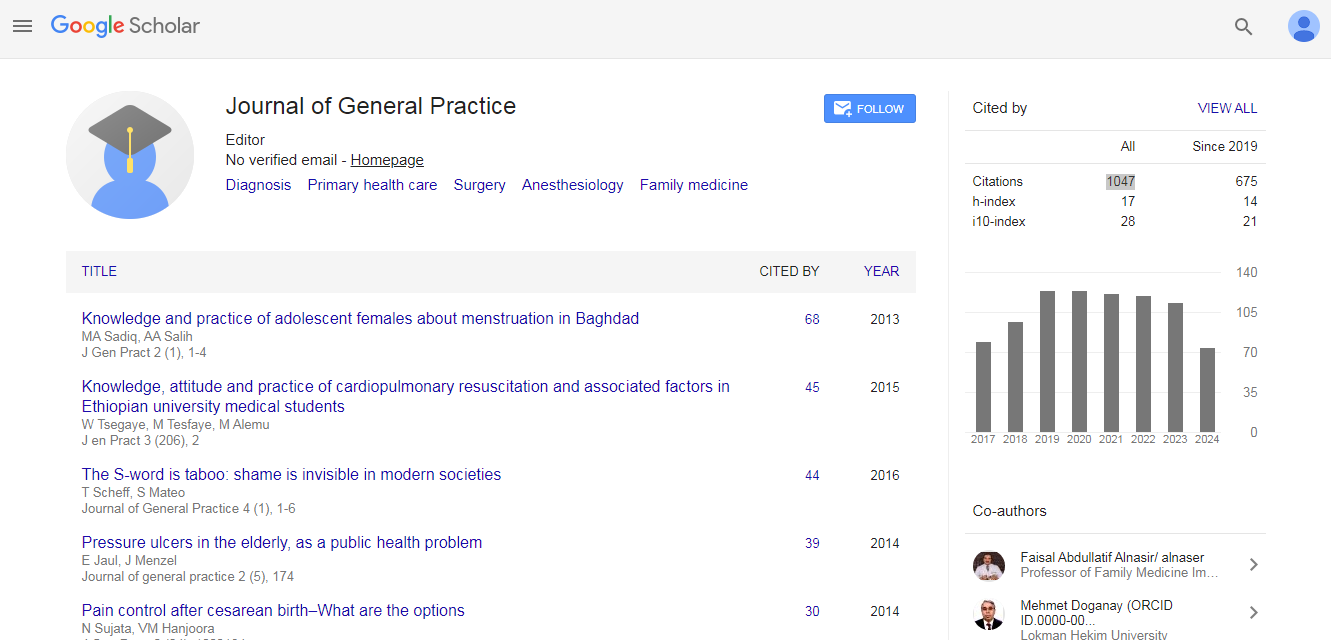
Journal of General Practice received 1047 citations as per Google Scholar report