Brief Report - (2026) Volume 16, Issue 1
Received: 01-Jan-2026, Manuscript No. jnt-26-191270;
Editor assigned: 05-Jan-2026, Pre QC No. P-191270;
Reviewed: 19-Jan-2026, QC No. Q-191270;
Revised: 22-Jan-2026, Manuscript No. R-191270;
Published:
29-Jan-2026
, DOI: 10.37421/2161-0959.2026.16.603
Citation: Mercer, Daniel. ”AI Revolutionizes Dialysis: Personalized Care, Enhanced Efficiency.” J Nephrol Ther 16 (2026):603.
Copyright: © 2026 Mercer D. This is an open-access article distributed under the terms of the Creative Commons Attribution License, which permits unrestricted use, distribution and reproduction in any medium, provided the original author and source are credited.
Artificial intelligence (AI) is fundamentally transforming the landscape of dialysis monitoring and management, ushering in an era of more personalized and efficient patient care. The capacity of AI algorithms to analyze extensive patient data, encompassing clinical parameters, laboratory results, and outputs from wearable sensors, enables the prediction of adverse events such as fluid overload, hypotension, or infections. This proactive strategy facilitates timely interventions, leading to improved patient outcomes and a reduction in hospitalizations. Furthermore, AI contributes to optimizing dialysis prescriptions, tailoring treatments to the unique needs of individual patients, and enhancing the operational efficiency of dialysis units. Machine learning models are actively being developed to detect subtle patterns indicative of complications before they manifest clinically, thereby significantly improving the quality of life for individuals undergoing dialysis [1].
The integration of machine learning into hemodialysis therapy holds substantial promise for enabling personalized treatment adjustments. By analyzing real-time patient data during dialysis sessions, AI can identify deviations from optimal parameters and recommend modifications to crucial elements like blood flow, dialysate composition, and ultrafiltration rates. This dynamic approach aims to maximize solute clearance while concurrently minimizing intradialytic complications, ultimately leading to enhanced patient tolerance and improved overall treatment efficacy. The early detection of trends that may predispose patients to adverse events, such as hypovolemia or electrolyte imbalances, is achievable through these AI-driven insights [2].
Remote patient monitoring, powered by AI-driven platforms, is actively revolutionizing the management of patients undergoing peritoneal dialysis (PD). Wearable sensors and connected devices facilitate the continuous collection of physiological data, which is subsequently analyzed by AI to detect early indicators of peritonitis, dehydration, or electrolyte disturbances. This capability enables prompt telehealth consultations and interventions, thereby reducing the necessity for frequent clinic visits and hospital admissions. The ability of AI to flag anomalies in fluid balance and metabolic parameters provides a critical layer of safety and support for PD patients who manage their treatment at home [3].
Predictive analytics leveraging AI are proving to be invaluable in forecasting fluid management challenges within hemodialysis. By integrating data from previous dialysis sessions, interdialytic weight gain patterns, and dietary intake information, AI models can accurately predict a patient's likelihood of developing fluid overload or dehydration. This foresight empowers nephrologists to proactively adjust fluid management strategies, including dietary recommendations or ultrafiltration targets, thereby mitigating risks and enhancing patient well-being. The inherent accuracy of these predictions translates to a more tailored and safer dialysis experience [4].
AI is also instrumental in enhancing the interpretation of dialysis adequacy markers by identifying intricate relationships between various parameters. Machine learning algorithms possess the capability to analyze a broader spectrum of data, including dialyzer performance and patient adherence, to provide a more comprehensive assessment of dialysis effectiveness than traditional metrics alone. This granular level of analysis is crucial for ensuring that each patient receives the optimal dialysis dose, leading to superior clearance of uremic toxins and improved long-term health outcomes. The overarching goal is to transition towards a more individualized and dynamic evaluation of dialysis adequacy [5].
The application of AI in identifying patterns of intradialytic hypotension is critically important for ensuring patient safety. Machine learning models are capable of analyzing subtle physiological changes that often precede hypotensive episodes, such as variations in heart rate variability and blood pressure trends. This allows for preemptive adjustments to ultrafiltration rates or fluid administration. Such predictive capabilities are instrumental in preventing or mitigating the severity of hypotension, a common yet potentially dangerous complication during hemodialysis, thereby enhancing patient comfort and reducing treatment interruptions [6].
AI-powered systems are being actively developed to streamline the complex processes of scheduling and resource allocation within dialysis centers. By analyzing critical factors such as patient needs, staff availability, and equipment utilization, AI can optimize the scheduling of dialysis sessions, leading to reduced patient wait times and improved overall operational efficiency. This not only enhances patient satisfaction but also facilitates better management of resources, ensuring that all patients receive timely and appropriate treatment. The efficiency gains realized through these AI applications can be substantial, particularly in busy dialysis facilities [7].
The use of AI in analyzing medical imaging for the detection of dialysis-related complications, such as arteriovenous fistula (AVF) stenosis or issues with peritoneal catheters, represents an emerging and promising area of research. Machine learning algorithms are adept at detecting subtle abnormalities in ultrasound or CT scans that might be overlooked by the human eye, enabling earlier diagnosis and more timely intervention. This capability directly contributes to extending the longevity of vascular access and reducing the incidence of complications associated with AVFs and peritoneal dialysis catheters. Early detection is fundamentally key to preserving the functional integrity of access sites [8].
AI-driven chatbots and virtual assistants are significantly enhancing patient education and support within the context of dialysis management. These intelligent tools can deliver personalized information to patients regarding their specific condition, prescribed treatment regimens, and essential dietary guidelines. They are also capable of answering frequently asked questions, providing timely medication reminders, and actively monitoring patient-reported symptoms. This enhanced accessibility to crucial information and ongoing support empowers patients to better manage their dialysis treatments at home, thereby improving adherence and leading to better overall treatment outcomes [9].
The future trajectory of dialysis monitoring and management will undoubtedly be characterized by increasingly sophisticated AI integration. This includes the development of AI capable of analyzing genomic data to predict individual patient responses to diverse dialysis modalities or pharmacological agents. Furthermore, AI will play a vital role in proactively managing the complex comorbidities frequently observed in dialysis patients. Advancements in explainable AI (XAI) are anticipated to be paramount in fostering trust and facilitating the widespread adoption of AI tools by clinicians, ensuring that AI serves as a supportive adjunct to, rather than a replacement for, clinical judgment in the intricate domain of nephrology [10].
Artificial intelligence (AI) is revolutionizing dialysis monitoring and management by enabling more personalized and efficient patient care. AI algorithms analyze vast amounts of patient data, including clinical parameters, laboratory results, and wearable sensor outputs, to predict adverse events like fluid overload, hypotension, or infection. This proactive approach allows for timely interventions, improving patient outcomes and reducing hospitalizations. Furthermore, AI assists in optimizing dialysis prescription, tailoring treatment to individual patient needs, and enhancing the efficiency of dialysis unit operations. Machine learning models are being developed to detect subtle patterns indicative of complications before they become clinically apparent, thereby improving the quality of life for dialysis patients [1].
The integration of machine learning into hemodialysis therapy is showing significant promise for personalized treatment adjustments. By analyzing real-time patient data during dialysis sessions, AI can identify deviations from optimal parameters and suggest modifications to blood flow, dialysate composition, and ultrafiltration rates. This dynamic approach aims to maximize solute clearance while minimizing intradialytic complications, leading to improved patient tolerance and overall treatment efficacy. Early detection of trends that might lead to adverse events, such as hypovolemia or electrolyte imbalances, can be achieved through these AI-driven insights [2].
Remote patient monitoring using AI-powered platforms is transforming the management of patients on peritoneal dialysis (PD). Wearable sensors and connected devices can continuously collect physiological data, which is then analyzed by AI to detect early signs of peritonitis, dehydration, or electrolyte disturbances. This enables prompt telehealth consultations and interventions, reducing the need for frequent clinic visits and hospital admissions. AI's ability to flag anomalies in fluid balance and metabolic parameters offers a crucial layer of safety and support for PD patients managing their treatment at home [3].
Predictive analytics using AI are proving invaluable in forecasting fluid management challenges in hemodialysis. By integrating data from previous dialysis sessions, interdialytic weight gain, and dietary intake patterns, AI models can predict a patient's likelihood of developing fluid overload or dehydration. This foresight allows nephrologists to proactively adjust fluid management strategies, such as dietary recommendations or ultrafiltration targets, thereby mitigating risks and improving patient well-being. The accuracy of these predictions can lead to a more tailored and safer dialysis experience [4].
AI is enhancing the interpretation of dialysis adequacy markers by identifying complex relationships between various parameters. Machine learning algorithms can analyze a broader spectrum of data, including dialyzer performance and patient adherence, to provide a more comprehensive assessment of dialysis effectiveness than traditional metrics alone. This granular analysis helps ensure that each patient receives the optimal dialysis dose, leading to better clearance of uremic toxins and improved long-term health outcomes. The goal is to move towards more individualized and dynamic assessment of dialysis adequacy [5].
The application of AI in identifying patterns of intradialytic hypotension is crucial for patient safety. Machine learning models can analyze subtle physiological changes preceding hypotensive episodes, such as shifts in heart rate variability and blood pressure trends, allowing for preemptive adjustments in ultrafiltration rates or fluid administration. This predictive capability helps to prevent or mitigate the severity of hypotension, a common and potentially dangerous complication during hemodialysis, thus enhancing patient comfort and reducing treatment interruptions [6].
AI-powered systems are being developed to streamline the scheduling and resource allocation in dialysis centers. By analyzing patient needs, staff availability, and equipment utilization, AI can optimize dialysis session scheduling, reducing patient wait times and improving operational efficiency. This not only enhances patient satisfaction but also allows for better management of resources, ensuring that all patients receive timely and appropriate treatment. The efficiency gains can be substantial in busy dialysis facilities [7].
The use of AI in analyzing medical imaging for dialysis-related complications, such as arteriovenous fistula (AVF) stenosis or peritoneal catheter issues, is an emerging area. Machine learning algorithms can detect subtle abnormalities in ultrasound or CT scans that might be missed by the human eye, enabling earlier diagnosis and intervention. This improves the longevity of vascular access and reduces complications associated with AVFs and peritoneal dialysis catheters. Early detection is key to preserving access function [8].
AI-driven chatbots and virtual assistants are enhancing patient education and support in dialysis management. These tools can provide patients with personalized information about their condition, treatment regimens, and dietary guidelines. They can also answer frequently asked questions, offer medication reminders, and monitor patient-reported symptoms. This accessibility to information and support empowers patients to better manage their dialysis at home, improving adherence and overall treatment outcomes [9].
The future of dialysis monitoring and management will undoubtedly involve more sophisticated AI integration. This includes developing AI that can analyze genomic data to predict individual responses to different dialysis modalities or medications, as well as AI that can proactively manage complex comorbidities common in dialysis patients. Furthermore, advancements in explainable AI (XAI) will be crucial for building trust and facilitating the adoption of AI tools by clinicians, ensuring that AI supports, rather than replaces, clinical judgment in the complex field of nephrology [10].
Artificial intelligence (AI) is revolutionizing dialysis monitoring and management through personalized patient care, enhanced efficiency, and proactive intervention. AI algorithms analyze extensive patient data to predict adverse events, optimize treatment prescriptions, and improve operational efficiency in dialysis units. Machine learning models facilitate personalized hemodialysis adjustments by analyzing real-time data and suggesting modifications to treatment parameters. Remote monitoring systems powered by AI are transforming peritoneal dialysis management by detecting early signs of complications and enabling prompt interventions. Predictive analytics help forecast fluid management challenges, leading to tailored strategies and improved patient well-being. AI also enhances the assessment of dialysis adequacy by analyzing complex relationships between various parameters, ensuring optimal treatment dosage. The identification of intradialytic hypotension patterns through AI improves patient safety by allowing preemptive adjustments. AI optimizes dialysis center operations by streamlining scheduling and resource allocation, reducing wait times and improving efficiency. Emerging applications of AI involve analyzing medical imaging to detect dialysis access complications, enabling earlier diagnosis and intervention. AI-driven chatbots and virtual assistants enhance patient education and support, empowering individuals to better manage their dialysis at home. Future advancements will involve more sophisticated AI integration, including genomic data analysis and proactive management of comorbidities, with explainable AI playing a crucial role in clinical adoption.
None
None
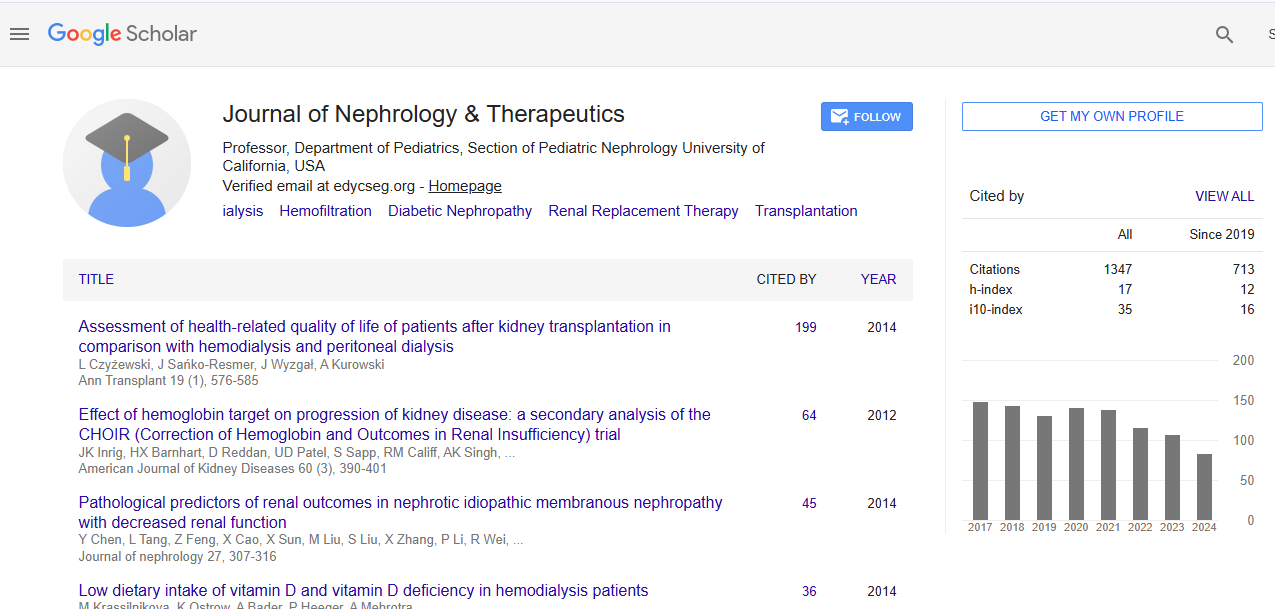
Journal of Nephrology & Therapeutics received 784 citations as per Google Scholar report