Perspective - (2025) Volume 13, Issue 3
Received: 02-Jun-2026, Manuscript No. jaat-26-183161;
Editor assigned: 04-Jun-2025, Pre QC No. P-183161;
Reviewed: 18-Jun-2025, QC No. Q-183161;
Revised: 23-Jun-2025, Manuscript No. R-183161;
Published:
30-Jun-2025
, DOI: 10.37421/2329-6542.2025.13.360
Citation: Russo, Alessandro. ”AI Powers Astrophysics and Space Exploration Discoveries.” J Astrophys Aerospace Technol 13 (2025):360.
Copyright: © 2025 Russo A. This is an open-access article distributed under the terms of the Creative Commons Attribution License, which permits unrestricted use, distribution and reproduction in any medium, provided the original author and source are credited.
Artificial intelligence (AI) is fundamentally transforming the field of astrophysics, offering unprecedented capabilities for analyzing massive datasets generated by large-scale sky surveys. This technological advancement significantly improves the efficiency and accuracy of exoplanet detection through sophisticated pattern recognition applied to observational data, while also enhancing astrophysical simulations by optimizing computational processes for greater fidelity. [1] Machine learning, a subset of AI, is increasingly employed to categorize astronomical objects from diverse sources, enabling the rapid identification of transient celestial events in real-time and the reduction of noise in astronomical images, thereby accelerating the pace of discovery. These algorithms are also crucial for enhancing the autonomy of space missions, assisting in mission planning and onboard decision-making. [2] Deep learning models are exhibiting remarkable proficiency in dissecting complex spectral data to characterize the atmospheric compositions of exoplanets, a critical step in the search for extraterrestrial life. Furthermore, these models excel at reconstructing faint astrophysical signals that are often obscured by noise in observational data. [3] AI-driven anomaly detection systems are proving to be invaluable tools for astronomers, facilitating the sifting of vast volumes of survey data to identify unexpected astronomical phenomena. Concurrently, these systems are employed to monitor the operational status of deep space probes, ensuring the integrity and success of missions. [4] Reinforcement learning techniques are emerging as powerful solutions for developing autonomous spacecraft control systems. This allows probes to dynamically adapt to unforeseen circumstances encountered during missions and to optimize their trajectories for maximizing the acquisition of valuable scientific data. [5] The application of AI in enhancing image processing for astrophysical purposes, particularly through techniques like super-resolution and deconvolution, leads to significantly improved detail and clarity when observing celestial objects. This refinement is critical for detailed study. [6] AI plays an instrumental role in the detection of gravitational wave signals, which are often buried within noisy data streams. This capability is pushing the boundaries of our understanding of extreme cosmic events and the fundamental physics governing the universe. [7] The development of more sophisticated cosmological simulations is being significantly advanced by AI, empowering astrophysicists to rigorously test fundamental theories about the origin, evolution, and structure of the universe. These simulations offer crucial insights into cosmic phenomena. [8] In radio astronomy, AI is accelerating the discovery of pulsars, which are vital for testing theories of gravity and for understanding extreme astrophysical environments. It also aids in the analysis of faint radio signals originating from distant galaxies. [9] AI algorithms are actively being developed to streamline and improve the efficiency of data pipelines utilized by large astronomical observatories. This optimization is essential for managing the immense data flow and for enhancing predictive capabilities in areas like space weather forecasting. [10]
Artificial intelligence is revolutionizing astrophysics by enabling sophisticated data analysis for large-scale sky surveys, improving exoplanet detection through pattern recognition in observational data, and enhancing astrophysical simulations by optimizing computational processes. In space missions, AI contributes to autonomous spacecraft navigation, intelligent fault detection and diagnosis, and optimizing scientific instrument operations, leading to more efficient and impactful exploration. [1] Machine learning algorithms are being employed to classify astronomical objects from diverse datasets, identify transient events in real-time, and reduce noise in astronomical images, significantly accelerating discovery. For space missions, AI enhances mission planning, onboard decision-making for autonomous operations, and the analysis of complex scientific data gathered from remote environments. [2] Deep learning models demonstrate remarkable capability in analyzing complex spectral data for identifying atmospheric compositions of exoplanets and in reconstructing faint astrophysical signals from noisy observations. In aerospace, AI is crucial for predictive maintenance of spacecraft components and for enabling intelligent robotic systems to perform tasks in challenging extraterrestrial conditions. [3] AI-driven anomaly detection is proving invaluable for sifting through vast amounts of astronomical survey data to find unexpected phenomena and for monitoring the operational status of deep space probes, ensuring mission integrity. The application of AI in optimizing telescope scheduling and in real-time data calibration further enhances observational efficiency in astrophysics. [4] Reinforcement learning is emerging as a powerful tool for autonomous spacecraft control, enabling probes to adapt to unforeseen circumstances and optimize their trajectories for scientific data acquisition. In astrophysics, AI assists in the simulation of complex cosmic phenomena, such as galaxy formation and the evolution of stellar populations, leading to deeper theoretical understanding. [5] The use of AI for image processing in astrophysics, including super-resolution and deconvolution techniques, significantly enhances the detail and clarity of celestial objects. For space missions, AI plays a critical role in sample return missions by enabling intelligent robotic manipulation and in optimizing the power consumption of onboard systems. [6] AI is instrumental in identifying gravitational wave signals from noisy data, pushing the boundaries of our understanding of cosmic events. In space missions, AI is utilized for autonomous rendezvous and docking maneuvers and for intelligent data compression to manage the vast quantities of information transmitted back to Earth. [7] AI is enabling the development of more sophisticated cosmological simulations, allowing astrophysicists to test fundamental theories of the universe. For space missions, AI is crucial for real-time decision-making in uncertain environments, such as during planetary landings, and for optimizing the deployment of scientific instruments. [8] The application of AI in radio astronomy is accelerating the search for pulsars and the analysis of faint radio signals from distant galaxies. In aerospace, AI contributes to advanced trajectory optimization for interplanetary missions and to the development of intelligent sensors for remote sensing applications. [9] AI algorithms are being developed to improve the efficiency of data pipelines for large astronomical observatories and to enhance the predictive capabilities of space weather forecasting. In space mission design, AI assists in optimizing hardware configurations and in simulating mission scenarios to identify potential risks. [10]
Artificial intelligence is rapidly advancing astrophysics and space exploration. AI excels at analyzing vast astronomical datasets from sky surveys, improving exoplanet detection, and enhancing astrophysical simulations. Machine learning algorithms aid in classifying celestial objects, identifying transient events, and reducing image noise, thereby accelerating discoveries. Deep learning models are crucial for analyzing exoplanet atmospheres and reconstructing faint signals. AI-powered anomaly detection helps identify unexpected phenomena and monitor spacecraft. Reinforcement learning enables autonomous spacecraft control and trajectory optimization. AI also enhances image processing for clearer celestial views and plays a vital role in sample return missions. Furthermore, AI is essential for gravitational wave detection, sophisticated cosmological simulations, and advancing radio astronomy techniques. Data pipeline efficiency and space weather forecasting are also benefiting from AI advancements, alongside optimizing space mission designs and hardware configurations.
None
None
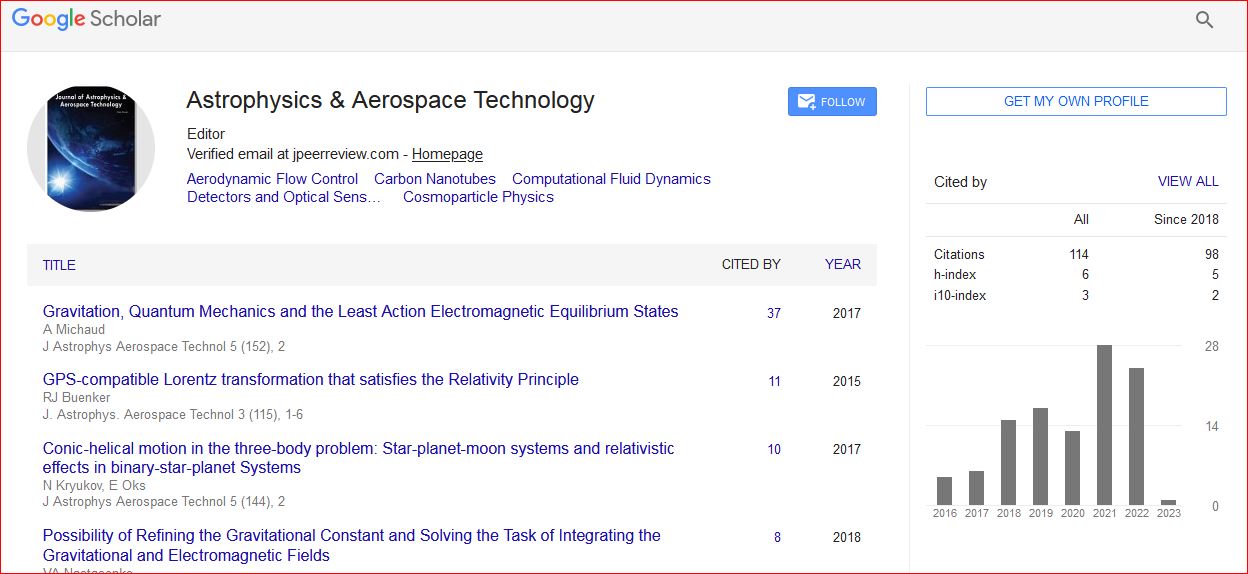
Astrophysics & Aerospace Technology received 114 citations as per Google Scholar report