Brief Report - (2025) Volume 16, Issue 3
Received: 29-May-2025, Manuscript No. gjto-25-175415;
Editor assigned: 02-Jun-2025, Pre QC No. P-175415;
Reviewed: 16-Jun-2025, QC No. QC-175415;
Revised: 23-May-2025, Manuscript No. R-175415;
Published:
30-Jun-2025
, DOI: 10.37421/2229-8711.2025.16.444
Citation: Rousseau, Gabrielle. âAI and Data Drive Industrial Transformation.â Global J Technol Optim 16 (2025):444.
Copyright: © 2025 Rousseau G. This is an open-access article distributed under the terms of the Creative Commons Attribution License, which permits unrestricted use,
distribution and reproduction in any medium, provided the original author and source are credited.
Machine learning significantly enhances predictive maintenance strategies for industrial systems, transforming traditional scheduled maintenance into data-driven approaches. These methods foresee equipment failures, optimize schedules, and reduce downtime. The core insight involves integrating diverse sensor data with advanced algorithms to build more reliable and efficient operational frameworks in manufacturing and other heavy industries [1]. Concurrently, Digital Twins are profoundly influencing smart manufacturing. These virtual replicas of physical assets, processes, and systems facilitate real-time monitoring, simulation, and optimization, driving remarkable improvements in efficiency and flexibility. Essentially, Digital Twins bridge the physical and digital worlds, offering predictive insights and fostering proactive decision-making throughout the manufacturing lifecycle [2]. Data analytics demonstrates its value in supply chain management. It offers robust capabilities to optimize elements like demand forecasting, inventory management, logistics, and risk mitigation. What this really means is that by harnessing advanced analytical techniques, organizations can cultivate supply chains that are more resilient, responsive, and cost-effective in dynamic global markets [3].
In product design and development, Artificial Intelligence (AI) is playing a pivotal role. AI tools, such as generative design and machine learning-driven simulations, streamline the design process, fostering innovation, and enhancing product performance. The central takeaway is that AI transcends mere automation, truly augmenting human creativity, empowering engineers to explore expansive design spaces and expedite sophisticated products to market faster [4]. Beyond manufacturing, data-driven approaches are proving indispensable in structural health monitoring. This involves the continuous assessment of civil infrastructure integrity, including bridges and buildings, through sophisticated sensors and advanced analytics. The main point is that these methods facilitate early detection of structural damage, enabling predictive maintenance, extending the lifespan of critical structures, safeguarding public safety, and optimizing resource allocation [5]. The domain of smart grids also benefits immensely from big data analytics. This involves analyzing vast quantities of data from sensors, smart meters, and grid operations to enhance the efficiency, reliability, and sustainability of power systems. Here's the thing: robust data analytics is critical for managing renewable energy integration, optimizing energy distribution networks, and constructing a more responsive and intelligent electrical infrastructure [6].
Moreover, data analytics approaches are being specifically tailored for human factors and ergonomics within complex systems. By meticulously analyzing human performance data, physiological responses, and interaction patterns, these approaches contribute to superior system design, a tangible reduction in operational errors, and a significantly enhanced user experience. The key insight here is that integrating analytics into human factors engineering helps forge safer, more intuitive, and productive environments for human operators across diverse industries, from aviation to healthcare and manufacturing [7]. For engineering projects, risk management is being revolutionized by data-driven methodologies, especially those leveraging machine learning. This involves employing historical project data alongside advanced analytics to effectively identify potential risks, accurately predict their probable impact, and develop informed mitigation strategies with greater efficacy than traditional methods. What this really means is that an analytical approach to risk empowers project managers to proactively anticipate challenges and make decisive, forward-thinking decisions, ultimately improving project success rates and drastically reducing unforeseen costs [8]. The expansive applications of big data analytics are also profoundly impacting environmental engineering. This covers pollution monitoring and control, efficient resource management, and complex climate modeling. The processing of intricate environmental datasets helps reveal critical patterns, predict future environmental changes, and inform sustainable practices. The central idea is that data analytics serves as a powerful toolkit for confronting urgent environmental challenges, supporting evidence-based policy formulation, and actively nurturing a more sustainable future [9]. Finally, data-driven process optimization holds significant promise in advanced manufacturing settings. Analytics, encompassing machine learning and various statistical methods, are systematically applied to monitor, control, and continually improve manufacturing processes, resulting in higher quality products and notable increases in operational efficiency. Let's break it down: by thoroughly analyzing real-time operational data, engineers gain the ability to pinpoint bottlenecks, accurately predict potential defects, and meticulously fine-tune production parameters, ultimately minimizing waste and maximizing output [10].
Modern industry is heavily leveraging advanced analytical techniques to enhance operational efficiency and predictive capabilities. Machine learning, for instance, has fundamentally transformed predictive maintenance strategies for industrial systems. Instead of relying on fixed schedules, industries now employ data-driven methods that can foresee equipment failures, optimize maintenance schedules, and significantly reduce downtime [1]. This transformation relies on integrating diverse sensor data with sophisticated algorithms to build more reliable and efficient operational frameworks, especially in manufacturing and heavy industries. Complementing this, Digital Twins are emerging as crucial tools in smart manufacturing [2]. These virtual replicas of physical assets, processes, and systems enable real-time monitoring, simulation, and optimization, leading to unprecedented levels of efficiency and flexibility in production environments. The essence here is that Digital Twins bridge the physical and digital realms, facilitating predictive insights and proactive decision-making throughout the manufacturing lifecycle [2].
Beyond machinery and virtual models, data analytics is also a cornerstone for optimizing broader operational flows. In supply chain management, comprehensive reviews highlight how analytics can optimize demand forecasting, inventory management, logistics, and risk mitigation [3]. What this really means is that leveraging advanced analytical techniques allows organizations to build more resilient, responsive, and cost-effective supply chains, which is critical in today's volatile global market. Similarly, Artificial Intelligence (AI) is redefining product design and development [4]. Tools like generative design and machine learning-driven simulations streamline the design process, fostering innovation and enhancing product performance. The core takeaway is that AI moves beyond mere automation, truly augmenting human creativity, enabling engineers to explore vast design spaces and bring more sophisticated products to market faster [4]. Furthermore, data-driven process optimization in advanced manufacturing employs machine learning and statistical methods to monitor, control, and improve manufacturing processes, resulting in higher quality products and increased efficiency by identifying bottlenecks and predicting defects [10].
The application of data-driven methods extends to critical infrastructure and complex systems, ensuring safety and reliability. Structural health monitoring (SHM) utilizes sensors combined with advanced analytics to continuously assess the integrity of civil infrastructure like bridges and buildings [5]. This provides early detection of damage, enabling predictive maintenance and extending the lifespan of critical structures, thus ensuring public safety and optimizing resource allocation. In the realm of smart grids, big data analytics tackles the challenges and opportunities presented by vast amounts of data from sensors and smart meters [6]. Analyzing this data improves the efficiency, reliability, and sustainability of power systems, which is essential for managing renewable energy integration, optimizing energy distribution, and building a more responsive and intelligent electrical infrastructure. For engineering projects, risk management benefits significantly from data-driven approaches, especially those using machine learning [8]. Historical project data, coupled with advanced analytics, can identify potential risks, predict their impact, and inform mitigation strategies more effectively than traditional methods. A more analytical approach to risk allows project managers to anticipate challenges and make proactive decisions, ultimately improving project success rates and reducing unforeseen costs [8].
Data analytics also enhances human interaction with complex systems and addresses pressing environmental concerns. Approaches applied to human factors and ergonomics within complex systems analyze human performance data, physiological responses, and interaction patterns [7]. This leads to better system design, reduced errors, and an enhanced user experience. The key insight is that integrating analytics into human factors engineering helps create safer, more intuitive, and productive environments for human operators in demanding industries like aviation, healthcare, and manufacturing. Furthermore, big data analytics finds wide-ranging applications in environmental engineering [9]. This includes pollution monitoring and control, resource management, and climate modeling. Complex environmental datasets are processed to reveal patterns, predict environmental changes, and inform sustainable practices. The central idea is that data analytics provides powerful tools for addressing pressing environmental challenges, supporting evidence-based policy making, and fostering a more sustainable future [9].
The modern industrial landscape is undergoing a significant transformation driven by advanced data analytics and Artificial Intelligence (AI). This shift enables more proactive and efficient management across various sectors. For example, machine learning significantly enhances predictive maintenance in industrial systems, moving away from traditional scheduled upkeep to data-driven methods that foresee equipment failures, optimize schedules, and minimize downtime. This is all about integrating diverse sensor data with sophisticated algorithms to create more reliable operational frameworks in manufacturing and heavy industries. Digital Twins, virtual replicas of physical assets, are revolutionizing smart manufacturing by enabling real-time monitoring, simulation, and optimization, boosting efficiency and flexibility in production. What this really means is that Digital Twins bridge the gap between the physical and digital worlds, allowing for predictive insights and proactive decision-making throughout the manufacturing lifecycle. Similarly, data analytics is vital in supply chain management, optimizing demand forecasting, inventory, logistics, and risk mitigation, leading to more resilient and cost-effective supply chains. Artificial Intelligence (AI) also plays a growing role in product design, streamlining processes with generative design and machine learning simulations, ultimately augmenting human creativity to bring sophisticated products to market faster. Data-driven approaches extend to structural health monitoring, where sensors combined with advanced analytics continuously assess civil infrastructure integrity. This allows for early damage detection, extending the lifespan of critical structures and ensuring public safety. In smart grids, big data analytics helps manage vast amounts of sensor data to improve efficiency, reliability, and sustainability of power systems, crucial for renewable energy integration and optimizing distribution. Furthermore, analytics applied to human factors and ergonomics in complex systems leads to better design, reduced errors, and enhanced user experience by analyzing performance data and interaction patterns. This helps create safer and more intuitive environments. Risk management in engineering projects also benefits from data-driven machine learning approaches, using historical data to identify potential risks and inform mitigation strategies, thereby improving project success rates. Big data analytics has widespread applications in environmental engineering, processing complex datasets for pollution monitoring, resource management, and climate modeling, supporting sustainable practices. Lastly, data-driven process optimization in advanced manufacturing leverages analytics to monitor, control, and improve processes, leading to higher quality products and increased efficiency by identifying bottlenecks and predicting defects.
None
None
Vivek KS, Manoj KM, Shishir KS. "Predictive maintenance strategy for industrial systems based on machine learning: A systematic review".J. Qual. Maint. Eng. 27 (2021):432-452.
Indexed at, Google Scholar, Crossref
Mohamed DEAA, Karim H, Hassan A. "Digital Twin for Smart Manufacturing: A Comprehensive Review".IEEE Trans. Ind. Inform. 18 (2022):8466-8480.
Indexed at, Google Scholar, Crossref
Shashi A, Anindya CK, Prafulla KS. "Data analytics in supply chain management: A comprehensive review and future research directions".J. Clean. Prod. 377 (2022):134103.
Indexed at, Google Scholar, Crossref
Md. A, Ahmed A, Syed RA. "Artificial intelligence in product design and development: a systematic review".J. Eng. Des. 34 (2023):478-500.
Indexed at, Google Scholar, Crossref
Hong Z, Wei L, Yan W. "Data-driven structural health monitoring: A review of recent advances and future trends".Struct. Control Health Monit. 30 (2023):e3005.
Indexed at, Google Scholar, Crossref
Md AH, Farhana MHK, Md. MI. "Big data analytics in smart grids: A review of challenges and opportunities".Renew. Sustain. Energy Rev. 144 (2021):111867.
Indexed at, Google Scholar, Crossref
Yu L, Shuo Z, Han S. "Data analytics approaches for human factors and ergonomics in complex systems: A review".Appl. Ergon. 111 (2023):104052.
Indexed at, Google Scholar, Crossref
Lei C, Yan L, Xu W. "Risk management in engineering projects: A data-driven approach using machine learning".Autom. Constr. 139 (2022):104445.
Indexed at, Google Scholar, Crossref
Abdullah AA, Sharaf MAK, Khalid A. "Applications of big data analytics in environmental engineering: A systematic review".J. Environ. Manage. 337 (2023):118698.
Indexed at, Google Scholar, Crossref
Jie L, R. SL, Hui C. "Data-driven process optimization in advanced manufacturing: A review".J. Manuf. Syst. 65 (2022):171-185.
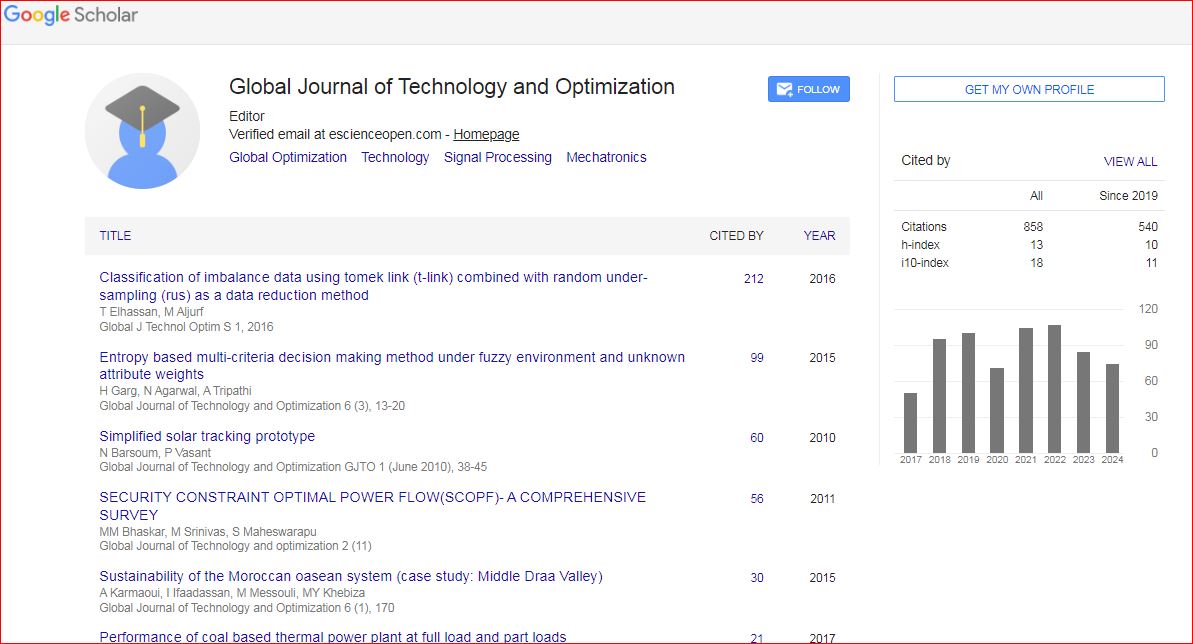
Global Journal of Technology and Optimization received 847 citations as per Google Scholar report