Brief Report - (2025) Volume 11, Issue 4
Received: 01-Aug-2025, Manuscript No. jpnp-25-175503;
Editor assigned: 04-Aug-2025, Pre QC No. P-175503;
Reviewed: 18-Aug-2025, QC No. Q-175503;
Revised: 22-Aug-2025, Manuscript No. R-175503;
Published:
29-Aug-2025
, DOI: 10.37421/2472-0992.2025.11.374
Citation: Yacoub, Youssef Ben. ”Agroforestry: Comprehensive Solutions for a Sustainable World.” J Pharmacogn Nat Prod 11 (2025):374.
Copyright: © 2025 Yacoub B. Youssef This is an open-access article distributed under the terms of the Creative Commons Attribution License, which permits unrestricted use, distribution and reproduction in any medium, provided the original author and source are credited.
Agroforestry's significant role in addressing climate change is well-documented. These systems enhance carbon sequestration in both biomass and soil, effectively reducing greenhouse gas emissions and building resilience within agricultural landscapes. This offers a potent dual solution for both climate change mitigation and adaptation [1].
A detailed meta-analysis further quantifies this potential, confirming that various agroforestry systems globally store substantial amounts of carbon, often outperforming conventional agricultural practices. This makes them indispensable for global climate change mitigation efforts [9].
Beyond climate benefits, agroforestry systems are crucial for biodiversity conservation. Systematic reviews highlight that integrating trees into agricultural land markedly increases species richness and abundance across diverse taxa. This integration, in turn, strongly supports essential ecosystem functions and services vital for ecological balance [2].
The economic viability of diverse agroforestry systems has been thoroughly evaluated on a global scale. While initial investments can sometimes be higher compared to traditional farming, the long-term economic returns often surpass those of conventional agriculture. This is attributed to diversified income streams, reduced input costs, and a host of ecosystem service benefits, positioning agroforestry as a truly profitable option for farmers looking for sustainable livelihoods [3].
Agroforestry practices also exert a profound positive influence on soil health. Research consistently shows that integrating trees significantly improves key indicators such as soil organic matter content, nutrient cycling efficiency, microbial diversity, and overall soil structure. These improvements collectively lead to enhanced long-term agricultural productivity and bolster ecosystem resilience against environmental stressors [4].
Furthermore, agroforestry systems are celebrated for their capacity to simultaneously enhance diverse ecosystem services while contributing directly to food security. The integration of trees provides numerous benefits, including improved water quality, vital pollination services, natural pest control, and ultimately, enhanced agricultural yields. This comprehensive approach supports sustainable livelihoods and fosters more resilient food systems globally [5].
The optimization of water management within agricultural landscapes is another critical benefit of agroforestry. Studies reveal that tree integration dramatically improves water infiltration into the soil, substantially reduces surface runoff, enhances groundwater recharge rates, and minimizes destructive water erosion. These combined effects contribute to significantly more efficient and sustainable water use across farming systems [6].
For smallholder farmers, particularly in developing regions, agroforestry presents viable pathways toward achieving sustainable intensification and promoting rural development. Key benefits include increased income, improved food security, heightened resilience to unpredictable climate shocks, and diversified livelihood options, all of which empower these farmers and strengthen their communities [7].
The successful scaling up of agroforestry adoption hinges on identifying and implementing effective policy and governance mechanisms. Global experiences underscore the critical importance of supportive legal frameworks, robust financial incentives, comprehensive capacity building programs, and strong multi-stakeholder collaboration to overcome existing barriers and foster widespread implementation [8].
Understanding the diverse factors influencing farmers' adoption of agroforestry practices is also essential. Research highlights that socioeconomic conditions, equitable access to knowledge and necessary resources, consistent policy support, and the perceived benefits of these practices are all critical determinants for their successful implementation and broader scaling [10].
Agroforestry systems are recognized as pivotal solutions in global climate change efforts, offering dual mitigation and adaptation strategies [1]. These systems enhance carbon sequestration by storing carbon in tree biomass and soil, reducing greenhouse gas emissions. Integrating trees builds critical resilience, helping agricultural systems adapt to climate variability. A meta-analysis quantifies this, confirming that various agroforestry systems consistently outperform conventional agriculture in carbon storage, making them indispensable for mitigation goals [9]. This natural, sustainable carbon capture offers a tangible pathway towards a more climate-resilient future for agriculture.
Beyond climate action, agroforestry practices deliver immense ecological benefits for biodiversity and soil health. Systematic reviews show that integrating trees into agricultural land significantly boosts biodiversity, increasing species richness and abundance across various taxa [2]. This enhanced biodiversity strengthens vital ecosystem functions and services. Moreover, agroforestry systems profoundly improve soil health by boosting organic matter, optimizing nutrient cycling, enhancing microbial diversity, and contributing to a more stable soil structure. These improvements lead to sustained agricultural productivity and bolster ecosystem resilience [4]. Furthermore, agroforestry amplifies diverse ecosystem services, including improved water quality, essential pollination, natural pest control, and enhanced crop yields. These multifaceted benefits are foundational for supporting sustainable livelihoods and robust food systems globally [5].
The economic case for agroforestry is compelling, often proving more profitable long-term than conventional farming. While initial investments can be higher, a global review concludes that long-term returns frequently surpass traditional agriculture due to diversified income streams, reduced input costs, and the economic value of ecosystem services [3]. These systems offer a financially attractive and sustainable option. Simultaneously, agroforestry transforms water management within agricultural landscapes. Studies clearly reveal that integrating trees substantially improves water infiltration, significantly reduces surface runoff, and enhances crucial groundwater recharge [6]. These processes, coupled with minimized water erosion, lead to more efficient and sustainable water use, critical in the face of scarcity. Ultimately, by providing these environmental and economic benefits, including enhanced yields, agroforestry directly contributes to strengthening global food security [5].
For smallholder farmers, particularly in developing regions vulnerable to climate shocks, agroforestry offers viable pathways for sustainable intensification and robust rural development. Benefits include significant increases in income due to diversified products and reduced risks, vastly improved food security through more resilient systems, and an enhanced capacity to withstand and recover from climate-related shocks. By promoting diversified livelihoods, agroforestry lessens reliance on single crops and provides multiple revenue streams, strengthening the economic stability and well-being of farming communities [7].
Widespread adoption and successful scaling of agroforestry practices critically depend on well-structured policy and governance mechanisms. Global experiences highlight the importance of supportive legal frameworks and robust financial incentives to encourage farmer transition [8]. Targeted capacity building programs are essential to equip farmers with necessary knowledge, while strong multi-stakeholder collaboration ensures effective cooperation. These elements are crucial to overcome barriers and facilitate widespread implementation. A systematic review analyzes diverse factors influencing farmer adoption, underscoring socioeconomic conditions, access to knowledge and resources, consistent policy support, and perceived benefits as critical determinants for successful expansion and sustained impact worldwide [10].
Agroforestry systems present a comprehensive solution for numerous environmental and agricultural challenges. They are vital in addressing climate change by enhancing carbon sequestration in biomass and soil, and by reducing greenhouse gas emissions, offering both mitigation and adaptation benefits [1, 9]. Beyond climate action, these integrated systems significantly boost biodiversity by increasing species richness and abundance across various taxa, thereby supporting ecosystem functions and services [2]. Economically, agroforestry proves to be a profitable endeavor for farmers despite higher initial investments, yielding long-term returns through diversified income streams, reduced input costs, and enhanced ecosystem service benefits [3]. From a soil health perspective, integrating trees markedly improves soil organic matter, nutrient cycling, microbial diversity, and overall soil structure, which in turn enhances agricultural productivity and resilience over time [4]. Furthermore, agroforestry is instrumental in optimizing water management, leading to better water infiltration, reduced runoff, increased groundwater recharge, and minimized water erosion, promoting sustainable water use in farming [6]. It also plays a crucial role in enhancing diverse ecosystem services, such as improved water quality, pollination, and pest control, which directly contribute to food security and resilient food systems [5]. For smallholder farmers, agroforestry offers viable pathways to sustainable intensification and rural development, providing increased income, better food security, and enhanced resilience against climate shocks [7]. The successful adoption and scaling of these practices depend on supportive legal frameworks, financial incentives, capacity building, and collaborative efforts among stakeholders [8, 10]. Socioeconomic conditions, access to knowledge, and perceived benefits are also critical in influencing farmers' willingness to adopt agroforestry [10].
None
None
Ramachandran N, P. KRN, Jagannath MA. "Agroforestry for climate change mitigation and adaptation".Curr. Opin. Environ. Sustain. 58 (2022):101217.
Indexed at, Google Scholar, Crossref
Graciela M, Bruno BCMM, Francisco dAS. "Agroforestry systems and their contribution to biodiversity conservation in agricultural landscapes: a systematic review".Agrofor. Syst. 97 (2023):1-18.
Indexed at, Google Scholar, Crossref
Shashi CSR, Ritesh KS, Mahesh KS. "Economic viability of agroforestry systems: a global review".Agrofor. Syst. 96 (2022):1-17.
Indexed at, Google Scholar, Crossref
A. KMZI, M. ZH, M. KH. "Agroforestry systems and their impacts on soil health: a review of current knowledge".Agronomy 12 (2022):969.
Indexed at, Google Scholar, Crossref
K. KS, R. MR, S. K. "Agroforestry: a sustainable approach to enhance ecosystem services and food security".Environ. Sci. Pollut. Res. 29 (2022):20042-20059.
Indexed at, Google Scholar, Crossref
H. SD, S. SB, M. K. "Agroforestry systems for improved water management in agricultural landscapes".J. Water Land Dev. 58 (2023):22-31.
Indexed at, Google Scholar, Crossref
Frank P, Lesley D, James MR. "Agroforestry for smallholder farmers: pathways to sustainable intensification and rural development".Land Use Policy 126 (2023):106540.
Indexed at, Google Scholar, Crossref
Ellen GHMLVdB, Peter M, Tony SR. "Policy and governance for scaling up agroforestry: lessons from global experiences".Forest Policy Econ. 147 (2023):102901.
Indexed at, Google Scholar, Crossref
S. HK, J. HL, Y. KK. "Carbon sequestration potential of agroforestry systems: a meta-analysis".Forests 13 (2022):1222.
Indexed at, Google Scholar, Crossref
Liyun Z, Xiaowei L, Yan W. "Factors influencing farmer adoption of agroforestry practices: a systematic review".J. Clean. Prod. 388 (2023):135763.
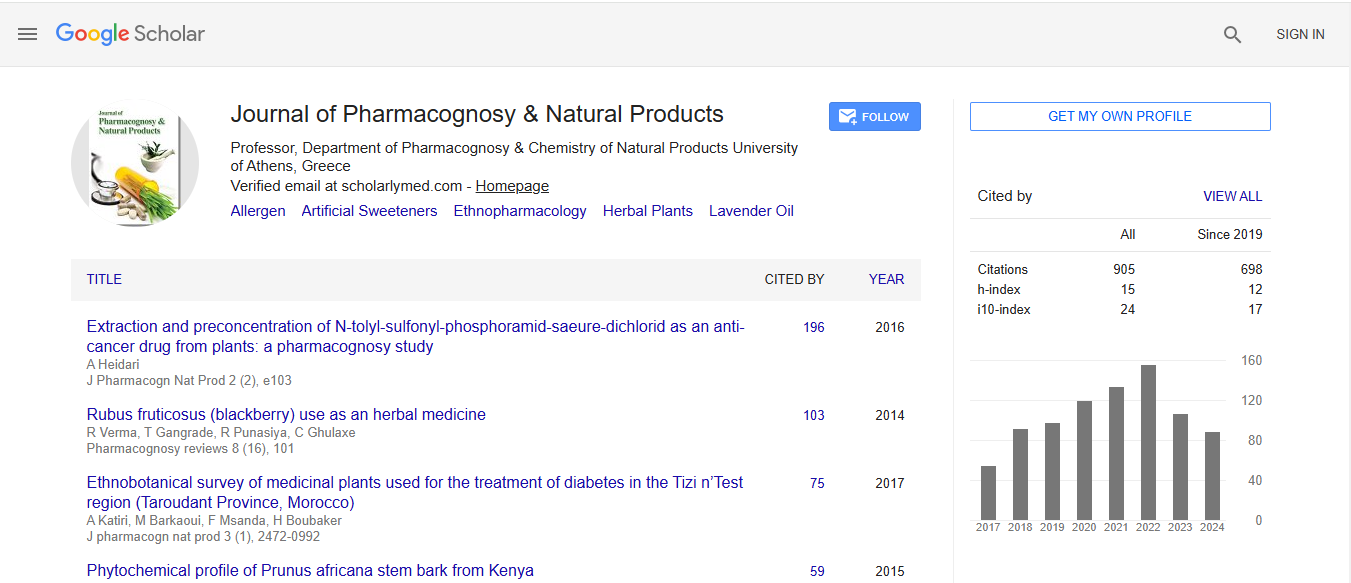
Journal of Pharmacognosy & Natural Products received 606 citations as per Google Scholar report