Opinion - (2025) Volume 16, Issue 4
Received: 01-Aug-2025, Manuscript No. jtse-26-184767;
Editor assigned: 03-Aug-2025, Pre QC No. P-184767;
Reviewed: 18-Aug-2025, QC No. Q-184767;
Revised: 22-Aug-2025, Manuscript No. R-184767;
Published:
29-Aug-2025
, DOI: 10.37421/2157-7552.2025.16.445
Citation: Conti, Isabella. ”Aging Impairs Tissue Repair Through Multiple Mechanisms.” J Tissue Sci Eng 16 (2025):445.
Copyright: © 2025 Conti I. This is an open-access article distributed under the terms of the Creative Commons Attribution License, which permits unrestricted use, distribution and reproduction in any medium, provided the original author and source are credited.
Aging exerts a profound and multifaceted influence on the body's capacity for tissue repair, fundamentally altering cellular and molecular mechanisms essential for regeneration. This decline in regenerative prowess is a significant concern, impacting health and quality of life in an aging population. The intricate processes involved in wound healing and tissue maintenance become progressively less efficient, leading to a cascade of detrimental effects across various tissues and organ systems. Understanding these age-related changes is paramount for developing effective interventions to mitigate their consequences. One of the primary contributors to impaired tissue repair in aging is the depletion and reduced efficacy of stem cell populations. These crucial cells, responsible for replenishing damaged tissues, become less numerous and their functional capacity diminishes, thereby hindering the initiation and execution of repair processes. Consequently, the ability of tissues to recover from injury is severely compromised [1].
Furthermore, the immune system undergoes significant transformations with age, a phenomenon known as immunosenescence, which directly impacts wound healing. Chronic low-grade inflammation, often referred to as "inflammaging," disrupts the normally transient inflammatory phase required for effective tissue repair. This sustained inflammatory state can lead to prolonged healing times and exacerbate scar formation, further compromising tissue integrity and function [2].
Mesenchymal stem cells (MSCs), pivotal players in tissue regeneration, also experience functional decline with advancing age. Aged MSCs exhibit reduced proliferation rates, impaired differentiation capabilities, and altered secretion profiles. These age-associated deficits collectively impede their ability to effectively promote tissue repair and regeneration, necessitating strategies to enhance or rejuvenate their function [3].
The extracellular matrix (ECM), which provides the essential structural scaffold and biochemical cues for tissue repair, undergoes detrimental changes during aging. ECM stiffening and compositional alterations occur, creating a less conducive environment for cell migration, proliferation, and differentiation. The accumulation of senescent cells further contributes to ECM degradation and inflammation, collectively impeding effective repair processes [4].
Cellular senescence, characterized by irreversible growth arrest, is another critical factor contributing to impaired tissue repair in aging. Senescent cells accumulate with age and release a cocktail of pro-inflammatory factors known as the senescence-associated secretory phenotype (SASP). This SASP fosters a chronic inflammatory environment, recruits immune cells, and can induce senescence in neighboring cells, thereby hindering regeneration. The development of senolytic therapies, aimed at eliminating senescent cells, shows promise in improving age-related tissue repair deficits [5].
The signaling pathways that orchestrate wound healing, such as Wnt, TGF-β, and Notch, are significantly altered by the aging process. Dysregulation of these critical pathways can lead to impaired cell proliferation, migration, and differentiation, ultimately resulting in delayed and incomplete tissue repair. Targeting these age-modified pathways presents a potential avenue for therapeutic intervention [6].
Fibrosis, defined as the excessive deposition of ECM components, frequently occurs as a consequence of impaired wound healing in aging. Aged tissues are more susceptible to developing fibrotic scars, which can lead to functional deficits. A thorough understanding of the molecular mechanisms that drive age-related fibrosis is essential for developing strategies to prevent or reverse this detrimental process and promote healthier tissue repair [7].
Vascularization plays a critical role in delivering nutrients and oxygen necessary for tissue repair. Aging impairs angiogenesis, the formation of new blood vessels, which leads to reduced perfusion and compromised healing. This diminished vascular network contributes to the overall decline in regenerative capacity observed in older individuals, highlighting the systemic impact of aging on repair processes [8].
Specifically within the skin, the aging process significantly compromises its inherent ability to repair itself. This includes reduced fibroblast function, altered collagen synthesis, and impaired immune surveillance. Consequently, aged skin exhibits slower wound healing, an increased propensity for scar formation, and a greater susceptibility to infections and the development of chronic wounds, underscoring the widespread impact of aging on regenerative capabilities [9].
The pervasive effects of aging on tissue repair are a complex interplay of cellular, molecular, and systemic changes that collectively diminish the body's ability to regenerate and recover from damage. This decline is not confined to a single tissue type but affects various organ systems, leading to a range of functional impairments and increased vulnerability to injury and disease. Understanding these age-related alterations is crucial for developing targeted therapeutic strategies aimed at restoring or enhancing regenerative capacity in older adults. The fundamental cellular changes that occur with aging directly impact the efficacy of tissue repair mechanisms. Stem cell populations, vital for replacing damaged cells and maintaining tissue homeostasis, dwindle in number and lose their functional effectiveness. This reduction in the pool of reparative cells and their impaired activity means that the initiation and progression of healing processes are significantly hampered, leading to slower and less complete tissue regeneration [1].
Parallel to changes in stem cells, the aging immune system undergoes substantial alterations that profoundly affect wound healing. Immunosenescence, the age-related decline in immune function, is characterized by chronic low-grade inflammation, termed "inflammaging." This sustained inflammatory state disrupts the finely tuned inflammatory phase essential for initiating repair, resulting in delayed healing, increased scar tissue formation, and impaired functional recovery of the injured tissue [2].
Mesenchymal stem cells (MSCs), a critical cell type for tissue repair and regeneration, also experience age-related functional deficits. Aged MSCs demonstrate reduced proliferative capacity, diminished differentiation potential into various cell types, and an altered secretome that is less supportive of regenerative processes. These changes compromise their ability to effectively contribute to tissue repair, making them a target for therapeutic interventions aimed at restoring their function [3].
The extracellular matrix (ECM), which provides the structural framework and essential biochemical signals for cellular activities, is significantly remodeled during aging. ECM stiffening and changes in its composition create a less permissive environment for cell migration, proliferation, and differentiation, which are all critical steps in tissue repair. Moreover, the accumulation of senescent cells within the ECM contributes to inflammation and degradation, further hindering effective repair [4].
Cellular senescence, a state of irreversible cell cycle arrest, is a hallmark of aging and a significant contributor to impaired tissue repair. Senescent cells accumulate with age and secrete a range of factors, collectively known as the senescence-associated secretory phenotype (SASP), which promotes a chronic inflammatory microenvironment. This SASP can induce senescence in neighboring cells and impair the function of resident stem cells, thereby suppressing tissue regeneration. Strategies targeting these senescent cells, such as senolytics, are being investigated for their potential to improve age-related tissue repair deficits [5].
Key signaling pathways that regulate cellular behavior during wound healing, including the Wnt, TGF-β, and Notch pathways, are significantly dysregulated in aging. These alterations can lead to impaired cell proliferation, aberrant cell migration, and defective differentiation, ultimately resulting in delayed and incomplete tissue repair. Therapeutic interventions that aim to modulate these age-modified signaling pathways may offer significant benefits for enhancing tissue regeneration [6].
Fibrosis, the excessive deposition of ECM components leading to scar tissue formation, is a common and often detrimental outcome of impaired wound healing in older individuals. Aged tissues exhibit an increased propensity for developing fibrotic scars, which can lead to a permanent loss of tissue function. Understanding the molecular underpinnings of age-related fibrosis is essential for developing strategies to mitigate or reverse this process and promote more functional tissue repair [7].
Vascularization is a critical component of tissue repair, ensuring adequate supply of oxygen and nutrients to the injured site. Aging is associated with impaired angiogenesis, the process of forming new blood vessels, leading to reduced perfusion and compromised healing. This diminished vascular network contributes to the overall decline in the body's regenerative capacity in older individuals, highlighting the systemic impact of aging on repair processes [8].
In the skin, the capacity for self-repair is notably compromised with age. This decline is characterized by reduced fibroblast function, altered collagen synthesis, and impaired immune surveillance within the dermal layers. Consequently, aged skin exhibits slower wound healing, a greater tendency towards scar formation, and an increased susceptibility to infections and the development of chronic wounds, reflecting a generalized reduction in regenerative competence [9].
Aging significantly impairs tissue repair through various mechanisms. Stem cell populations decline and become less effective, while the immune system exhibits chronic inflammation and reduced adaptive responses. Mesenchymal stem cells age, leading to reduced proliferation and differentiation. The extracellular matrix stiffens and its composition changes, hindering cell function. Cellular senescence accumulates, releasing pro-inflammatory factors that create a chronic inflammatory environment. Key signaling pathways like Wnt, TGF-β, and Notch become dysregulated. Fibrosis, or excessive scar tissue formation, is more common in aged tissues. Angiogenesis, the formation of new blood vessels, is impaired, reducing nutrient and oxygen supply. These factors collectively result in slower wound healing, increased susceptibility to damage, and a general decline in tissue regenerative capacity.
None
None
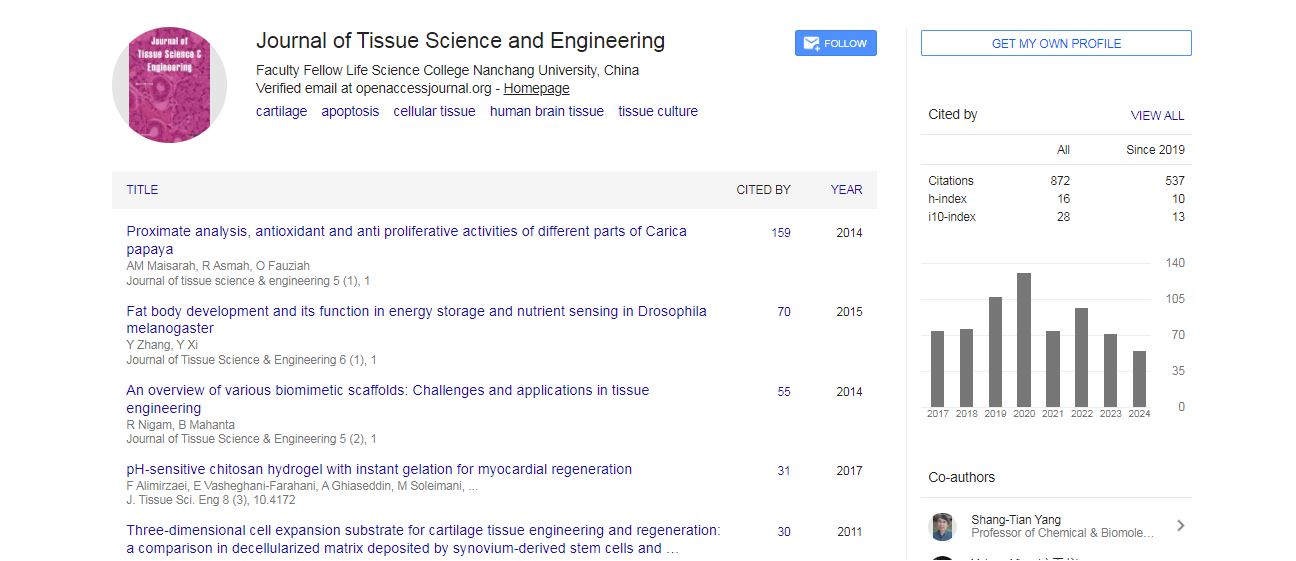
Journal of Tissue Science and Engineering received 807 citations as per Google Scholar report