Commentary - (2025) Volume 11, Issue 3
Received: 02-Jun-2025, Manuscript No. jpnp-25-175490;
Editor assigned: 04-Jun-2025, Pre QC No. P-175490;
Reviewed: 18-Jun-2025, QC No. Q-175490;
Revised: 23-Jun-2025, Manuscript No. R-175490;
Published:
30-Jun-2025
, DOI: 10.37421/2472-0992.2025.11.362
Citation: Santos, Miguel R.. ”African, Amazonian Medicinal Plants: Knowledge to Drugs.” J Pharmacogn Nat Prod
Copyright: © 2025 Santos R. Miguel This is an open-access article distributed under the terms of the Creative Commons Attribution License, which permits unrestricted use, distribution and reproduction in any medium, provided the original author and source are credited.
This study comprehensively documented the traditional knowledge and medicinal plant usage among indigenous communities in the Southern Highlands of Tanzania. Researchers identified numerous plant species employed for various ailments, highlighting the local therapeutic practices and the critical need for conservation and further pharmacological investigation into these traditional remedies. The work underscores the importance of ethnobotanical research in preserving cultural heritage and discovering potential new medicines [1].
This ethnobotanical investigation in Mberengwa District, Zimbabwe, cataloged a significant number of medicinal plants and their uses by local traditional healers. The findings reveal a rich repository of indigenous medical knowledge, indicating that these plants are crucial for primary healthcare in the region. The study emphasizes the importance of validating these traditional uses through scientific research to ensure efficacy and safety, while also promoting their sustainable management [2].
Researchers conducted an ethnobotanical study in Baringo County, Kenya, to document the medicinal plants used by indigenous communities. The study identified key plant species and their traditional applications, revealing the depth of local ethnobotanical knowledge. The findings advocate for the preservation of this knowledge and the exploration of these plants for their pharmacological potential, highlighting their role in local healthcare systems [3].
This study focused on ethnobotanical knowledge and traditional uses of medicinal plants within two indigenous communities in the Peruvian Amazon. The research unveiled a vast array of plant species and their therapeutic applications, demonstrating the intricate relationship between culture and plant use in the region. The authors emphasize the urgent need to conserve both the plants and the associated traditional knowledge, which are under threat from deforestation and cultural erosion [4].
An ethnobotanical study in the Mwinilunga District, North-Western Zambia, documented the medicinal plants used by local traditional healers. The research cataloged a diverse range of plant remedies employed for various health conditions, highlighting their significance in community healthcare. The findings call for further phytochemical and pharmacological studies to validate these traditional uses and ensure the sustainable utilization of these valuable plant resources [5].
This ethnobotanical survey in northern Algeria recorded medicinal plants traditionally used for treating diabetes. The study identified several plant species commonly employed by local communities, showcasing their traditional knowledge in managing the condition. This research provides a foundation for future pharmacological investigations into these plants, aiming to discover new anti-diabetic compounds and validate the traditional practices [6].
Researchers conducted an ethnobotanical study on medicinal plants utilized by the Maasai community in Narok County, Kenya. The study comprehensively documented the plant species and their traditional uses, reflecting the rich ethnobotanical heritage of the Maasai people. The findings underscore the importance of protecting this indigenous knowledge and exploring the therapeutic potential of these plants through scientific research, ensuring their continued benefit to the community [7].
This ethnobotanical study in the South Wello Zone, Ethiopia, meticulously documented medicinal plants and their traditional uses by local communities. The research revealed a vast amount of traditional knowledge regarding plant-based remedies for various ailments. The authors stress the significance of preserving this indigenous knowledge and scientifically validating the therapeutic claims, which could lead to the development of new pharmaceutical agents [8].
Researchers conducted an ethnobotanical study in the Manafwa District, Eastern Uganda, to identify medicinal plants used for common human diseases. The study documented a rich repertoire of plant-based remedies, reflecting deep-rooted traditional healing practices. This work is vital for safeguarding indigenous knowledge and provides a foundation for pharmacological screening to validate the efficacy and safety of these traditionally used plants [9].
This ethnobotanical study focused on medicinal plants used by the Limpopo Pedi community in Sekhukhune District, South Africa. The research comprehensively documented a variety of plant species and their traditional applications, showcasing the community's rich ethnobotanical heritage. The findings emphasize the need for conservation efforts and further scientific investigation to validate the efficacy of these plants for their traditional uses, potentially leading to new drug discoveries [10].
Ethnobotanical research in the Southern Highlands of Tanzania comprehensively documented traditional knowledge and medicinal plant usage among indigenous communities. This work identified numerous plant species used for various ailments, emphasizing local therapeutic practices and the critical need for conservation and further pharmacological investigation into these traditional remedies. The study highlights the importance of ethnobotanical research in preserving cultural heritage and discovering potential new medicines [1]. Similarly, an investigation in Mberengwa District, Zimbabwe, cataloged a significant number of medicinal plants and their uses by local traditional healers. Findings reveal a rich repository of indigenous medical knowledge, indicating these plants are crucial for primary healthcare. The study stresses validating traditional uses through scientific research for efficacy and safety, while promoting sustainable management [2].
In Baringo County, Kenya, researchers conducted an ethnobotanical study to document medicinal plants used by indigenous communities. This effort identified key plant species and their traditional applications, revealing the depth of local ethnobotanical knowledge. The findings advocate for preserving this knowledge and exploring these plants for their pharmacological potential, highlighting their role in local healthcare systems [3]. Another study focused on ethnobotanical knowledge and traditional uses of medicinal plants within two indigenous communities in the Peruvian Amazon. This research unveiled a vast array of plant species and their therapeutic applications, demonstrating the intricate relationship between culture and plant use. Authors emphasize the urgent need to conserve both the plants and associated traditional knowledge, which are under threat from deforestation and cultural erosion [4].
An ethnobotanical study in the Mwinilunga District, North-Western Zambia, documented medicinal plants used by local traditional healers. The research cataloged a diverse range of plant remedies for various health conditions, highlighting their significance in community healthcare. Findings call for further phytochemical and pharmacological studies to validate these traditional uses and ensure sustainable utilization of valuable plant resources [5]. Concurrently, an ethnobotanical survey in northern Algeria recorded medicinal plants traditionally used for treating diabetes. The study identified several plant species commonly employed by local communities, showcasing their traditional knowledge in managing the condition. This research provides a foundation for future pharmacological investigations into these plants, aiming to discover new anti-diabetic compounds and validate traditional practices [6].
Researchers conducted an ethnobotanical study on medicinal plants utilized by the Maasai community in Narok County, Kenya. The study comprehensively documented plant species and their traditional uses, reflecting the rich ethnobotanical heritage of the Maasai people. Findings underscore the importance of protecting this indigenous knowledge and exploring the therapeutic potential of these plants through scientific research, ensuring their continued benefit to the community [7]. In the South Wello Zone, Ethiopia, an ethnobotanical study meticulously documented medicinal plants and their traditional uses by local communities. The research revealed a vast amount of traditional knowledge regarding plant-based remedies for various ailments. The authors stress the significance of preserving this indigenous knowledge and scientifically validating therapeutic claims, which could lead to the development of new pharmaceutical agents [8].
An ethnobotanical study in the Manafwa District, Eastern Uganda, aimed to identify medicinal plants used for common human diseases. The study documented a rich repertoire of plant-based remedies, reflecting deep-rooted traditional healing practices. This work is vital for safeguarding indigenous knowledge and provides a foundation for pharmacological screening to validate the efficacy and safety of these traditionally used plants [9]. Finally, research focused on medicinal plants used by the Limpopo Pedi community in Sekhukhune District, South Africa. This study comprehensively documented a variety of plant species and their traditional applications, showcasing the community's rich ethnobotanical heritage. The findings emphasize the need for conservation efforts and further scientific investigation to validate the efficacy of these plants for their traditional uses, potentially leading to new drug discoveries [10].
Recent ethnobotanical studies across Africa and the Peruvian Amazon consistently illuminate the profound traditional knowledge of medicinal plant usage among indigenous communities and local healers. These comprehensive investigations, spanning diverse regions like the Southern Highlands of Tanzania, Mberengwa District in Zimbabwe, Baringo and Narok Counties in Kenya, Mwinilunga District in North-Western Zambia, the South Wello Zone in Ethiopia, Manafwa District in Eastern Uganda, Sekhukhune District in South Africa, and Northern Algeria, have meticulously documented a vast array of plant species. These plants are traditionally employed for various ailments, from general health conditions to specific issues like diabetes. A unifying thread across these studies is the critical call for the preservation of this invaluable indigenous medical knowledge, which is increasingly vulnerable to threats such as deforestation and cultural erosion. Researchers strongly advocate for rigorous scientific validation, including phytochemical and pharmacological screening, to confirm the efficacy and safety of these long-standing traditional remedies. This scientific rigor is not only crucial for potentially integrating these plant-based treatments into modern healthcare systems but also for ensuring their sustainable management and utilization. The collective findings highlight the immense potential for discovering novel therapeutic compounds and developing new pharmaceutical agents from these traditional sources. Overall, this body of ethnobotanical research underscores its vital role in safeguarding cultural heritage, enhancing local healthcare systems, and driving future drug discovery efforts.
None
None
Indexed at, Google Scholar, Crossref
Indexed at, Google Scholar, Crossref
Indexed at, Google Scholar, Crossref
Indexed at, Google Scholar, Crossref
Indexed at, Google Scholar, Crossref
Indexed at, Google Scholar, Crossref
Indexed at, Google Scholar, Crossref
Indexed at, Google Scholar, Crossref
Indexed at, Google Scholar, Crossref
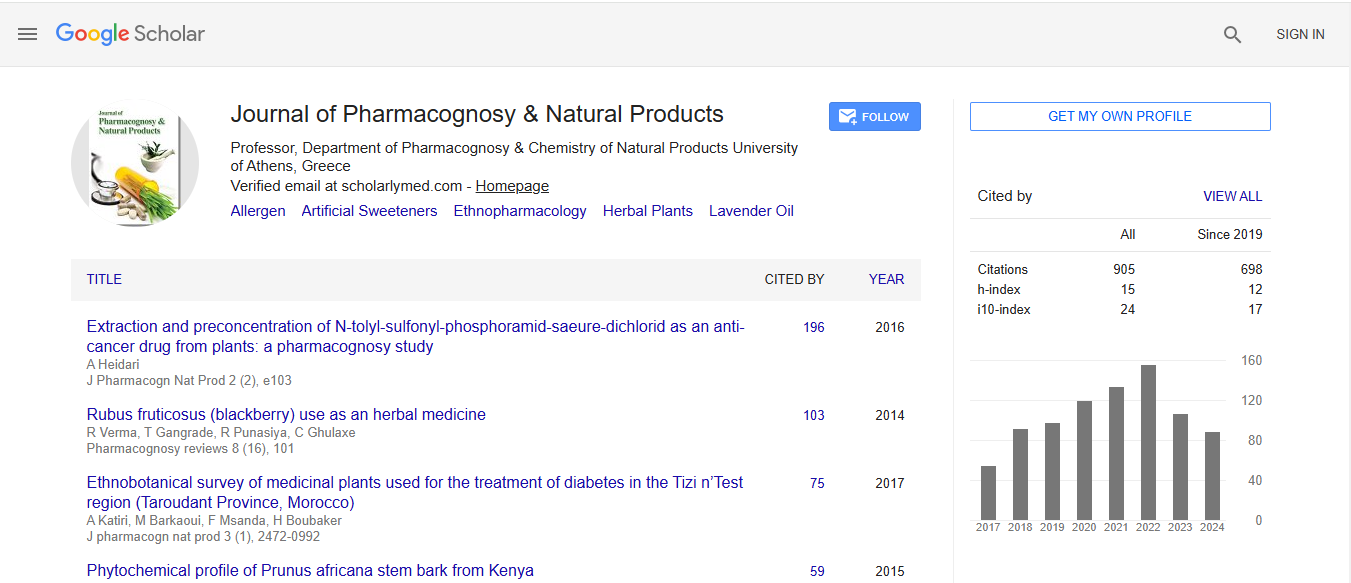
Journal of Pharmacognosy & Natural Products received 606 citations as per Google Scholar report