Brief Report - (2025) Volume 15, Issue 6
Received: 27-Nov-2025, Manuscript No. jmcj-25-176930;
Editor assigned: 01-Dec-2025, Pre QC No. P-176930;
Reviewed: 15-Dec-0025, QC No. Q-176930;
Revised: 22-Dec-2025, Manuscript No. R-176930;
Published:
29-Dec-2025
, DOI: 10.37421/2165-7912.2025.15.653
Citation: MacGregor, Fiona L. Advocacy Journalism: Ethics, Impact, Evolution. J Mass Communicat Journalism 15(2025):653.
Copyright: © 2025 MacGregor L. Fiona This is an open-access article distributed under the terms of the Creative Commons Attribution License, which permits unrestricted use, distribution and reproduction in any medium, provided the original author and source are credited.
This piece explores the inherent tension journalists face when covering environmental issues, specifically balancing traditional journalistic objectivity with the clear need for advocacy. It dives into how environmental reporters navigate this tightrope, often blurring the lines to highlight critical issues while trying to maintain credibility within their field[1].
This study examines the role of advocacy journalism in driving social change, using disability rights as a specific lens. It highlights how journalistic narratives, when intentionally framed to advocate for marginalized groups, can significantly influence public perception and policy, pushing for greater inclusivity and rights[2].
This article delves into the ethical tightrope walk that contemporary journalists undertake when engaging in advocacy. It discusses how the traditional ideal of objectivity clashes with the impulse to address pressing societal issues, proposing frameworks for ethical engagement that maintain credibility while still enabling effective advocacy[3].
This research explores how digital platforms and social media have profoundly reshaped advocacy journalism. It highlights the new opportunities these tools offer for journalists to connect directly with audiences, mobilize action, and bypass traditional gatekeepers, simultaneously examining the challenges related to misinformation and maintaining journalistic standards[4].
This paper investigates the critical function of advocacy journalism in bringing human rights abuses to the forefront globally. It details how journalists, by explicitly taking a stand, can draw international attention to injustices, pressure governments, and empower victims, demonstrating the measurable impact of such focused reporting[5].
This article explores how advocacy journalism shapes the public discourse around climate change. It argues that by deliberately framing the climate crisis with a sense of urgency and emphasizing potential solutions, journalists can significantly impact public understanding, foster civic engagement, and influence policy-making efforts to address environmental threats[6].
This paper explores how advocacy journalism can serve as a vital strategy for revitalizing local news and fostering community building. It argues that by taking a clear stance on local issues and actively engaging with residents, journalists can empower communities, facilitate civic dialogue, and address local challenges more effectively, moving beyond traditional objective reporting[7].
This article analyzes the role of advocacy journalism during public health emergencies, particularly drawing insights from the COVID-19 pandemic. It demonstrates how journalists, by advocating for public safety measures, challenging misinformation, and amplifying expert voices, can play a crucial role in public health communication and crisis management, despite facing criticism regarding neutrality[8].
This paper explores the unique position of Indigenous journalists in Australia, who often find themselves caught between traditional journalistic ideals of objectivity and the urgent need to advocate for their communities. It highlights how these journalists navigate this tension, leveraging their lived experiences to challenge dominant narratives and push for greater recognition of Indigenous rights and issues[9].
This article reignites the debate surrounding objectivity within the context of advocacy journalism. It argues that a rigid adherence to traditional notions of objectivity can sometimes hinder effective reporting on critical social issues. The authors propose a nuanced understanding of journalistic ethics that allows for informed advocacy while still upholding principles of accuracy and fairness[10].
Contemporary journalism frequently grapples with the inherent tension between traditional objectivity and the compelling call for advocacy. This dynamic is particularly evident in fields like environmental reporting, where journalists navigate a tightrope, often blurring established lines to highlight critical issues while striving to maintain credibility within their professional sphere [1]. This piece explores how environmental reporters manage this balance, demonstrating that effective coverage sometimes requires stepping beyond strict neutrality to address pressing ecological concerns. The ethical tightrope walk journalists undertake when engaging in advocacy involves a clear clash between the traditional ideal of objectivity and the impulse to address pressing societal concerns, proposing new frameworks for ethical engagement. What this really means is developing guidelines that uphold credibility while still enabling impactful advocacy [3]. Furthermore, a rigid adherence to traditional notions of objectivity can sometimes hinder effective reporting on vital social issues. This realization leads to a necessary reevaluation of journalistic ethics, suggesting a nuanced understanding that allows for informed advocacy alongside fundamental principles of accuracy and fairness [10]. The core argument here is that journalism must adapt to serve public good comprehensively.
Advocacy journalism serves as a powerful mechanism for driving significant social change. For instance, a focused study on disability rights reveals how journalistic narratives, when intentionally framed to advocate for marginalized groups, can profoundly influence public perception and policy, thereby pushing for greater inclusivity and rights [2]. This kind of focused reporting is not limited to domestic issues; it extends to bringing human rights abuses to the forefront globally. This research details how journalists, by explicitly taking a stand, can draw critical international attention to injustices, pressure governments to act, and empower victims, demonstrating the measurable impact of such dedicated reporting [5]. These examples underscore the capacity of journalism to transcend mere information dissemination and actively shape societal outcomes.
The application of advocacy journalism is diverse and proves highly impactful across various critical domains. Here's the thing: it actively shapes the public discourse around climate change. By deliberately framing the climate crisis with a sense of urgency and emphasizing potential solutions, journalists can significantly impact public understanding, foster civic engagement, and directly influence policy-making efforts designed to address environmental threats [6]. Moreover, during public health emergencies, particularly drawing insights from the COVID-19 pandemic, research demonstrates how journalists, by advocating for public safety measures, challenging misinformation, and amplifying expert voices, play an absolutely crucial role in public health communication and crisis management. This is achieved despite the inevitable criticism regarding neutrality that such engaged reporting often faces [8]. This shows the essential, proactive stance journalism can take during times of crisis.
Let's break it down: digital platforms and social media have profoundly reshaped the evolving landscape of advocacy journalism. These modern tools offer new, unprecedented opportunities for journalists to connect directly with audiences, mobilize action more quickly, and bypass traditional gatekeepers who once controlled information flow. However, this rapidly evolving digital environment also brings significant challenges related to the rapid spread of misinformation and the continuous effort required to maintain high journalistic standards [4]. Beyond the digital realm, advocacy journalism is equally vital for revitalizing local news and fostering stronger community building. It argues that by taking a clear stance on local issues and actively engaging with residents, journalists can empower communities, facilitate robust civic dialogue, and address local challenges much more effectively, moving beyond a purely traditional objective reporting model [7]. This approach positions local news as a community catalyst.
A unique and compelling perspective comes from Indigenous journalists, particularly those in Australia, who often find themselves caught between traditional journalistic ideals of objectivity and the urgent, deeply personal need to advocate for their communities. This research highlights how these journalists skillfully navigate this tension, leveraging their invaluable lived experiences to challenge dominant, often colonial, narratives and push vigorously for greater recognition of Indigenous rights and issues [9]. This specific context powerfully illustrates how personal connection and cultural understanding can profoundly inform and strengthen advocacy within the journalistic profession, offering insights that traditional models often overlook.
Advocacy journalism navigates a complex ethical landscape, balancing traditional journalistic objectivity with the pressing need to champion critical societal issues. This approach is evident in environmental reporting, where journalists often blur lines to highlight urgent matters like climate change, aiming to influence public understanding and policy. Here's the thing: it is not just about reporting facts but actively engaging with the narrative to drive social change, as seen in efforts for disability rights and bringing human rights abuses to global attention. The field has profoundly evolved with digital platforms and social media, offering new avenues for journalists to connect directly with audiences, mobilize action, and bypass traditional gatekeepers. While this presents opportunities, it also introduces challenges related to misinformation and maintaining journalistic standards. The debate around objectivity is central; a rigid adherence to traditional notions can sometimes hinder effective reporting on significant social issues, leading to a call for a more nuanced understanding of journalistic ethics. This allows for informed advocacy while still upholding principles of accuracy and fairness. We also see this in public health crises, like the COVID-19 pandemic, where advocacy played a crucial role in public communication despite neutrality criticisms. Indigenous journalists, too, leverage their lived experiences to challenge dominant narratives and push for greater recognition of rights. Ultimately, advocacy journalism is reimagining local news, fostering community building by taking clear stances on local challenges.
None
None
Laura RS, Stephen Q, Kerry T. "Journalism as activism: Negotiating objectivity and advocacy in environmental reporting".Journalism Practice 17 (2023):707-724.
Indexed at, Google Scholar, Crossref
Mary EJ, David C, Sarah L. "Advocacy journalism and its impact on social change: A case study of disability rights".Media Cult Soc 44 (2022):1184-1200.
Indexed at, Google Scholar, Crossref
Robert GP, Paul SV, Stephen W. "The Ethics of Engagement: Navigating Advocacy and Objectivity in Contemporary Journalism".Journalism Stud 22 (2021):361-377.
Indexed at, Google Scholar, Crossref
Megan KJ, Chris MP, Sarah LE. "Digital Activism, Social Media and the Evolving Landscape of Advocacy Journalism".Digit J 11 (2023):851-868.
Indexed at, Google Scholar, Crossref
Anya S, Ben C, Sophia R. "The Role of Advocacy Journalism in Highlighting Human Rights Violations: A Global Perspective".J Hum Rights Pract 13 (2021):365-380.
Indexed at, Google Scholar, Crossref
Sarah JG, Michael PD, Eleanor HW. "Framing Climate Crisis: Advocacy Journalism's Contribution to Public Understanding and Policy".Environ Commun 16 (2022):496-512.
Indexed at, Google Scholar, Crossref
Elizabeth LT, Christopher RS, Jessica AB. "Reimagining local news: Advocacy journalism as a strategy for community building".Journalism Practice 14 (2020):712-727.
Indexed at, Google Scholar, Crossref
David AM, Sarah KG, Robert LJ. "Advocacy Journalism in Public Health Crises: Lessons from the COVID-19 Pandemic".Health Commun 36 (2021):1361-1372.
Indexed at, Google Scholar, Crossref
Lawry LS, Melissa HW, Michael CB. "Navigating the 'objectivity' trap: Indigenous journalists and advocacy in Australia".Journalism 21 (2020):1673-1690.
Indexed at, Google Scholar, Crossref
Mark AJ, Susan BC, Peter DK. "Rethinking Objectivity in Advocacy Journalism: A Normative and Practical Debate".J Mass Media Ethics 35 (2020):90-104.
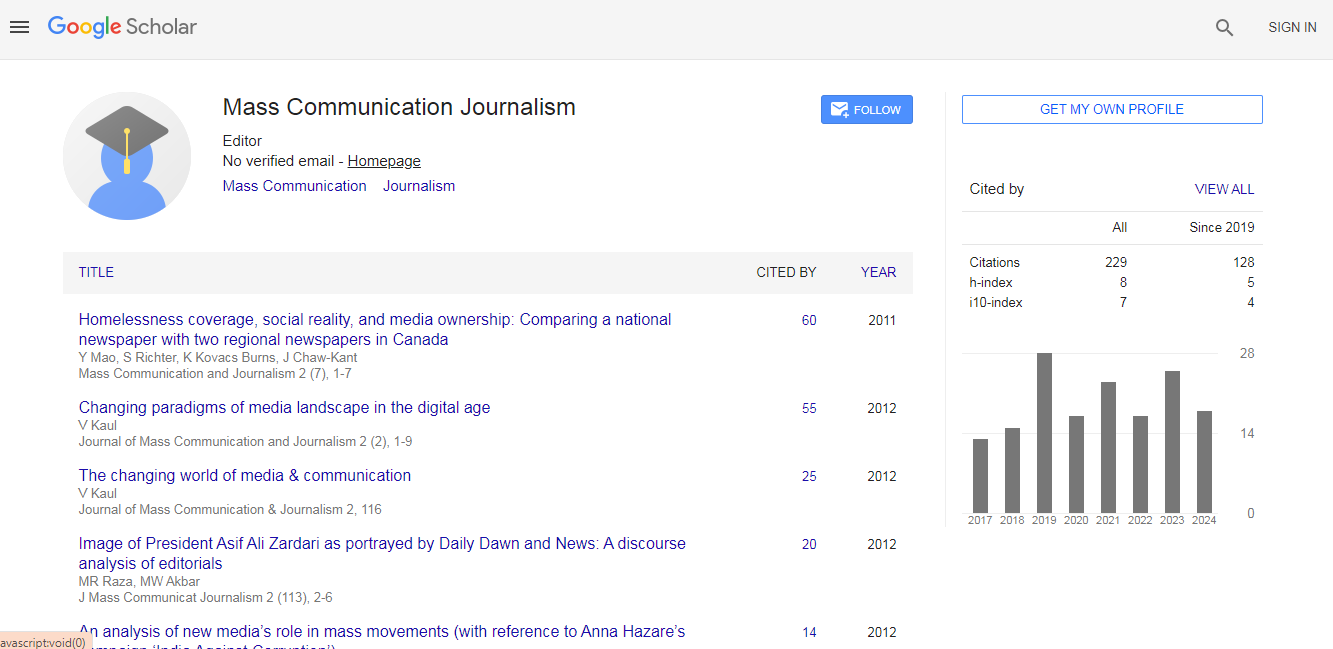
Journal of Mass Communication & Journalism received 205 citations as per Google Scholar report