Commentary - (2025) Volume 16, Issue 3
Received: 01-Apr-2025, Manuscript No. hycr-25-172518;
Editor assigned: 03-Apr-2025, Pre QC No. P-172518;
Reviewed: 17-Apr-2025, QC No. Q-172518;
Revised: 22-Apr-2025, Manuscript No. R-172518;
Published:
29-May-2025
, DOI: 10.37421/2157-7587.2025.16.579
Citation: Rossi, Isabella .”A dvancing Wastewater: Recovery, Purity, Sustainability.” Hydrol Current Res 16(2025):579.
Copyright: ©2025 Rossi.IThis is an o pen-access article distributed under the terms of the Creative Commons Attribution License, which permits unrestricted use, distribution
and reproduction in any medium, provided the original author and source are credited.
The increasing global demand for clean water and escalating challenges from wastewater discharge necessitate continuous innovation in treatment technologies. A thorough review explores advanced methods for reclaiming urban wastewater, evaluating their effectiveness, challenges, and environmental impacts. This work highlights pivotal roles of methods like membrane bioreactors, advanced oxidation processes, and biological treatments in promoting sustainable water management and facilitating resource recovery [1].
Concurrently, there is a distinct evolution in resource recovery from wastewater. This area details recent advancements crucial for extracting valuable resources, including essential nutrients, recoverable energy, and reusable water. Such research discusses the significant technical and economic hurdles that must be overcome, offering insights into future directions for achieving truly sustainable wastewater management practices [2].
Addressing specific pollutants, the presence and removal of microplastics in wastewater treatment plants has become an urgent focus. Comprehensive reviews evaluate the effectiveness of diverse treatment stages, identify key factors influencing removal efficiencies, and outline critical research gaps. This work also proposes forward-looking strategies essential for effectively mitigating microplastic pollution [3].
Similarly, intensive scrutiny is applied to the occurrence, complex behavior, and myriad removal methods for emerging contaminants in wastewater, encompassing pharmaceuticals, personal care products, and industrial chemicals. The efficacy of both conventional and advanced treatment processes is critically assessed, underscoring the formidable challenges inherent in completely eliminating these persistent pollutants [4].
Innovation extends to process optimization and novel designs. Recent advancements in anaerobic wastewater treatment are comprehensively surveyed, with a significant emphasis on strategies for process intensification and enhanced resource recovery. This vital domain encompasses innovative reactor designs, sophisticated operational optimizations, and the considerable potential for concurrently treating wastewater while generating valuable bioenergy or other beneficial byproducts [5].
Furthermore, membrane bioreactor (MBR) technology, a cornerstone for municipal wastewater treatment, continues to witness substantial developments. Overviews detail improvements specifically in membrane fouling control, energy efficiency, and overall operational performance. They also critically explore emerging trends and the significant future potential of MBRs within sustainable urban water management [6].
Beyond engineered solutions, nature-based approaches are increasingly recognized. Articles thoroughly examine the application of nature-based solutions (NBS) for wastewater treatment, such as robust constructed wetlands and innovative integrated algal systems. These studies consistently highlight their inherent ecological benefits and demonstrable cost-effectiveness. The discussions further encompass current trends, practical challenges encountered during implementation, and their indispensable role in achieving broader sustainable development goals [7].
Complementing these biological and physical methods, advanced oxidation processes (AOPs) represent a powerful toolkit for effectively removing persistent organic pollutants from wastewater. Detailed reviews specifically focus on the latest developments across various AOP techniques, including Fenton processes, advanced photocatalysis, and effective ozonation, meticulously discussing their underlying mechanisms, performance metrics, and crucial practical applications within diverse and complex wastewater matrices [8].
The overarching goal of environmental sustainability strongly drives the integration of wastewater management into the circular economy framework. Reviews extensively explore current practices focused on maximizing resource recovery, efficient energy generation, and safe water reuse. This critical assessment identifies promising opportunities and clarifies significant challenges associated with transitioning towards a more circular approach within existing wastewater treatment systems [9].
Finally, significant progress is being made in sewage sludge management. Recent advancements are reviewed, specifically emphasizing innovative approaches geared towards energy recovery and substantially enhancing overall environmental sustainability. Various transformative technologies, such as anaerobic digestion, pyrolysis, and gasification, are rigorously assessed for their inherent potential to convert what was once waste sludge into valuable resources [10].
The increasing global demand for sustainable water management fuels extensive research into advanced wastewater treatment and comprehensive resource recovery strategies. Modern approaches integrate diverse technologies, aiming not only to purify wastewater to meet stringent discharge standards but also to reclaim valuable byproducts. A foundational review covers advanced technologies for urban wastewater reclamation, including sophisticated membrane bioreactors, potent advanced oxidation processes, and various innovative biological treatments. This analysis highlights their demonstrable effectiveness, identifies intrinsic operational challenges, and assesses their broader environmental impacts [1]. Crucially, a significant focus across the field lies on the evolving landscape of resource recovery, meticulously detailing recent advancements in extracting vital resources such as essential nutrients, valuable energy, and reusable water directly from wastewater. Researchers are actively engaged in discussing the intricate technical and economic hurdles involved, alongside offering profound insights into future research directions essential for establishing truly sustainable wastewater management [2]. This pervasive push towards fully integrating wastewater management within a circular economy framework underscores current best practices for maximizing resource recovery, optimizing energy generation, and facilitating widespread water reuse, simultaneously identifying both promising opportunities and persistent challenges inherent in this critical transition [9].
Addressing the pervasive problem of persistent contaminants constitutes a major and urgent area of investigation. The presence and accumulation of microplastics within wastewater treatment plants represent a growing environmental concern, prompting a series of comprehensive reviews. These studies meticulously evaluate the effectiveness of various treatment stages in microplastic removal and precisely identify key operational factors that significantly affect removal efficiencies [3]. Importantly, these reviews also outline critical existing research gaps and propose forward-looking strategies indispensable for effectively mitigating the escalating issue of microplastic pollution. Similarly, the occurrence, complex behavior, and diverse removal methods for emerging contaminants, a broad category encompassing pharmaceuticals, personal care products, and various industrial chemicals, are rigorously scrutinized. The efficacy of both conventional and highly advanced treatment processes is meticulously assessed, often acknowledging the significant and ongoing challenges in completely eliminating these pervasive and often persistent pollutants from treated effluents [4]. Furthermore, a dedicated review specifically focuses on advanced oxidation processes (AOPs) as a powerful methodology for the effective removal of refractory organic pollutants from complex wastewater matrices. This work thoroughly evaluates various AOP techniques, including Fenton processes, advanced photocatalysis, and efficient ozonation, extensively discussing their underlying mechanisms, observed performance characteristics, and crucial practical applications in diverse industrial and municipal settings [8].
Continuous technological advancements are fundamentally reshaping and refining wastewater treatment processes. Recent comprehensive surveys in anaerobic wastewater treatment, for instance, specifically emphasize innovative strategies for process intensification and enhanced resource recovery. These studies delve into innovative reactor designs, sophisticated operational optimizations, and the considerable dual potential for simultaneously treating wastewater effectively while generating valuable bioenergy or other beneficial byproducts [5]. Concurrently, Membrane Bioreactor (MBR) technology, a recognized cornerstone for municipal wastewater treatment, has witnessed substantial and ongoing progress. Detailed overviews highlight continuous improvements specifically in membrane fouling control, overall energy efficiency, and general operational performance. Emerging trends and the significant future potential of MBRs within the broader context of sustainable urban water management are also continuously explored, marking a clear trajectory towards more efficient and integrated treatment systems [6].
Beyond purely engineered solutions, nature-based solutions (NBS) are increasingly offering ecologically sound and often cost-effective alternatives for wastewater treatment. A notable body of articles meticulously examines the practical application of NBS, exemplified by constructed wetlands and innovative integrated algal systems. These studies consistently highlight their inherent ecological benefits, such as biodiversity support and ecosystem services, alongside their demonstrable cost-effectiveness compared to conventional infrastructure. The discussions further encompass current implementation trends, practical challenges encountered during their deployment, and their vital, often underestimated, role in achieving broader sustainable development goals [7]. This growing interest represents a strategic move towards more harmonious, environmentally friendly, and resilient wastewater treatment options that leverage natural processes.
Finally, effective sewage sludge management is not merely an auxiliary process but a crucial component for achieving overall environmental sustainability and resource circularity. Recent progress in this often-overlooked area is thoroughly reviewed, with a strong focus on innovative approaches primarily geared towards efficient energy recovery. Various transformative technologies, such as advanced anaerobic digestion, pyrolysis, and gasification, are rigorously assessed for their inherent potential to convert what was once considered waste sludge into valuable resources. These include biogas, bio-oil, or nutrient-rich soil amendments, thereby contributing significantly to a sustainable resource cycle [10]. Collectively, these diverse efforts underscore a holistic and integrated approach to modern wastewater management, extending well beyond simple pollutant disposal to encompass comprehensive purification, valuable resource extraction, and robust environmental protection.
The field of wastewater treatment is rapidly advancing, focusing on both efficient pollutant removal and sustainable resource recovery. Thorough reviews highlight advanced technologies for reclaiming urban wastewater, including membrane bioreactors, advanced oxidation processes, and biological treatments, assessing their effectiveness and environmental impacts. A key trend involves extracting valuable resources like nutrients, energy, and water from wastewater, with researchers exploring technical and economic hurdles to achieve sustainable management. Significant attention is also directed at mitigating persistent pollutants. Studies delve into the presence and removal of microplastics in wastewater treatment plants, evaluating various treatment stages and identifying critical research gaps. Similarly, the occurrence, behavior, and removal methods for emerging contaminantsâ??such as pharmaceuticals, personal care products, and industrial chemicalsâ??are under scrutiny, assessing the efficacy of both conventional and advanced processes. Innovations in anaerobic wastewater treatment emphasize process intensification and resource recovery through novel reactor designs and operational optimizations. Membrane bioreactor (MBR) technology is continuously improving, focusing on fouling control, energy efficiency, and overall performance in municipal wastewater treatment. Furthermore, nature-based solutions like constructed wetlands and integrated algal systems are gaining traction for their ecological benefits and cost-effectiveness, aligning with sustainable development goals. Advanced oxidation processes (AOPs), including Fenton, photocatalysis, and ozonation, are evaluated for their effectiveness against refractory organic pollutants. The broader context of sustainable wastewater management is increasingly integrated into the circular economy framework, exploring practices for water reuse, energy generation, and resource recovery. This comprehensive approach extends to sewage sludge management, where innovative technologies are being developed for energy recovery and environmental sustainability.
None
None
Indexed at, Google Scholar, Crossref
Indexed at, Google Scholar, Crossref
Indexed at, Google Scholar, Crossref
Indexed at, Google Scholar, Crossref
Indexed at, Google Scholar, Crossref
Indexed at, Google Scholar, Crossref
Indexed at, Google Scholar, Crossref
Indexed at, Google Scholar, Crossref
Indexed at, Google Scholar, Crossref
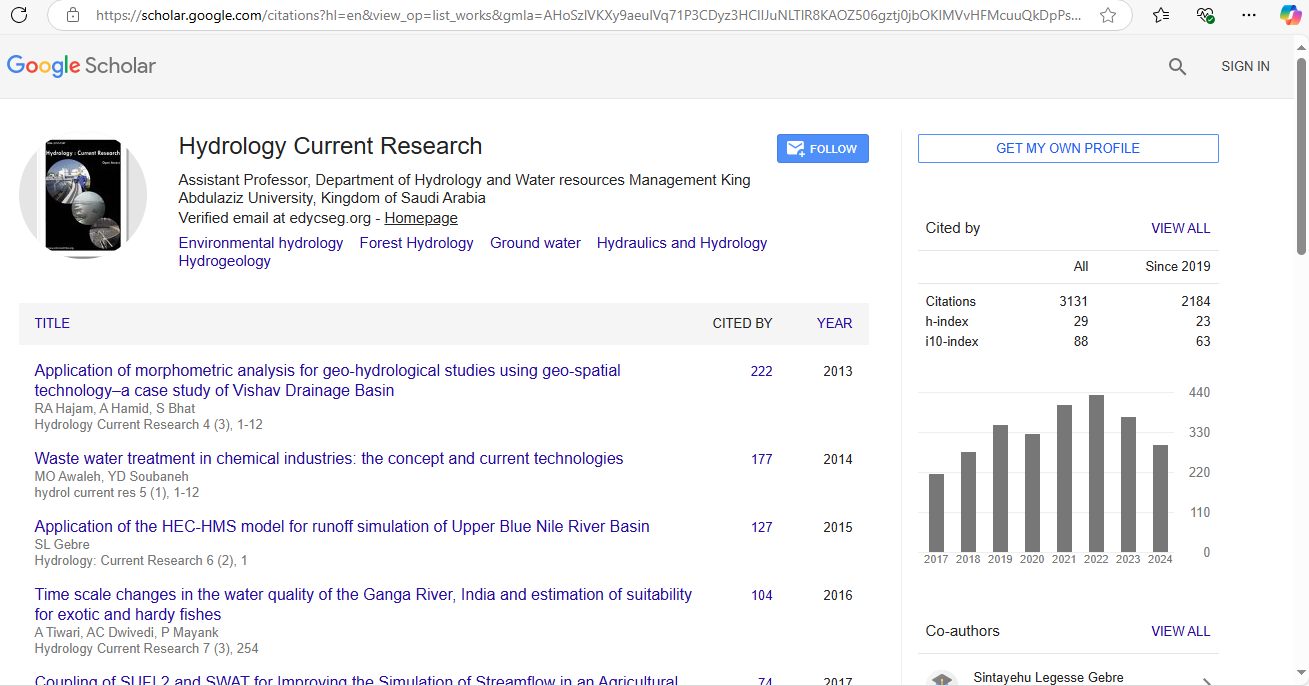
Hydrology: Current Research received 2843 citations as per Google Scholar report