Opinion - (2025) Volume 9, Issue 4
Received: 01-Jul-2025, Manuscript No. fsb-26-189956;
Editor assigned: 03-Jul-2025, Pre QC No. P-189956;
Reviewed: 17-Jul-2025, QC No. Q-189956;
Revised: 22-Jul-2025, Manuscript No. R-189956;
Published:
29-Jul-2025
, DOI: 10.37421/2577-0543.2025.9.242
Citation: Hughes, Benjamin. ”Advancing Peptide and Protein Drug Delivery Systems.” J Formul Sci Bioavailab 09 (2025):242.
Copyright: © 2025 Hughes B. This is an open-access article distributed under the terms of the Creative Commons Attribution License, which permits unrestricted use, distribution and reproduction in any medium, provided the original author and source are credited.
The field of peptide and protein drug delivery is undergoing rapid innovation, driven by the need to overcome significant bioavailability and stability challenges inherent to these large biomolecules. Advanced formulation strategies are crucial for unlocking the therapeutic potential of peptides and proteins across various administration routes. This involves a multifaceted approach, considering not only the intrinsic properties of the drug but also the complex biological barriers it must traverse to reach its target site and exert its therapeutic effect. The development of novel delivery systems aims to enhance drug stability, improve absorption, achieve sustained release, and ultimately increase patient compliance through more convenient and effective administration methods. One significant area of focus is the oral delivery of peptides, which historically has been plagued by poor enzymatic degradation in the gastrointestinal tract and low permeability across the intestinal epithelium. Researchers are exploring sophisticated strategies, including the use of lipid-based formulations and self-emulsifying drug delivery systems (SMEDDS), to protect peptides from the harsh environment of the stomach and enhance their absorption through the intestinal wall. These systems aim to mimic natural absorption pathways and improve the overall bioavailability of orally administered peptide therapeutics, offering a promising alternative to injections [2].
Complementing oral delivery efforts, pulmonary administration represents another avenue for systemic or localized lung treatment with peptides and proteins. Formulating dry powder inhalers (DPIs) for this purpose requires careful consideration of aerosol performance, stability of the peptide in its dry state, and efficient deposition within the lung. Excipients and particle engineering play pivotal roles in optimizing these aspects, ensuring that the therapeutic payload is effectively delivered to the respiratory tract for absorption [4].
Transdermal delivery, particularly via microneedle technology, is emerging as a minimally invasive and potentially pain-free method for administering peptides and proteins. These systems are designed to create transient pathways through the stratum corneum, facilitating drug diffusion into the systemic circulation. Research in this area focuses on the design of microneedle arrays, fabrication techniques, and formulation strategies to ensure drug stability and efficient skin penetration, paving the way for self-administered biologics [5].
Polymeric nanoparticles are also proving to be versatile platforms for the sustained and targeted delivery of therapeutic proteins. By carefully selecting polymer types and optimizing nanoparticle design, researchers can control drug encapsulation, release kinetics, and cellular uptake. This allows for improved therapeutic efficacy and potentially reduces the dosing frequency, enhancing patient convenience and therapeutic outcomes [3].
The inherent instability of therapeutic peptides and proteins poses a significant hurdle in their formulation and administration. Factors such as temperature, pH, shear stress, and oxidation can lead to aggregation and degradation, compromising their therapeutic efficacy. Formulation strategies, including the use of stabilizers, antioxidants, and lyophilization techniques, are essential for enhancing their shelf-life and ensuring their integrity during storage and administration [6].
Beyond polymeric nanoparticles, other nanomaterials like mesoporous silica nanoparticles (MSNs) are being investigated for protein drug delivery. The tunable pore size, surface modification capabilities, and high loading capacity of MSNs make them attractive carriers for controlled protein release and improved bioavailability. Their versatility as drug delivery platforms is a key advantage in developing effective protein-based therapeutics [7].
Hydrogel-based formulations offer another promising approach for peptide drug delivery, particularly for applications such as wound healing and subcutaneous administration. These versatile biomaterials can encapsulate peptides, control their release rates, and protect them from degradation. The selection of appropriate natural or synthetic polymers is critical in tailoring the hydrogel's properties for optimal drug delivery [8].
Advanced formulation strategies for peptide and protein drugs encompass a wide array of innovative delivery systems, including but not limited to nanoparticles, hydrogels, and microneedles. These technologies are designed to overcome barriers such as enzymatic degradation and poor membrane permeability, ultimately aiming to enhance stability, bioavailability, and patient compliance. The focus is on creating sophisticated delivery mechanisms that can effectively administer these complex biomolecules through various routes, including oral, pulmonary, and transdermal pathways [1].
For pulmonary protein delivery, ex vivo lung perfusion (EVLP) is emerging as a valuable tool to optimize drug delivery systems. This technique allows for the assessment of drug deposition, distribution, and efficacy within the lung, providing critical insights for the preclinical evaluation and formulation development of novel pulmonary delivery approaches. EVLP aids in refining strategies to ensure effective drug delivery to the respiratory system [9].
The development of advanced formulation strategies for peptide and protein drugs is paramount for their successful therapeutic application, addressing inherent challenges like enzymatic degradation and poor membrane permeability. These strategies encompass a wide range of innovative delivery systems designed to improve stability, bioavailability, and patient compliance across various administration routes. Oral delivery, a particularly challenging route, is being significantly advanced through the exploration of lipid-based formulations and self-emulsifying drug delivery systems (SMEDDS). These systems are engineered to shield peptides from the harsh conditions of the gastrointestinal tract and enhance their absorption, offering a viable alternative to parenteral administration [2].
Pulmonary delivery, especially through dry powder inhalers (DPIs), is another critical area of research. The formulation of DPIs for peptides requires meticulous attention to aerosol performance, stability of the peptide in the dry state, and efficient lung deposition. The judicious selection of excipients and advanced particle engineering techniques are essential for optimizing these parameters and achieving effective therapeutic outcomes in the lungs [4].
Transdermal drug delivery is increasingly leveraging microneedle technology for peptides and proteins, offering a minimally invasive and potentially pain-free administration route. The design of microneedle arrays, fabrication methods, and formulation considerations are key to ensuring drug stability and effective permeation through the skin. This approach holds promise for convenient, self-administered biologic therapies [5].
Polymeric nanoparticles represent a versatile platform for the controlled and targeted delivery of therapeutic proteins. The choice of polymer, along with the careful design of the nanoparticle, dictates drug encapsulation efficiency, release kinetics, and cellular uptake. Such tailored nanoparticle systems can significantly enhance the therapeutic efficacy and reduce the need for frequent dosing [3].
The inherent instability of therapeutic peptides and proteins presents a major hurdle, as they are susceptible to degradation and aggregation induced by factors like temperature, pH, shear stress, and oxidation. To counteract this, formulation strategies involving stabilizers, antioxidants, and lyophilization are employed to enhance their shelf-life and maintain their therapeutic integrity [6].
Beyond polymeric nanoparticles, mesoporous silica nanoparticles (MSNs) are emerging as promising carriers for protein drug delivery. Their customizable pore characteristics, surface modification potential, and high loading capacities allow for controlled protein release and improved bioavailability. MSNs offer a versatile platform for developing effective protein-based therapeutics [7].
Hydrogel-based formulations are particularly well-suited for peptide drug delivery in applications such as wound healing and subcutaneous administration. These hydrogels, composed of various natural or synthetic polymers, can effectively encapsulate peptides, control their release rates, and protect them from degradation [8].
Overall, advanced formulation strategies are essential for maximizing the therapeutic potential of peptide and protein drugs. This includes a broad spectrum of innovative delivery systems and approaches aimed at overcoming biological barriers and improving drug performance. From oral and pulmonary routes to transdermal and subcutaneous delivery, each method requires specific formulation techniques to ensure efficacy and patient acceptance [1].
Furthermore, ex vivo lung perfusion (EVLP) is being utilized as an advanced tool to refine drug delivery systems for pulmonary protein administration. EVLP facilitates the evaluation of drug deposition, distribution, and efficacy within the lung tissue, thereby aiding in the formulation development and preclinical assessment of novel delivery strategies for inhaled protein therapeutics [9].
Additional research explores synergistic strategies for oral peptide delivery, combining mucoadhesion and permeation enhancement techniques. This involves investigating novel excipients to overcome the intestinal mucus barrier and boost peptide absorption, aiming for more effective oral formulations [10].
This compilation of research highlights significant advancements in the formulation and delivery of peptide and protein drugs. Key areas of focus include overcoming barriers to oral, pulmonary, and transdermal administration through innovative delivery systems such as nanoparticles, hydrogels, and microneedles. Stability challenges are addressed using stabilizers and advanced formulation techniques. Research also explores specialized methods like ex vivo lung perfusion for optimizing pulmonary delivery and synergistic strategies to enhance oral absorption. The overarching goal is to improve drug efficacy, bioavailability, and patient compliance by developing sophisticated and patient-friendly delivery platforms.
None
None
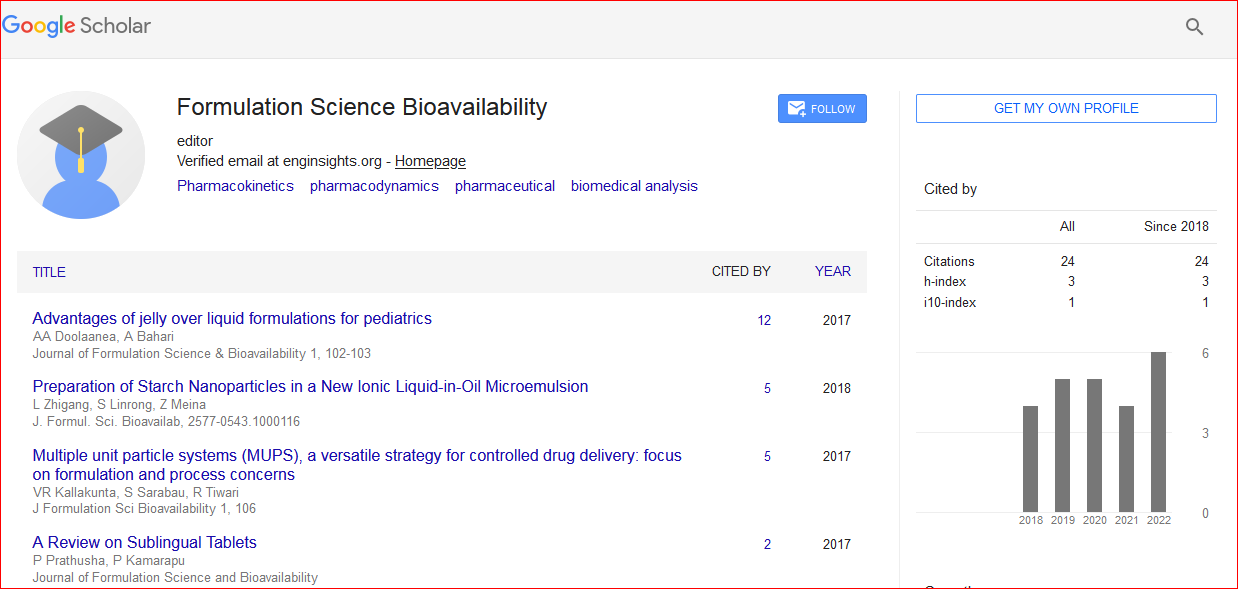
Journal of Formulation Science & Bioavailability received 23 citations as per Google Scholar report