Commentary - (2025) Volume 9, Issue 4
Received: 01-Jul-2025, Manuscript No. hps-26-184477;
Editor assigned: 03-Jul-2025, Pre QC No. P-184477;
Reviewed: 17-Jul-2025, QC No. Q-184477;
Revised: 22-Jul-2025, Manuscript No. R-184477;
Published:
29-Jul-2025
, DOI: 10.37421/2573-4563.2025.9.352
Citation: Rossi, Isabella M.. ”Advancing PDAC Detection, Therapy, and Monitoring.” J Hepatol Pancreat Sci 09 (2025):352.
Copyright: © 2025 Rossi M. Isabella This is an open-access article distributed under the terms of the Creative Commons Attribution License, which permits unrestricted use, distribution and reproduction in any medium, provided the original author and source are credited.
Pancreatic ductal adenocarcinoma (PDAC) presents a significant therapeutic challenge, characterized by late diagnoses and limited effective treatment options. Recent advancements in understanding PDAC biology have underscored the importance of novel biomarkers for early detection and prognostication, as well as the development of targeted therapies that leverage specific molecular vulnerabilities [1].
The tumor microenvironment (TME) plays a critical role in PDAC, with its intricate cellular and molecular composition profoundly influencing treatment response. Investigating the TME is therefore crucial for developing more effective therapeutic strategies [2].
The genetic landscape of PDAC is notably characterized by recurrent mutations in key genes such as KRAS, TP53, and SMAD4. Understanding these genetic alterations is pivotal for the development of targeted therapies that can specifically address the underlying oncogenic drivers [3].
Liquid biopsies, particularly those employing circulating tumor DNA (ctDNA), are emerging as powerful tools for monitoring PDAC. Their ability to detect minimal residual disease and predict treatment response offers real-time insights into tumor dynamics [4].
PARP inhibitors have demonstrated considerable promise in the treatment of PDAC, especially in patients harboring BRCA mutations. Their integration into standard treatment paradigms for select PDAC patients represents a significant step toward personalized therapy [5].
Antibody-drug conjugates (ADCs) represent a novel class of targeted therapies designed to deliver cytotoxic payloads directly to tumor cells, thereby minimizing systemic toxicity. The development of ADCs targeting specific antigens on PDAC cells is a key area of investigation [6].
While immunotherapy has revolutionized cancer treatment, its efficacy in PDAC has been historically limited due to the immunosuppressive nature of its TME. Current research focuses on strategies to enhance immunotherapy responses in PDAC [7].
The role of circulating tumor cells (CTCs) as a liquid biopsy marker for PDAC is under active exploration. The ability to detect and quantify CTCs provides a non-invasive method for disease monitoring and therapeutic decision-making [8].
The inherent heterogeneity of PDAC poses a substantial challenge for effective treatment. Examining the molecular subtypes of PDAC and their influence on therapeutic response is essential for overcoming treatment resistance [9].
Novel drug delivery systems are being investigated to improve the efficacy and reduce the toxicity of PDAC treatments. Nanocarrier-based systems for targeted drug delivery hold significant promise for enhancing drug penetration and sustained release within PDAC tumors [10].
PDAC remains a formidable challenge due to late diagnosis and limited effective treatments. Recent advances in understanding PDAC biology have highlighted the potential of novel biomarkers for early detection and prognostication, as well as the development of targeted therapies that exploit specific molecular vulnerabilities. This review synthesizes key findings on emerging biomarkers, including circulating tumor DNA (ctDNA), microRNAs, and protein-based markers, and discusses their clinical utility. It also examines promising targeted therapies, such as PARP inhibitors, antibody-drug conjugates, and immunotherapies, alongside the challenges and future directions in PDAC treatment [1].
Investigating the tumor microenvironment (TME) is crucial for PDAC, as its complex cellular and molecular composition significantly influences treatment response. This paper delves into the role of immune cells, stromal components, and extracellular matrix in PDAC progression and resistance to therapy. It highlights how targeting specific elements within the TME, such as cancer-associated fibroblasts or myeloid-derived suppressor cells, in combination with conventional therapies, could offer new avenues for improving patient outcomes [2].
The genetic landscape of PDAC is characterized by frequent mutations in genes like KRAS, TP53, and SMAD4. This research explores the implications of these genetic alterations for targeted therapy development. It discusses how understanding these driver mutations and their downstream signaling pathways can inform the design of drugs that specifically inhibit these oncogenic mechanisms, offering a more personalized approach to treatment [3].
Liquid biopsies, particularly circulating tumor DNA (ctDNA), are emerging as powerful tools for monitoring PDAC. This study evaluates the clinical utility of ctDNA in detecting minimal residual disease (MRD) after surgery and in predicting treatment response to chemotherapy. The findings suggest that ctDNA analysis can provide real-time insights into tumor dynamics, enabling more timely treatment adjustments and potentially improving survival [4].
PARP inhibitors have shown promise in PDAC, particularly in patients with BRCA mutations. This paper reviews the preclinical rationale and clinical evidence supporting the use of PARP inhibitors, discussing their mechanisms of action, efficacy in various settings, and potential resistance mechanisms. The integration of PARP inhibitors into standard treatment paradigms for select PDAC patients is a significant step towards personalized therapy [5].
Antibody-drug conjugates (ADCs) represent a novel class of targeted therapies that deliver cytotoxic payloads directly to tumor cells, minimizing systemic toxicity. This review explores the development of ADCs targeting specific antigens expressed on PDAC cells, such as HER2 and mesothelin. The potential for ADCs to overcome resistance to conventional therapies and improve patient outcomes is a key focus [6].
Immunotherapy has revolutionized cancer treatment, but its efficacy in PDAC has been limited due to the immunosuppressive nature of its TME. This article discusses current strategies for enhancing immunotherapy responses in PDAC, including combinations with chemotherapy, radiation, and targeted agents. The identification of predictive biomarkers for immunotherapy response is a critical area of ongoing research [7].
The role of circulating tumor cells (CTCs) as a liquid biopsy marker for PDAC is being explored. This study investigates the prognostic significance of CTCs in patients with advanced PDAC and their potential to predict response to systemic therapy. The ability to detect and quantify CTCs offers a non-invasive method for disease monitoring and therapeutic decision-making [8].
The heterogeneity of PDAC presents a significant challenge for treatment. This paper examines the molecular subtypes of PDAC and how these differences influence response to therapy. Understanding tumor heterogeneity is essential for developing more effective, personalized treatment strategies that can overcome treatment resistance [9].
Novel drug delivery systems are being explored to enhance the efficacy and reduce the toxicity of PDAC treatments. This research focuses on nanocarriers for targeted delivery of chemotherapeutic agents and small molecules to PDAC tumors. The improved drug penetration and sustained release offered by these systems hold promise for overcoming the challenges of drug delivery in this difficult-to-treat cancer [10].
Pancreatic ductal adenocarcinoma (PDAC) remains a major health challenge. Research is advancing rapidly in the identification of novel biomarkers for early detection and prognostication, including ctDNA, microRNAs, and protein-based markers. Targeted therapies are also showing promise, with developments in PARP inhibitors, antibody-drug conjugates, and immunotherapies. The tumor microenvironment (TME) is a critical factor influencing treatment response, and strategies to target TME components are being explored. Understanding the genetic landscape of PDAC, with frequent mutations in KRAS, TP53, and SMAD4, is guiding the development of personalized therapies. Liquid biopsies, such as ctDNA and CTCs, are emerging as valuable tools for monitoring disease and predicting treatment outcomes. Challenges remain, including tumor heterogeneity and immune evasion, but novel approaches like nanoparticle-based drug delivery systems offer potential solutions to improve treatment efficacy and reduce toxicity.
None
None
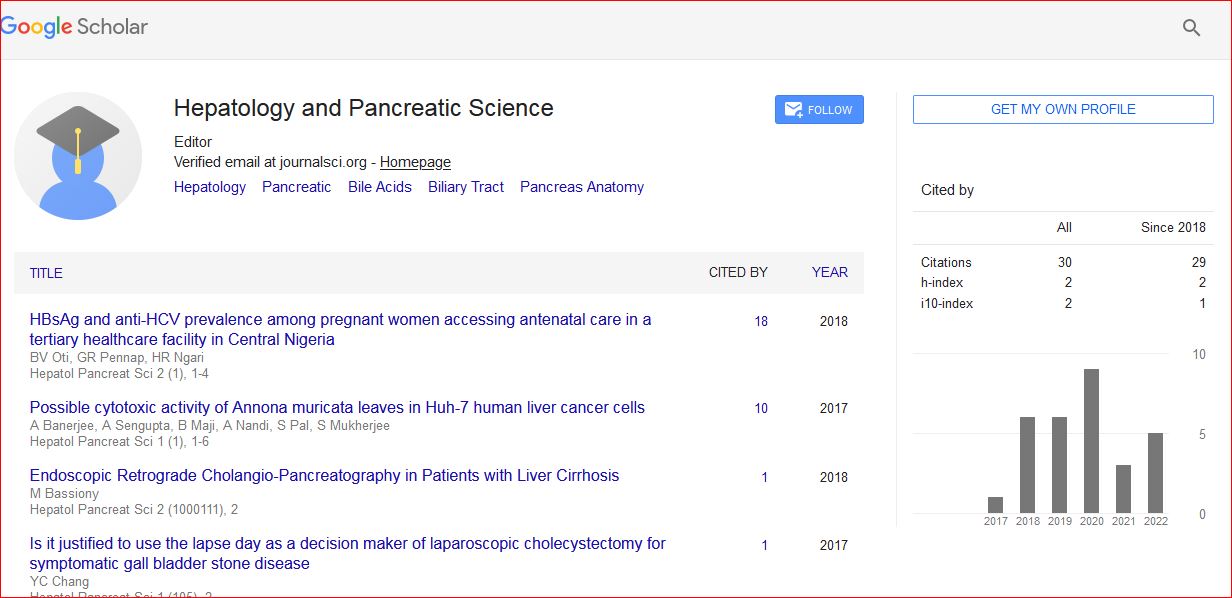
Hepatology and Pancreatic Science received 34 citations as per Google Scholar report