Short Communication - (2025) Volume 11, Issue 3
Received: 01-May-2025, Manuscript No. ohcr-25-174274;
Editor assigned: 05-May-2025, Pre QC No. P-174274;
Reviewed: 19-May-2025, QC No. Q-174274;
Revised: 22-May-2025, Manuscript No. R-174274;
Published:
29-May-2025
, DOI: 10.37421/2471-8726.2025.11.199
Citation: Ricci, Matteo. ”Advancing Oral Cancer Detection: Early, Accurate.” Oral Health Case Rep 11 (2025):199.
Copyright: © 2025 Ricci M. This is an open-access article distributed under the terms of the Creative Commons Attribution License, which permits unrestricted use, distribution and reproduction in any medium, provided the original author and source are credited.
Artificial intelligence tools are rapidly transforming how we approach oral cancer detection, offering promising avenues for earlier and more accurate diagnosis. These systems can analyze medical images and patient data to identify suspicious lesions that might be missed by the human eye, improving diagnostic efficiency and potentially leading to better patient outcomes. The exciting part is how AI can integrate with existing diagnostic workflows, providing a powerful secondary opinion for clinicians [1].
Liquid biopsy techniques are emerging as a less invasive way to detect oral cancer by analyzing biological fluids like blood or saliva for circulating tumor cells or DNA. This approach bypasses the need for traditional tissue biopsies in some cases, making screening and monitoring more patient-friendly. What this really means is we might soon have methods that can spot early cancer markers without discomfort, which is a big step forward [2].
Optical techniques are proving invaluable for spotting oral cancer at its earliest stages. Using light to visualize tissue changes, methods like spectroscopy and autofluorescence can highlight suspicious areas that aren't yet visible to the naked eye. This non-invasive visual screening capability allows for real-time assessment during examinations, guiding clinicians to areas that need closer attention and potentially preventing progression [3].
Salivary biomarkers offer a remarkably accessible and non-invasive way to detect oral squamous cell carcinoma. Think about it: a simple saliva sample could reveal critical genetic or protein markers indicating early cancer development. This method is incredibly appealing for widespread screening, particularly in high-risk populations, making early intervention much more feasible and less daunting for patients [4].
Autofluorescence imaging is a compelling technique for identifying potentially malignant oral lesions and early-stage oral cancer. It works by detecting changes in natural fluorescence emitted by tissue, which can indicate cellular alterations before they are clinically evident. This is powerful because it gives practitioners an objective visual aid to differentiate between healthy and abnormal tissue, improving the accuracy of initial screenings [5].
Exosomes, those tiny vesicles released by cells, are gaining serious traction as promising biomarkers for oral cancer. They carry molecular cargo, like proteins and nucleic acids, that reflect the state of the parent cell, including cancer cells. The cool thing here is their potential for non-invasive detection and even for tracking disease progression, providing a new layer of insight into cancer biology [6].
MicroRNAs (miRNAs) are proving to be powerful diagnostic and prognostic markers for oral squamous cell carcinoma. These small RNA molecules regulate gene expression, and their altered profiles are often seen in cancer. Identifying specific miRNA signatures in patient samples offers a precise way to detect cancer early and even predict how it might behave, which is a game-changer for personalized treatment strategies [7].
Photodynamic diagnosis is offering clinicians a targeted way to visualize oral potentially malignant disorders and early oral squamous cell carcinoma. This technique involves using a photosensitizing agent that preferentially accumulates in abnormal cells, which then fluoresces under specific light. The benefit? It enhances the contrast between healthy and diseased tissue, allowing for more precise biopsies and early therapeutic interventions [8].
Oral brush biopsy has become a less invasive and highly effective method for screening and early detection of oral squamous cell carcinoma and other potentially malignant disorders. Instead of a surgical cut, it uses a brush to collect cells from suspicious lesions. This simplicity makes it a great tool for initial screening, helping to identify cases that need further, more invasive investigation without subjecting every patient to a surgical procedure [9].
Raman spectroscopy offers a non-invasive, label-free approach to detecting oral squamous cell carcinoma by analyzing the unique biochemical fingerprint of tissues. It provides highly specific molecular information, allowing differentiation between normal, precancerous, and cancerous lesions in real-time. This is exciting because it could transform how we screen for oral cancer, making the process faster and more objective right at the point of care [10].
Artificial Intelligence (AI) tools are dramatically changing how oral cancer is detected, offering precise and early diagnosis. These systems analyze images and patient data to spot suspicious lesions, which might escape human observation, thereby boosting diagnostic accuracy and leading to better patient outcomes [1]. The true value of AI lies in its ability to integrate with existing clinical workflows, essentially offering a powerful second opinion to practitioners, enhancing human expertise. Optical techniques further contribute to early detection by using light to visualize tissue changes [3]. Methods like spectroscopy and autofluorescence highlight subtle areas not visible to the naked eye. This non-invasive visual screening capability allows for real-time assessment during examinations, guiding clinicians to areas that need closer attention and potentially preventing disease progression [3]. Autofluorescence imaging specifically identifies potentially malignant oral lesions and early-stage oral cancer by detecting changes in natural fluorescence emitted by tissue, indicating cellular alterations before they become clinically evident [5]. This is powerful because it gives practitioners an objective visual aid to differentiate between healthy and abnormal tissue, improving the accuracy of initial screenings significantly [5].
Less invasive detection methods are gaining traction, with liquid biopsy techniques emerging as a significant advancement in oral cancer detection [2]. By analyzing biological fluids such as blood or saliva for circulating tumor cells or DNA, this approach often eliminates the need for traditional tissue biopsies in some cases, making screening and monitoring much more patient-friendly [2]. What this really means is we might soon have methods that can spot early cancer markers without discomfort, a big step forward in patient care. Salivary biomarkers, for example, present an incredibly accessible and non-invasive way to detect oral squamous cell carcinoma [4]. Think about it: a simple saliva sample could reveal crucial genetic or protein markers indicative of early cancer development. This method is incredibly appealing for widespread screening, particularly in high-risk populations, making early intervention much more feasible and less daunting for patients [4]. Similarly, exosomes, which are tiny vesicles released by cells, are being recognized as promising biomarkers for oral cancer [6]. They carry molecular cargo like proteins and nucleic acids that mirror the state of their parent cells, including cancer cells. The cool thing here is their potential for non-invasive detection and even for tracking disease progression, providing a new layer of insight into cancer biology [6].
MicroRNAs (miRNAs) are proving to be potent diagnostic and prognostic markers for oral squamous cell carcinoma [7]. These small RNA molecules regulate gene expression, and altered miRNA profiles are frequently observed in cancer. Identifying specific miRNA signatures in patient samples offers a precise way to detect cancer early and even predict its behavior, which is a pivotal step toward personalized treatment strategies and improved outcomes [7]. Photodynamic diagnosis also offers clinicians a targeted approach to visualize oral potentially malignant disorders and early oral squamous cell carcinoma [8]. This technique employs a photosensitizing agent that selectively accumulates in abnormal cells, fluorescing under specific light. The primary advantage here is the enhanced contrast between healthy and diseased tissue, enabling more precise biopsies and facilitating earlier therapeutic interventions, ultimately aiding in more effective treatment planning [8].
Oral brush biopsy stands out as a less invasive and highly effective method for screening and early detection of oral squamous cell carcinoma and other potentially malignant disorders [9]. Rather than a surgical incision, this technique uses a brush to collect cells from suspicious lesions. This simplicity makes it a great tool for initial screening, helping to identify cases that need further, more invasive investigation without subjecting every patient to a surgical procedure, thus reducing patient discomfort and anxiety associated with traditional biopsies [9].
Finally, Raman spectroscopy offers a non-invasive, label-free method for detecting oral squamous cell carcinoma by analyzing the unique biochemical fingerprint of tissues [10]. It provides highly specific molecular information, allowing real-time differentiation between normal, precancerous, and cancerous lesions right at the point of care. This is exciting because it could transform how we screen for oral cancer, making the process faster, more objective, and significantly improving accessibility for patients [10].
Advancements in oral cancer detection are rapidly improving early diagnosis and patient outcomes. Artificial Intelligence (AI) tools analyze medical images and patient data to identify suspicious lesions, enhancing diagnostic efficiency and providing valuable secondary opinions to clinicians. Complementing this, optical techniques like spectroscopy and autofluorescence imaging use light to visualize subtle tissue changes, highlighting potentially malignant areas not visible to the naked eye for real-time assessment. Liquid biopsy techniques are emerging as less invasive alternatives to traditional tissue biopsies. They analyze biological fluids, such as blood or saliva, for circulating tumor cells or DNA, paving the way for more patient-friendly screening and monitoring. Specific biomarkers found in saliva, including genetic or protein markers, offer a remarkably accessible means for early cancer detection, especially valuable for widespread screening in high-risk populations. Further innovations include exosomes and MicroRNAs (miRNAs), which serve as promising molecular biomarkers. Exosomes, tiny cell-released vesicles carrying molecular cargo, offer potential for non-invasive detection and disease tracking, while altered miRNA profiles in patient samples provide precise diagnostic and prognostic indicators for oral squamous cell carcinoma. Photodynamic diagnosis utilizes photosensitizing agents to enhance contrast between healthy and diseased tissue, enabling more precise biopsies and early therapeutic interventions. Oral brush biopsy provides a less invasive method for cell collection from suspicious lesions, serving as an effective initial screening tool. Finally, Raman spectroscopy offers a non-invasive, label-free approach to differentiate between normal, precancerous, and cancerous lesions by analyzing their unique biochemical fingerprints in real-time. Together, these diverse methods represent a significant leap towards earlier, more accurate, and less invasive oral cancer diagnosis.
None
None
1. Suma R, Sudha J, Nivedita S. "Artificial intelligence for oral cancer detection: Current status and future perspectives".J Oral Maxillofac Pathol 27 (2023):425-430.
Indexed at, Google Scholar, Crossref
2. Meena S, Preeti S, Garima S. "Liquid biopsy in oral squamous cell carcinoma: A comprehensive review of current advances and future implications".Oral Oncol 131 (2022):105995.
Indexed at, Google Scholar, Crossref
3. Rahul RS, Ajay KS, Ritesh S. "Optical techniques for early detection of oral cancer: A review".J Biophotonics 14 (2021):e202100125.
Indexed at, Google Scholar, Crossref
4. Aditya BS, Priyanka GS, Rajeev K. "Diagnostic utility of salivary biomarkers in oral squamous cell carcinoma: A systematic review".Arch Oral Biol 154 (2023):105753.
Indexed at, Google Scholar, Crossref
5. Rajesh G, Sanjay K, Anupama S. "Autofluorescence imaging for early detection of oral potentially malignant disorders and oral cancer: A systematic review and meta-analysis".Oral Oncol 104 (2020):104625.
Indexed at, Google Scholar, Crossref
6. Divya S, Rajani S, Abhishek K. "Exosomes as novel diagnostic and prognostic biomarkers in oral squamous cell carcinoma: A comprehensive review".Mol Diagn Ther 25 (2021):287-302.
Indexed at, Google Scholar, Crossref
7. Shivani A, Manish S, Deepanshu A. "MicroRNAs as diagnostic and prognostic biomarkers in oral squamous cell carcinoma: A systematic review and meta-analysis".Clin Oral Investig 23 (2019):2869-2882.
Indexed at, Google Scholar, Crossref
8. Kavita G, Sachin K, Vivek S. "Photodynamic diagnosis for the detection of oral potentially malignant disorders and oral squamous cell carcinoma: A systematic review and meta-analysis".Photodiagnosis Photodyn Ther 38 (2022):102769.
Indexed at, Google Scholar, Crossref
9. Alok KS, Pooja S, Vinay K. "Oral brush biopsy for early detection of oral squamous cell carcinoma and oral potentially malignant disorders: A systematic review".J Oral Maxillofac Surg 78 (2020):1297-1306.
Indexed at, Google Scholar, Crossref
10. Gaurav S, Rakesh KS, Amit G. "Raman spectroscopy for non-invasive detection of oral squamous cell carcinoma: A systematic review and meta-analysis".Analyst 148 (2023):18-36.
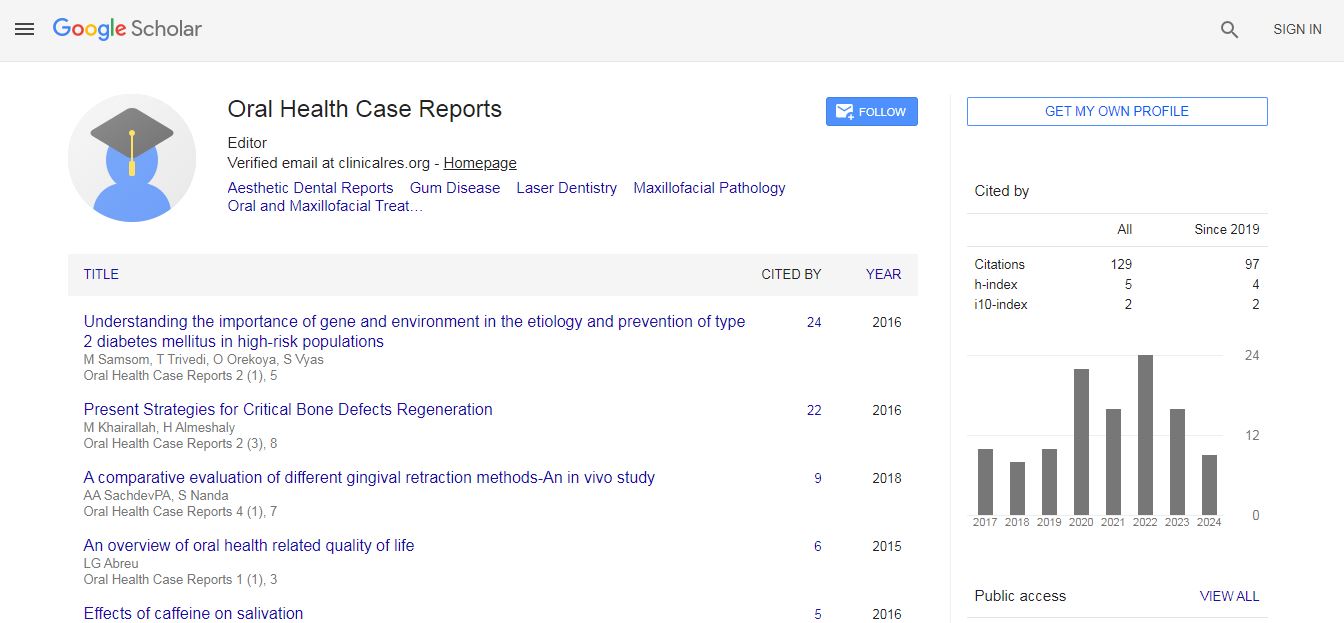
Oral Health Case Reports received 120 citations as per Google Scholar report