Commentary - (2025) Volume 9, Issue 3
Received: 01-May-2025, Manuscript No. fsb-26-189948;
Editor assigned: 05-May-2025, Pre QC No. P-189948;
Reviewed: 19-May-2025, QC No. Q-189948;
Revised: 22-May-2025, Manuscript No. R-189948;
Published:
29-May-2025
, DOI: 10.37421/2577-0543.2025.9.234
Citation: AlMansoori, Hana. ”Advancing Lipid Systems For Oral Drug Bioavailability.” J Formul Sci Bioavailab 09 (2025):234.
Copyright: © 2025 AlMansoori H. This is an open-access article distributed under the terms of the Creative Commons Attribution License, which permits unrestricted use, distribution and reproduction in any medium, provided the original author and source are credited.
Self-emulsifying drug delivery systems (SEDDS) have emerged as a significant strategy for improving the oral bioavailability of poorly soluble drugs, addressing a major challenge in pharmaceutical development. These systems form fine oil-in-water emulsions upon contact with gastrointestinal fluids, thereby enhancing drug dissolution and absorption [1].
Recent advancements have focused on refining formulation strategies and employing novel excipients to optimize the performance of SEDDS across a wider range of drug candidates [1].
Nanostructured lipid carriers (NLCs) represent another promising lipid-based formulation approach, particularly effective for delivering hydrophobic drugs. By incorporating both solid and liquid lipids, NLCs offer improved drug loading capacity and altered release profiles compared to traditional solid lipid nanoparticles [2].
The development of these nanocarriers aims to enhance solubility and bioavailability, making them suitable for overcoming absorption barriers [2].
Solid self-emulsifying drug delivery systems (S-SEDDS) are being developed to improve the handling and stability of conventional liquid SEDDS. Utilizing co-processed excipients is a key trend in this area, aiming to enhance the physicochemical properties and dissolution rates of poorly water-soluble drugs, thereby simplifying their formulation and administration [3].
The application of lipid-based drug delivery systems, including SEDDS, is being critically evaluated for the oral delivery of sensitive biomolecules such as proteins and peptides. These formulations are designed to protect these complex molecules from degradation in the gastrointestinal tract and facilitate their absorption, opening new avenues for oral biologics [4].
The selection of appropriate surfactants is crucial for the performance of SEDDS, as they directly influence the emulsification properties and drug release characteristics. Research is ongoing to understand the impact of different surfactant types and concentrations on droplet size and self-emulsification time, guiding rational formulation design [5].
Nanostructured lipid carriers (NLCs) are also being engineered for the delivery of challenging therapeutic agents, such as antifungal drugs. The design of NLCs focuses on improving oral bioavailability and therapeutic efficacy, with preclinical studies demonstrating enhanced drug absorption and reduced toxicity compared to conventional dosage forms [6].
To further enhance oral drug absorption, SEDDS are being combined with mucoadhesive polymers. This synergistic approach aims to prolong the residence time of the SEDDS in the gastrointestinal tract, thereby increasing the opportunity for drug absorption and improving overall bioavailability, especially for poorly soluble drugs [7].
Beyond traditional small molecules, lipid nanoparticles (LNPs) have gained significant attention for delivering nucleic acid therapeutics, such as mRNA. The design and formulation of LNPs are critical for the stability and efficacy of these advanced therapeutics, with lipid composition playing a pivotal role in their performance for vaccine development and gene therapy [8].
Novel modifications of SEDDS, such as nano-SEDDS, are being explored to extend their utility to hydrophilic drugs. By adjusting the formulation components, nano-SEDDS can accommodate both lipophilic and hydrophilic compounds, thereby expanding their therapeutic applications and improving solubility and permeability [9].
Cyclodextrins are well-established excipients for enhancing drug solubility and bioavailability. Their integration with lipid-based delivery systems, including SEDDS, offers synergistic benefits through complexation and lipid formulation, providing a robust strategy to address solubility limitations for a wide range of therapeutic agents [10].
Self-emulsifying drug delivery systems (SEDDS) represent a significant advancement in pharmaceutical science, primarily focused on enhancing the oral bioavailability of poorly soluble drugs. These systems are meticulously designed to form fine emulsions upon dilution in gastrointestinal fluids, facilitating improved drug dissolution and subsequent absorption. The ongoing evolution of SEDDS involves the exploration of novel excipients and sophisticated formulation strategies to broaden their applicability to a diverse array of drug molecules [1].
Nanostructured lipid carriers (NLCs) have emerged as a powerful alternative for the oral delivery of hydrophobic drugs. These carriers are constructed using a combination of solid and liquid lipids, which contributes to their enhanced drug encapsulation efficiency and modulated drug release kinetics. The fundamental objective behind NLC development is to significantly boost drug solubility and bioavailability, thereby enabling more effective oral administration [2].
The development of solid self-emulsifying drug delivery systems (S-SEDDS) addresses practical challenges associated with liquid SEDDS, such as handling and stability. A key innovation in this domain involves the use of co-processed excipients, which are engineered to improve the critical physicochemical properties and dissolution characteristics of drugs that are poorly soluble in water, thus streamlining their formulation [3].
Lipid-based drug delivery systems, including SEDDS, are increasingly being investigated for their potential in the oral administration of sensitive biological molecules like proteins and peptides. The primary challenge addressed is protecting these delicate biomolecules from enzymatic degradation within the gastrointestinal tract and promoting their absorption, which could revolutionize the delivery of protein-based therapeutics [4].
The efficacy of SEDDS is heavily reliant on the judicious selection of surfactants, which dictate the system's emulsification behavior and the rate at which the drug is released. Current research is dedicated to understanding the intricate relationships between surfactant type, concentration, and crucial formulation parameters like droplet size and self-emulsification time, aiming for optimized SEDDS design [5].
Further innovation in lipid-based carriers is evident in the formulation of nanostructured lipid carriers (NLCs) for the delivery of specific drug classes, such as antifungal agents. These NLCs are engineered to enhance oral absorption and therapeutic outcomes, with preclinical evidence suggesting superior drug bioavailability and reduced systemic toxicity compared to conventional formulations [6].
To augment drug absorption from SEDDS, a complementary approach involves incorporating mucoadhesive polymers. The strategy aims to extend the contact time between the SEDDS and the intestinal mucosa, thereby increasing the therapeutic window for absorption and significantly improving the oral bioavailability of drugs with poor solubility [7].
In the realm of advanced therapeutics, lipid nanoparticles (LNPs) have proven indispensable for the delivery of nucleic acid-based medicines, notably mRNA. The sophisticated design and precise formulation of LNPs are paramount for ensuring the stability and biological activity of these therapeutic agents, underpinning their utility in groundbreaking applications like vaccines and gene therapy [8].
Adaptations to the traditional SEDDS formulation, such as the creation of nano-SEDDS, are expanding their therapeutic scope to include hydrophilic drugs. This formulation strategy allows for the co-encapsulation of both lipophilic and hydrophilic compounds, thereby improving their solubility and permeability across biological membranes [9].
Cyclodextrins, recognized for their capacity to enhance drug solubility and bioavailability, are being synergistically integrated with lipid-based delivery systems like SEDDS. This combined approach leverages the advantages of both complexation and lipid formulation, offering a potent solution for overcoming the solubility challenges of a broad spectrum of therapeutic agents [10].
This collection of research highlights advancements in lipid-based drug delivery systems, focusing on enhancing oral bioavailability of poorly soluble drugs. Self-emulsifying drug delivery systems (SEDDS) and nanostructured lipid carriers (NLCs) are central to these efforts, with ongoing work exploring novel excipients, solid formulations (S-SEDDS), and the incorporation of mucoadhesive polymers to improve drug absorption and retention. Emerging applications include the delivery of sensitive biomolecules like proteins and peptides, as well as mRNA therapeutics via lipid nanoparticles (LNPs). Research also details the critical role of surfactants in SEDDS performance and the benefits of combining cyclodextrins with lipid systems. Overall, these studies demonstrate significant progress in overcoming drug delivery challenges and expanding therapeutic possibilities.
None
None
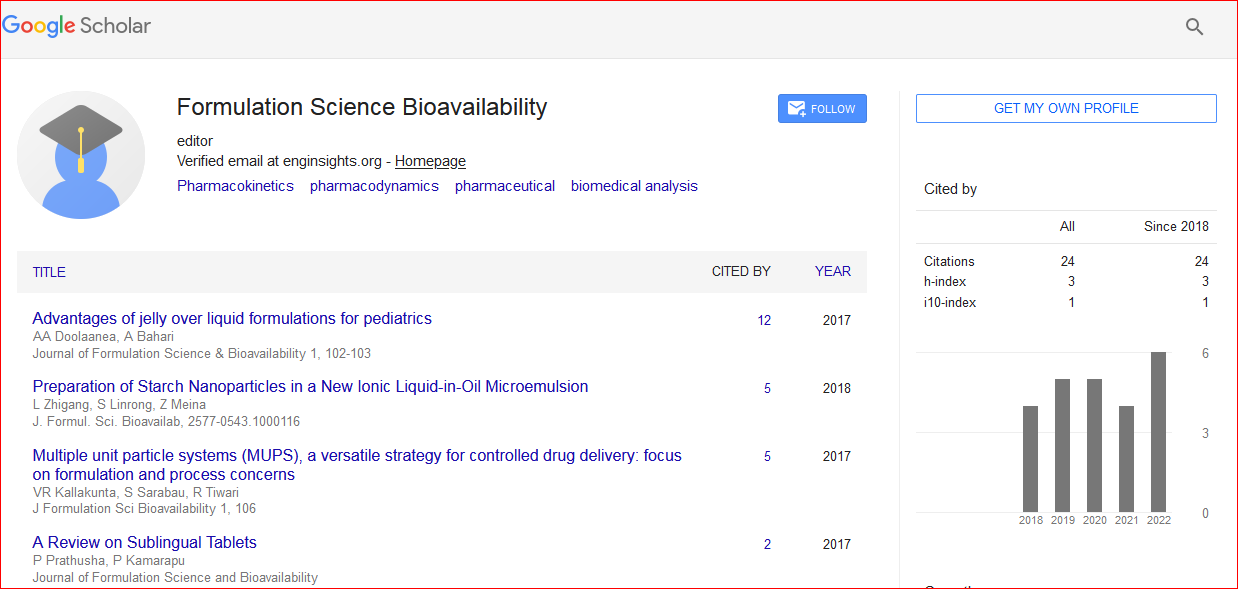
Journal of Formulation Science & Bioavailability received 23 citations as per Google Scholar report