Brief Report - (2025) Volume 9, Issue 6
Received: 03-Nov-2025, Manuscript No. jchd-26-185715;
Editor assigned: 05-Nov-2025, Pre QC No. P-185715;
Reviewed: 19-Nov-2025, QC No. Q-185715;
Revised: 24-Nov-2025, Manuscript No. R-185715;
Published:
01-Dec-2025
, DOI: 10.37421/2684-6020.2024.9.271
Citation: Dupont, Vincent. ”Advancing Coronary Heart Disease
Management: Precision Medicine.” J Coron Heart Dis 09 (2025):271.
Copyright: © 2025 Dupont V. This is an open-access article distributed under the terms of the Creative Commons Attribution License, which permits unrestricted use,
distribution and reproduction in any medium, provided the original author and source are credited.
Modern medicine has significantly advanced the fight against coronary heart disease (CHD) through innovative diagnostic tools and targeted therapeutic strategies. This includes the development of novel pharmacological agents that effectively manage risk factors like hyperlipidemia and hypertension, alongside less invasive surgical and interventional procedures such as percutaneous coronary intervention (PCI) and advanced imaging techniques for early detection and risk stratification. Research is increasingly focusing on personalized medicine approaches, leveraging genetic insights and biomarkers to tailor prevention and treatment plans, thereby improving patient outcomes and reducing disease burden. [1]
The role of lifestyle interventions in preventing and managing coronary heart disease remains paramount, even with sophisticated medical advancements. Emphasis is placed on comprehensive approaches that integrate dietary modifications, regular physical activity, smoking cessation, and stress management. Emerging evidence highlights the efficacy of digital health platforms and mHealth technologies in supporting adherence to these lifestyle changes, offering personalized feedback and remote monitoring for individuals at risk or diagnosed with CHD. [2] Precision medicine is revolutionizing coronary heart disease treatment by enabling individualized therapeutic strategies. This involves utilizing genetic profiling, advanced imaging, and biomarker analysis to identify specific disease pathways and predict treatment response. The goal is to move beyond one-size-fits-all approaches, offering tailored interventions that are more effective and have fewer side effects for patients with diverse genetic backgrounds and disease presentations. [3] The development of advanced imaging technologies has dramatically improved the diagnosis and risk assessment of coronary heart disease. Techniques such as advanced cardiac MRI, CT angiography, and novel echocardiographic methods provide detailed anatomical and functional information, allowing for earlier detection of atherosclerosis and more accurate prognostication. These tools facilitate personalized treatment decisions by identifying individuals who will benefit most from aggressive management strategies. [4] Pharmacological advancements continue to be a cornerstone in managing coronary heart disease. New drug classes targeting lipid metabolism, inflammation, and thrombosis offer enhanced efficacy and improved safety profiles. Research into novel agents, including PCSK9 inhibitors and anti-inflammatory drugs, is expanding treatment options for patients with refractory hyperlipidemia and high cardiovascular risk, contributing to a reduction in major adverse cardiovascular events. [5] Interventional cardiology has seen significant progress in treating complex coronary artery disease. Advances in stent technology, including bioresorbable scaffolds and drug-eluting stents with improved polymer coatings, have enhanced procedural success and long-term outcomes. Furthermore, the development of techniques for treating in-stent restenosis and chronic total occlusions offers new hope for patients previously considered ineligible for revascularization. [6] Understanding the genetic underpinnings of coronary heart disease is crucial for developing personalized prevention and treatment strategies. Genome-wide association studies (GWAS) and next-generation sequencing are identifying novel genetic variants associated with increased risk, susceptibility, and response to therapy. This knowledge is paving the way for pharmacogenomics-guided treatment decisions and the development of gene-targeted therapies. [7] The integration of artificial intelligence (AI) and machine learning (ML) in cardiovascular medicine is transforming the landscape of coronary heart disease management. These technologies are being employed for early risk prediction, image analysis for lesion characterization, and optimizing treatment pathways. AI-powered tools can analyze vast datasets to identify subtle patterns that may be missed by human clinicians, leading to more accurate diagnoses and personalized interventions. [8] Biomarker discovery is a critical area in the ongoing fight against coronary heart disease. Identification of novel biomarkers for early detection, risk stratification, and prediction of treatment response is revolutionizing how we approach CHD. From traditional markers like troponin and LDL cholesterol to emerging inflammatory and genetic markers, these tools are essential for tailoring preventive measures and therapeutic interventions to individual patient needs. [9] The development of advanced preventive strategies for coronary heart disease is increasingly focused on targeting modifiable risk factors with greater precision. This includes a deeper understanding of the interplay between inflammation, metabolic syndrome, and atherosclerosis. Personalized risk assessment tools, coupled with tailored lifestyle and pharmacological interventions, are crucial in reducing the incidence and progression of CHD in diverse populations. [10]Modern medicine has significantly advanced the fight against coronary heart disease (CHD) through innovative diagnostic tools and targeted therapeutic strategies. This includes the development of novel pharmacological agents that effectively manage risk factors like hyperlipidemia and hypertension, alongside less invasive surgical and interventional procedures such as percutaneous coronary intervention (PCI) and advanced imaging techniques for early detection and risk stratification. Research is increasingly focusing on personalized medicine approaches, leveraging genetic insights and biomarkers to tailor prevention and treatment plans, thereby improving patient outcomes and reducing disease burden. [1]
The role of lifestyle interventions in preventing and managing coronary heart disease remains paramount, even with sophisticated medical advancements. Emphasis is placed on comprehensive approaches that integrate dietary modifications, regular physical activity, smoking cessation, and stress management. Emerging evidence highlights the efficacy of digital health platforms and mHealth technologies in supporting adherence to these lifestyle changes, offering personalized feedback and remote monitoring for individuals at risk or diagnosed with CHD. [2] Precision medicine is revolutionizing coronary heart disease treatment by enabling individualized therapeutic strategies. This involves utilizing genetic profiling, advanced imaging, and biomarker analysis to identify specific disease pathways and predict treatment response. The goal is to move beyond one-size-fits-all approaches, offering tailored interventions that are more effective and have fewer side effects for patients with diverse genetic backgrounds and disease presentations. [3] The development of advanced imaging technologies has dramatically improved the diagnosis and risk assessment of coronary heart disease. Techniques such as advanced cardiac MRI, CT angiography, and novel echocardiographic methods provide detailed anatomical and functional information, allowing for earlier detection of atherosclerosis and more accurate prognostication. These tools facilitate personalized treatment decisions by identifying individuals who will benefit most from aggressive management strategies. [4] Pharmacological advancements continue to be a cornerstone in managing coronary heart disease. New drug classes targeting lipid metabolism, inflammation, and thrombosis offer enhanced efficacy and improved safety profiles. Research into novel agents, including PCSK9 inhibitors and anti-inflammatory drugs, is expanding treatment options for patients with refractory hyperlipidemia and high cardiovascular risk, contributing to a reduction in major adverse cardiovascular events. [5] Interventional cardiology has seen significant progress in treating complex coronary artery disease. Advances in stent technology, including bioresorbable scaffolds and drug-eluting stents with improved polymer coatings, have enhanced procedural success and long-term outcomes. Furthermore, the development of techniques for treating in-stent restenosis and chronic total occlusions offers new hope for patients previously considered ineligible for revascularization. [6] Understanding the genetic underpinnings of coronary heart disease is crucial for developing personalized prevention and treatment strategies. Genome-wide association studies (GWAS) and next-generation sequencing are identifying novel genetic variants associated with increased risk, susceptibility, and response to therapy. This knowledge is paving the way for pharmacogenomics-guided treatment decisions and the development of gene-targeted therapies. [7] The integration of artificial intelligence (AI) and machine learning (ML) in cardiovascular medicine is transforming the landscape of coronary heart disease management. These technologies are being employed for early risk prediction, image analysis for lesion characterization, and optimizing treatment pathways. AI-powered tools can analyze vast datasets to identify subtle patterns that may be missed by human clinicians, leading to more accurate diagnoses and personalized interventions. [8] Biomarker discovery is a critical area in the ongoing fight against coronary heart disease. Identification of novel biomarkers for early detection, risk stratification, and prediction of treatment response is revolutionizing how we approach CHD. From traditional markers like troponin and LDL cholesterol to emerging inflammatory and genetic markers, these tools are essential for tailoring preventive measures and therapeutic interventions to individual patient needs. [9] The development of advanced preventive strategies for coronary heart disease is increasingly focused on targeting modifiable risk factors with greater precision. This includes a deeper understanding of the interplay between inflammation, metabolic syndrome, and atherosclerosis. Personalized risk assessment tools, coupled with tailored lifestyle and pharmacological interventions, are crucial in reducing the incidence and progression of CHD in diverse populations. [10]Coronary heart disease (CHD) management has seen significant advancements, encompassing novel pharmacological agents and less invasive interventional procedures. Personalized medicine, driven by genetic insights and biomarkers, is increasingly utilized for tailored prevention and treatment. Lifestyle interventions remain crucial, with digital health platforms enhancing adherence. Advanced imaging techniques improve diagnosis and risk assessment, while interventional cardiology progresses with improved stent technology and techniques for complex cases. Artificial intelligence and machine learning are transforming risk prediction and treatment optimization. Biomarker discovery aids in early detection and personalized care, alongside proactive strategies targeting modifiable risk factors with greater precision. These integrated approaches aim to improve patient outcomes and reduce disease burden.
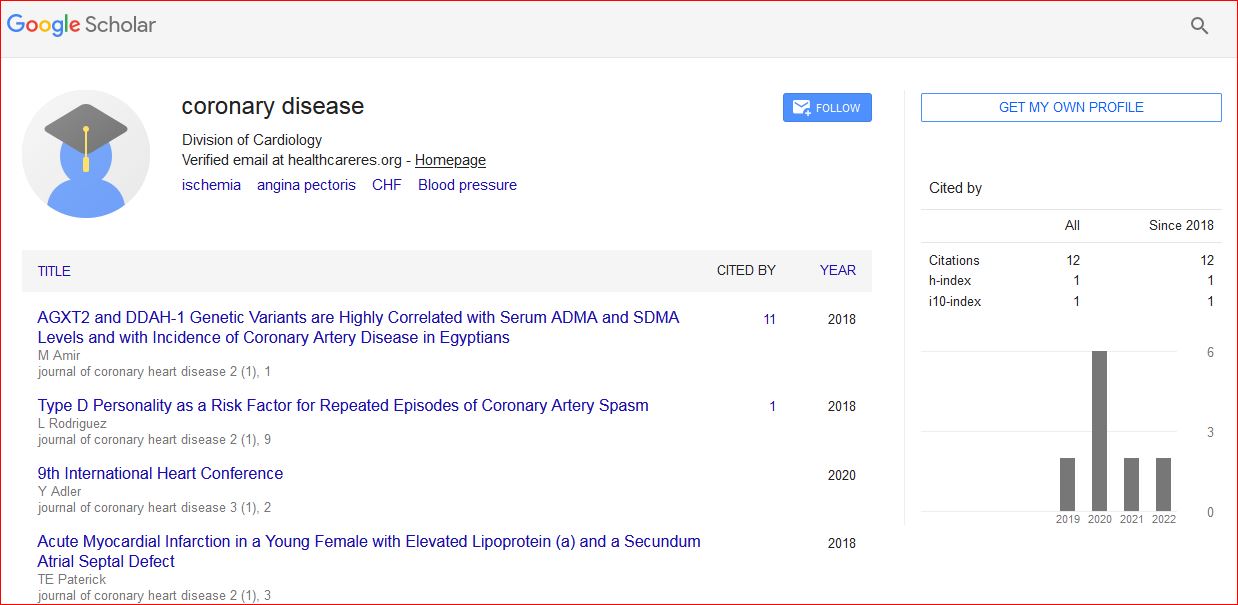
Journal of Coronary Heart Diseases received 15 citations as per Google Scholar report