Commentary - (2025) Volume 9, Issue 3
Received: 01-May-2025, Manuscript No. jchd-26-185687;
Editor assigned: 04-May-2025, Pre QC No. P-185687;
Reviewed: 18-May-2025, QC No. Q-185687;
Revised: 22-May-2025, Manuscript No. R-185687;
Published:
29-May-2025
, DOI: 10.37421/2684-6020.2024.9.243
Citation: Muller, Sofia. ”Advancing Coronary Heart Disease Management:
Innovations and Outcomes.” J Coron Heart Dis 09 (2026):243.
Copyright: © 2026 Müller S. This is an open-access article distributed under the terms of the Creative Commons Attribution License, which permits unrestricted use, distribution
and reproduction in any medium, provided the original author and source are credited.
The management of coronary heart disease (CHD) is undergoing a profound transformation driven by rapid technological and therapeutic advancements. Innovations in early detection methods are enabling a more proactive approach to identifying individuals at risk and managing existing conditions with greater precision. These developments are crucial for improving patient prognoses and reducing the significant burden of CHD on global health systems [1].
Interventional cardiology has witnessed a substantial evolution, particularly in the realm of minimally invasive procedures designed to treat complex coronary artery disease. Advances in stent technology, alongside sophisticated imaging guidance and physiological assessment tools, have made interventions safer and more effective, offering renewed hope for patients facing challenging diagnoses [2].
The burgeoning field of digital health and artificial intelligence (AI) is also making significant inroads into cardiovascular medicine. AI algorithms are demonstrating considerable promise in enhancing risk prediction, refining the interpretation of diagnostic imaging, and facilitating the development of personalized treatment strategies for CHD, thereby addressing long-standing challenges in patient care [3].
Furthermore, a deeper understanding of the genetic underpinnings of CHD is emerging through comprehensive genetic and multi-omics approaches. By analyzing genomics, transcriptomics, and proteomics, researchers are identifying novel therapeutic targets and paving the way for truly personalized medicine strategies aimed at combating the disease at its molecular roots [4].
Complementing these genetic insights are significant strides in advanced imaging techniques. Non-invasive modalities such as CT angiography and cardiac MRI are providing earlier and more accurate diagnoses of coronary artery disease, which is instrumental in guiding treatment decisions and improving patient outcomes by overcoming diagnostic limitations [5].
On the pharmacological front, novel agents are being developed to target specific pathways involved in the pathogenesis of atherosclerosis and thrombosis. The emergence of new drug classes and the repurposing of existing medications offer improved efficacy and safety profiles, equipping clinicians with enhanced tools to manage CHD more effectively [6].
Another area of active research and development is regenerative medicine, particularly the application of stem cell therapies to repair myocardial damage following ischemic events. The latest preclinical and clinical findings in this domain hold considerable promise for restoring heart tissue function and improving the quality of life for patients with CHD [7].
The integration of wearable devices and remote monitoring technologies is revolutionizing the continuous care of cardiovascular patients. These innovations facilitate proactive disease management, enable the early detection of potential complications, and foster greater patient engagement in their own healthcare journey [8].
Crucially, the importance of patient stratification and personalized risk assessment cannot be overstated in the effective management of CHD. Advanced statistical models and novel biomarkers are proving invaluable in identifying individuals at higher risk, allowing for tailored interventions and more effective strategies to improve outcomes [9].
Finally, the synergistic integration of computational modeling and big data analytics is providing powerful new tools for understanding and treating CHD. These in silico approaches, when combined with extensive patient datasets, have the potential to accelerate drug discovery, optimize treatment protocols, and advance the field of precision cardiology significantly [10].
The landscape of coronary heart disease (CHD) management is being reshaped by a wave of technological and therapeutic innovations that are fundamentally altering how the disease is detected, treated, and monitored. These advancements are collectively contributing to improved patient outcomes and a better quality of life for those affected by this pervasive condition [1].
In the field of interventional cardiology, the focus remains on refining minimally invasive techniques to address increasingly complex coronary artery disease. The continuous improvement of stent designs, the integration of advanced intravascular imaging, and the precise application of physiological assessment tools are key to the ongoing success of percutaneous coronary interventions in improving patient prognoses [2].
The integration of artificial intelligence (AI) and digital health solutions into cardiovascular medicine represents a paradigm shift. AI's capacity for complex data analysis is being harnessed for predictive modeling, diagnostic support through image interpretation, and the tailoring of therapeutic regimens, offering new avenues to overcome traditional diagnostic and treatment barriers in CHD [3].
Our comprehension of CHD susceptibility and progression is being dramatically enhanced by multi-omics approaches. By examining the intricate interplay of genetic, transcriptomic, and proteomic data, researchers are uncovering novel biological pathways and identifying potential targets for precision therapies that can be specifically designed to combat the disease at its source [4].
Simultaneously, the development of advanced non-invasive imaging technologies is revolutionizing the diagnostic process for coronary artery disease. Modalities like CT angiography and cardiac MRI provide detailed anatomical and functional information, enabling earlier and more accurate diagnoses, which are critical for guiding timely and appropriate treatment decisions [5].
In the realm of pharmacotherapy, there is a significant emphasis on developing novel agents and exploring novel applications for existing drugs. These emerging pharmacological therapies are designed to more effectively modulate key pathways involved in atherosclerosis and thrombosis, offering improved clinical benefits and enhanced safety profiles for patients with CHD [6].
Regenerative medicine, particularly the use of stem cell-based therapies, is emerging as a promising frontier for repairing myocardial tissue damaged by ischemic events. Ongoing research is focused on elucidating the mechanisms of action and optimizing the clinical application of these regenerative approaches to restore cardiac function in patients suffering from the consequences of CHD [7].
The proliferation of wearable devices and remote monitoring systems is fundamentally changing the delivery of cardiovascular care. These technologies provide continuous physiological data, enabling proactive management of chronic conditions like CHD, facilitating early intervention for potential complications, and empowering patients through increased awareness and engagement [8].
The critical need for personalized patient management is being addressed through sophisticated risk stratification techniques. The application of advanced statistical modeling and the identification of novel biomarkers are essential for accurately assessing individual risk profiles and tailoring interventions, thereby optimizing treatment strategies and improving the likelihood of favorable outcomes for CHD patients [9].
Lastly, the convergence of computational modeling and big data analytics presents a powerful toolkit for dissecting the complexities of CHD. These in silico methods, when applied to large-scale patient data, are accelerating the discovery of new therapeutic targets, refining treatment algorithms, and pushing the boundaries of personalized cardiovascular medicine [10].
This collection of articles highlights significant advancements in the management of coronary heart disease (CHD). Innovations span early detection, personalized treatment strategies, and novel interventional techniques, all aimed at improving patient outcomes. The review covers minimally invasive procedures in interventional cardiology, the impact of artificial intelligence and digital health on risk prediction and personalized care, and insights gained from genetic and multi-omics research. Furthermore, progress in advanced non-invasive imaging, emerging pharmacological therapies, regenerative medicine, wearable devices for remote monitoring, personalized risk stratification, and the application of big data and computational modeling are discussed. These diverse areas collectively contribute to a more proactive, precise, and effective approach to combating CHD, offering new avenues to overcome traditional challenges and enhance patient prognoses.
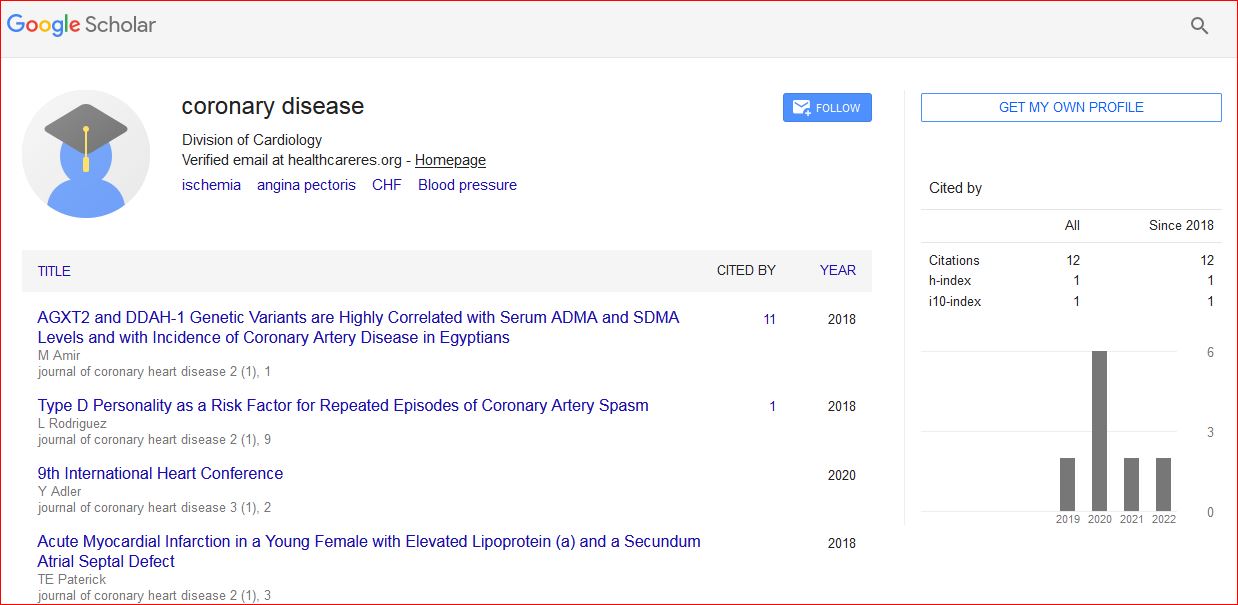
Journal of Coronary Heart Diseases received 15 citations as per Google Scholar report