Opinion - (2025) Volume 13, Issue 2
Received: 01-Apr-2025, Manuscript No. jcdd-25-175434;
Editor assigned: 03-Apr-2025, Pre QC No. P-175434;
Reviewed: 17-Apr-2025, QC No. Q-175434;
Revised: 22-Apr-2025, Manuscript No. R-175434;
Published:
29-Apr-2025
, DOI: 10.37421/2329-9517.2025.13.659
Citation: Aisha Al Mansoori. ”Advancing Arrhythmia Care: Detection
and Management.” J Cardiovasc Dis Diagn 13 (2025):659.
Copyright: © 2025 M. Al Aisha This is an open-access article distributed under the terms of the Creative Commons Attribution License, which permits unrestricted use,
distribution and reproduction in any medium, provided the original author and source are credited.
Cardiac arrhythmias, defined as irregular heart rhythms, represent a significant challenge in cardiovascular medicine, impacting patient quality of life and often posing life-threatening risks. Recent advances across various domains are transforming how these conditions are understood, diagnosed, and managed. Technology, in particular, is playing a pivotal role. Wearable devices, for instance, are fundamentally changing arrhythmia detection and management. These innovations incorporate advanced sensors and Artificial Intelligence (AI) algorithms, enabling earlier identification of irregular heart rhythms. What this really means is monitoring becomes more accessible and less invasive, moving cardiology towards a more personalized patient care model. [1] Digital health solutions broadly enhance the management of cardiovascular diseases, and arrhythmias are no exception. These tools, ranging from remote monitoring to AI-driven risk assessment, provide novel avenues to engage patients, track their conditions, and deliver timely interventions. The core benefit here is empowering both patients and clinicians with more immediate and insightful data. [10] Beyond technology, deeper clinical understandings are refining diagnostic and treatment pathways. Cardiac amyloidosis, for example, frequently manifests with diverse arrhythmias, encompassing both bradycardias and rapid, potentially fatal tachycardias. Early and accurate diagnosis of this underlying condition is critical, as these rhythm disturbances often serve as the initial diagnostic clue. A clearer grasp of specific arrhythmia types associated with amyloidosis facilitates improved patient management and prompts earlier consideration of the disease. [2] The devastating reality of sudden cardiac death (SCD) underscores the importance of understanding its root causes for effective prevention strategies. A significant number of individuals who experience SCD have an underlying heart condition, which is often undiagnosed or subclinical. Both genetic factors and environmental triggers contribute substantially, highlighting the urgent need for enhanced screening and robust risk stratification. [4] Ventricular arrhythmias and SCD are subjects of continuous research, with new insights constantly pushing the boundaries of risk assessment. The approach is evolving beyond simple ejection fraction measurements to include factors like myocardial scarring, genetic predispositions, and intricate electrophysiological characteristics. This comprehensive, holistic perspective allows for more precise identification of high-risk individuals, enabling intervention before a catastrophic event occurs. [5] Genetic contributions to arrhythmia syndromes are profound and increasingly recognized. For inherited conditions such as Long QT syndrome or Brugada syndrome, identifying specific gene mutations is instrumental not only for diagnosis but also for guiding patient management and screening at-risk family members. This really means genetic testing is emerging as an increasingly powerful and indispensable tool in contemporary cardiology. [7] Treatment modalities are also seeing significant innovation. Mapping the heart's electrical activity is fundamental for effectively treating complex arrhythmias, especially atrial fibrillation. High-density mapping systems offer incredibly detailed insights into the origin and propagation of erratic electrical signals. This enhanced precision directly leads to better ablation outcomes, allowing electrophysiologists to target problematic areas with greater effectiveness. [6] Catheter ablation techniques for atrial fibrillation are continuously evolving, with ongoing advancements in technologies and methods consistently improving patient outcomes. The field is observing more personalized approaches, seamless integration of advanced imaging, and refined energy delivery systems. The overarching goal remains to maximize success rates while concurrently minimizing complications, a critical consideration as this procedure becomes more widespread. [9] Pharmacological interventions also remain a cornerstone of arrhythmia management. A deep understanding of how various drugs interact with cardiac ion channels is foundational for developing safer and more effective antiarrhythmic therapies. Research in this area explores the intricate pharmacology of these channels, detailing how different medications modulate heart rhythm. Getting this right is crucial for minimizing adverse effects and tailoring treatments to the specific type of arrhythmia. [8] Finally, for patients facing the dual challenge of atrial fibrillation and chronic kidney disease, selecting the appropriate anticoagulant requires a delicate balance. While Newer Oral Anticoagulants (NOACs) are often favored over traditional warfarin, kidney function remains a paramount consideration for accurate dosing and monitoring. What this boils down to is that individualized treatment plans are essential to both prevent strokes and mitigate bleeding risks within this particularly vulnerable patient population. [3]
Arrhythmias, characterized by irregular heart rhythms, represent a significant and diverse area within cardiology, with ongoing advancements aimed at improving detection, diagnosis, and management. One major area of innovation lies in technological integration. Wearable technologies are fundamentally reshaping how arrhythmias are detected and managed, providing more accessible and less invasive monitoring options. These devices incorporate advanced sensors and Artificial Intelligence (AI) algorithms, which are increasingly capable of identifying irregular heart rhythms at an earlier stage. This is particularly beneficial for patients at risk for conditions such as atrial fibrillation, paving the way for more personalized care approaches [1]. Complementing this, broader digital health solutions are stepping up to manage cardiovascular diseases, including arrhythmias. These tools encompass remote monitoring and AI-driven risk assessment, offering new avenues for patient engagement, condition tracking, and timely intervention. The goal is to empower both patients and clinicians with better, more immediate data for informed decision-making [10].
Understanding the underlying causes of arrhythmias is crucial for effective treatment. Cardiac amyloidosis, for instance, frequently manifests with a spectrum of arrhythmias, from slow to rapid and life-threatening heart rates. These rhythm disturbances can be the initial clue to diagnosis, making it vital to recognize the specific types of arrhythmias seen in amyloidosis to manage patients better and consider the underlying condition sooner [2]. Similarly, genetics play a profound role in numerous arrhythmia syndromes. For inherited conditions like Long QT syndrome or Brugada syndrome, identifying specific gene mutations guides diagnosis, patient management, and even family screening. This highlights genetic testing as an increasingly powerful tool in cardiology [7].
Sudden cardiac death (SCD) remains a devastating outcome, making the identification of its underlying causes paramount for prevention. Many individuals experiencing SCD have an underlying heart condition, often undiagnosed or subclinical. Genetic factors, alongside environmental triggers, contribute significantly to SCD risk, emphasizing the need for improved screening and risk stratification [4]. Contemporary research provides newer insights into ventricular arrhythmias and SCD, moving beyond simple ejection fraction to consider factors such as myocardial scarring, genetic predispositions, and detailed electrophysiological characteristics. This holistic view enhances the accurate identification of high-risk individuals, enabling proactive intervention [5].
Treatment strategies for arrhythmias are also advancing rapidly. Mapping the heart's electrical activity is key for treating complex arrhythmias, particularly atrial fibrillation. High-density mapping systems provide incredibly detailed insights into the propagation of erratic electrical signals. This precision translates directly into improved ablation outcomes, allowing electrophysiologists to target problematic areas with greater effectiveness [6]. Furthermore, catheter ablation for atrial fibrillation continues to evolve with new techniques and technologies constantly enhancing outcomes. Personalized approaches, improved imaging integration, and refined energy delivery methods aim to maximize success rates while minimizing complications, which is especially important as this procedure becomes more common [9].
Pharmacology remains a critical component in managing arrhythmias. A deep understanding of how antiarrhythmic drugs interact with ion channels in the heart is fundamental for developing safer and more effective therapies. This knowledge helps tailor treatments to specific arrhythmia types and minimizes adverse effects [8]. Finally, managing atrial fibrillation in patients with chronic kidney disease requires a delicate balance when choosing anticoagulants. Newer Oral Anticoagulants (NOACs) are often preferred over warfarin, but kidney function critically influences dosing and monitoring. Individualized treatment is essential to prevent strokes and minimize bleeding risks in this vulnerable patient group [3].
Recent advancements are significantly improving the detection, diagnosis, and management of cardiac arrhythmias. Wearable technologies and digital health solutions, leveraging advanced sensors and Artificial Intelligence, offer more accessible, less invasive, and personalized monitoring, enhancing early detection and patient engagement [1, 10]. Deeper clinical understanding is also crucial; for example, recognizing specific arrhythmias in cardiac amyloidosis can be the first diagnostic clue for this serious underlying condition [2]. Similarly, the role of genetics is expanding, with gene mutation identification guiding diagnosis and management for inherited arrhythmia syndromes like Long QT and Brugada syndromes [7]. Efforts to prevent sudden cardiac death are focusing on better screening and risk stratification, acknowledging that many cases stem from undiagnosed heart conditions, influenced by both genetic and environmental factors [4]. Risk assessment for ventricular arrhythmias and sudden cardiac death is moving towards a holistic view, incorporating myocardial scarring and detailed electrophysiological characteristics beyond simple ejection fraction to identify high-risk individuals more accurately [5]. Treatment modalities are also evolving. High-density mapping systems provide precise electrical activity insights, leading to better ablation outcomes for complex arrhythmias like atrial fibrillation [6]. Catheter ablation techniques for atrial fibrillation are becoming more personalized and effective, improving success rates and reducing complications [9]. Pharmacological research into cardiac ion channels continues to refine antiarrhythmic drug therapies, ensuring safer and more tailored treatments [8]. Lastly, managing atrial fibrillation in patients with chronic kidney disease requires careful, individualized anticoagulant therapy to balance stroke prevention and bleeding risks, often favoring Newer Oral Anticoagulants over warfarin with close attention to kidney function [3].
Indexed at, Google Scholar, Crossref
Indexed at, Google Scholar, Crossref
Indexed at, Google Scholar, Crossref
Indexed at, Google Scholar, Crossref
Indexed at, Google Scholar, Crossref
Indexed at, Google Scholar, Crossref
Indexed at, Google Scholar, Crossref
Indexed at, Google Scholar, Crossref
Indexed at, Google Scholar, Crossref
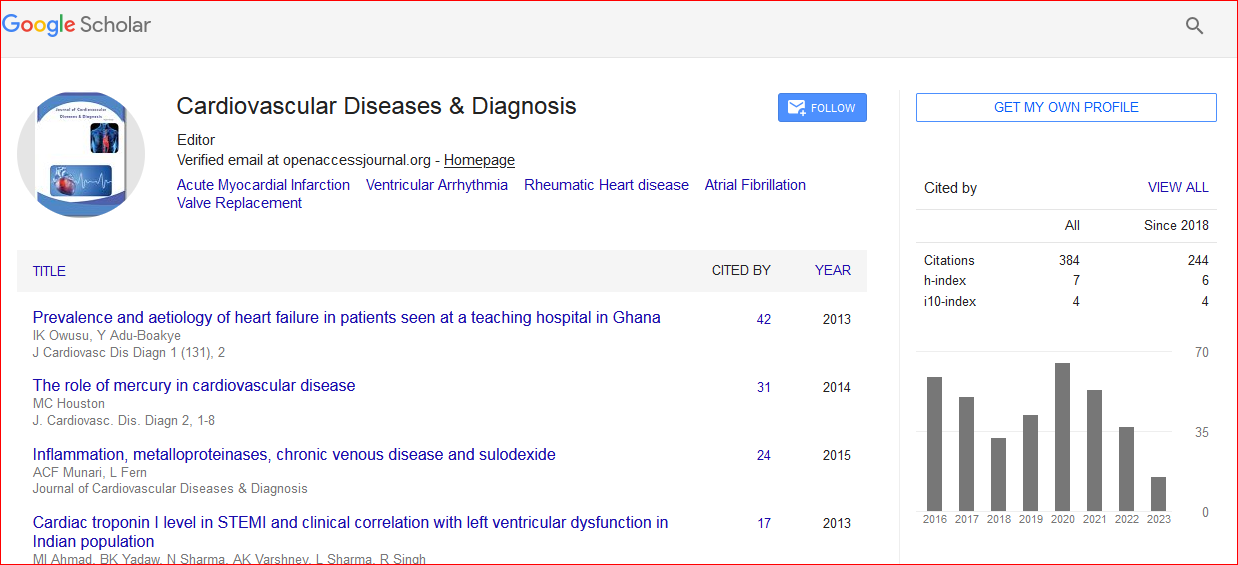
Cardiovascular Diseases & Diagnosis received 427 citations as per Google Scholar report