Short Communication - (2025) Volume 14, Issue 5
Received: 01-Oct-2025, Manuscript No. idse-26-183628;
Editor assigned: 03-Oct-2025, Pre QC No. P-183628;
Reviewed: 17-Oct-2025, QC No. Q-183628;
Revised: 22-Oct-2025, Manuscript No. R-183628;
Published:
29-Oct-2025
, DOI: 10.37421/2168-9768.2025.14.515
Citation: Petrov, Nikolai. ”Advancing Agricultural Water Management:
Irrigation, Drainage, and Technology.” Irrigat Drainage Sys Eng 14
(2025):515.
Copyright: © 2025 Petrov N. This is an open-access article distributed under the terms of the Creative Commons Attribution License, which permits unrestricted use, distribution
and reproduction in any medium, provided the original author and source are credited.
The advancement of agricultural practices hinges on the efficient and sustainable management of water resources. Modern irrigation systems, a cornerstone of global food production, are increasingly being optimized through technological innovation to meet the demands of a growing population and the challenges posed by climate change [1].
Effective water management in agriculture is intrinsically linked to sophisticated drainage strategies. Ensuring proper soil moisture regulation and preventing waterlogging are critical for crop health and yield, particularly in regions prone to excessive rainfall or specific soil conditions [2].
Technological integration has revolutionized irrigation control. Smart irrigation controllers, leveraging real-time data and predictive analytics, offer a path towards optimizing water application, thereby conserving water and maintaining ideal soil conditions for plant growth [3].
The physical infrastructure of drainage systems plays a pivotal role. A comparative understanding of various surface and subsurface drainage designs, considering their performance under diverse environmental factors like soil type and rainfall intensity, is essential for effective water management [4].
Beyond water application and drainage, the operational efficiency of agricultural systems is crucial. The energy consumption and associated costs of pumping systems used in irrigation and drainage are significant, prompting research into more efficient technologies like variable frequency drives [5].
Precision irrigation techniques, such as drip irrigation and micro-sprinklers, represent a significant leap forward in water use efficiency. Their application, especially for high-value crops, demonstrably reduces water consumption while potentially improving crop quality and yield [6].
For large-scale agricultural operations, the monitoring and management of extensive irrigation and drainage networks require advanced tools. The integration of remote sensing and Geographic Information Systems (GIS) provides powerful capabilities for assessing water distribution and identifying areas for improvement [7].
The overarching influence of climate change necessitates a forward-looking approach to agricultural infrastructure. Understanding its impact on drainage system design and performance is vital for developing resilient systems capable of handling future hydrological conditions [8].
Furthermore, addressing water quality issues stemming from agricultural drainage is paramount for environmental sustainability. Constructed wetlands have emerged as a promising solution for treating agricultural runoff, removing pollutants, and improving water quality before discharge or reuse [9].
Finally, the successful implementation of advanced agricultural technologies, particularly irrigation systems, depends not only on their technical efficacy but also on their economic viability and social acceptance within farming communities, especially among smallholder farmers [10].
Optimizing irrigation system performance is a key area of agricultural research, focusing on the integration of advanced sensor networks and machine learning algorithms. This approach aims to significantly reduce water wastage and concurrently enhance crop yields by enabling real-time data analysis for dynamic water management, leading to more efficient resource allocation and improved agricultural sustainability [1].
The impact of different drainage designs on soil moisture regulation and crop waterlogging prevention is a critical concern, especially in semi-arid regions. A comparative analysis of conventional and novel drainage techniques highlights their effectiveness in managing excess water and improving soil aeration, demonstrating that tailored drainage solutions can substantially mitigate crop losses caused by waterlogged conditions [2].
A smart irrigation controller integrated with weather forecasting data offers a proactive approach to water management. This technology optimizes water application by utilizing predictive irrigation scheduling, which has been shown to lead to substantial water savings and maintain optimal soil water content for crop growth, emphasizing the benefits of adaptive strategies that respond to both current and anticipated weather patterns [3].
The efficiency of various surface and subsurface drainage systems is being rigorously examined under a range of soil types and rainfall intensities. This research provides a quantitative assessment of water removal rates and their consequential impact on groundwater levels and soil salinity, offering practical guidance for selecting appropriate drainage technologies based on specific site conditions [4].
Investigating the energy efficiency and operational costs of modern pump systems employed in irrigation and drainage applications is essential for sustainable agricultural practices. The performance of variable frequency drives (VFDs) in reducing energy consumption while maintaining required flow rates is a key focus, underscoring the economic advantages of adopting energy-efficient pumping technologies [5].
The effectiveness of precision irrigation techniques, such as drip irrigation and micro-sprinklers, in improving water use efficiency for high-value crops is being thoroughly evaluated. Studies quantify the reduction in water consumption and assess the impact on crop quality and yield when compared to traditional methods, advocating for the widespread adoption of these techniques for sustainable agriculture [6].
The integration of remote sensing and GIS technologies is proving invaluable for the monitoring and management of large-scale irrigation and drainage networks. By utilizing satellite imagery and spatial analysis, it becomes possible to assess water distribution, identify inefficiencies, and support evidence-based decision-making for system maintenance and upgrades, enhancing operational oversight [7].
In the context of a changing climate, understanding the impact of projected scenarios on the design and performance of drainage systems is crucial. Modeling future rainfall patterns and their implications for both urban and agricultural drainage infrastructure highlights the critical need for resilient system designs and adaptive solutions [8].
The role of constructed wetlands in treating agricultural drainage water is being investigated for their hydrological performance and pollutant removal efficiency. These systems are assessed for their ability to improve water quality before discharge or reuse, positioning them as sustainable and cost-effective options for agricultural drainage water management [9].
Finally, the economic viability and social acceptance of implementing advanced irrigation technologies in smallholder farming systems are being thoroughly analyzed. This research examines the return on investment, labor requirements, and farmer perceptions, providing essential insights to facilitate the adoption of sustainable irrigation practices among small-scale farmers [10].
This collection of research explores advancements in agricultural water management, focusing on irrigation and drainage systems. Key themes include the optimization of irrigation through sensor networks, machine learning, and smart controllers that leverage real-time data and weather forecasts to enhance water use efficiency and crop yields. The studies also delve into the comparative performance of various drainage designs, the impact of climate change on drainage infrastructure, and the role of precision irrigation techniques. Furthermore, the economic and social aspects of adopting new technologies in smallholder farming are examined, alongside the development of sustainable solutions like constructed wetlands for treating agricultural runoff. The research highlights the importance of integrated approaches, leveraging technologies like remote sensing and GIS for large-scale network management and emphasizes energy efficiency in pumping systems.
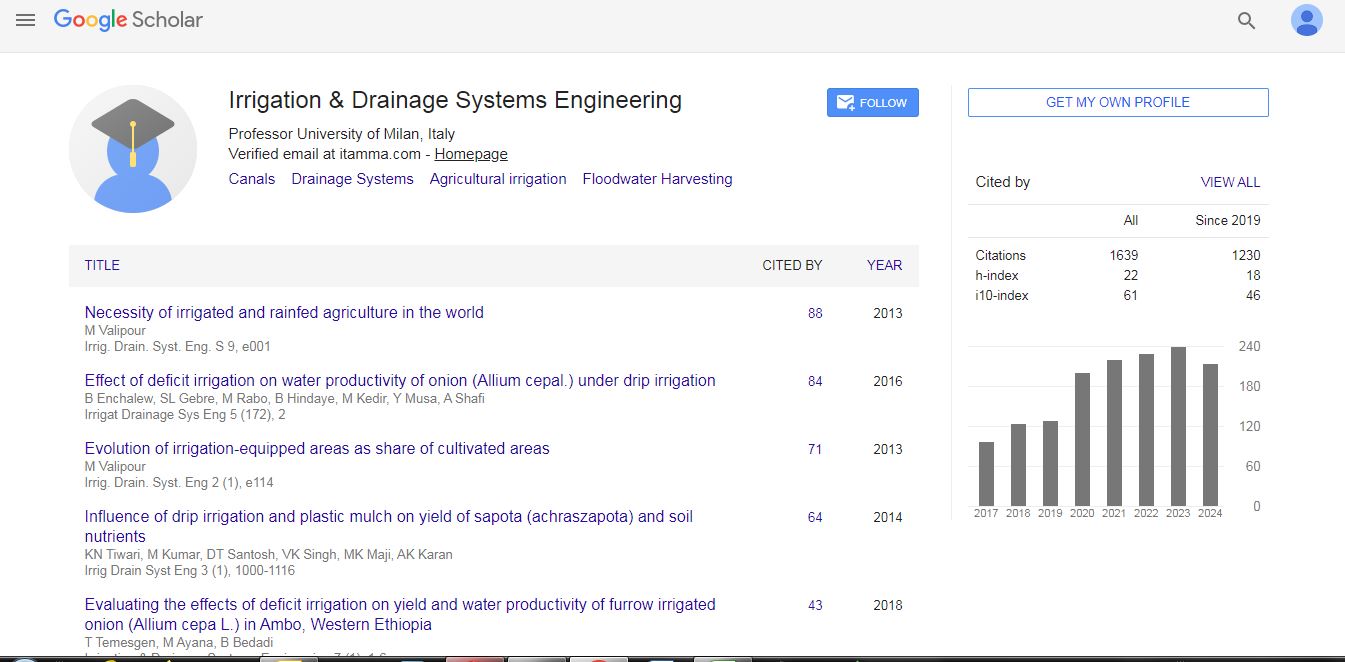
Irrigation & Drainage Systems Engineering received 835 citations as per Google Scholar report