Perspective - (2025) Volume 14, Issue 4
Received: 01-Aug-2025, Manuscript No. idse-26-182837;
Editor assigned: 04-Aug-2025, Pre QC No. P-182837;
Reviewed: 18-Aug-2025, QC No. Q-182837;
Revised: 22-Aug-2025, Manuscript No. R-182837;
Published:
29-Aug-2025
, DOI: 10.37421/2168-9768.2025.14.503
Citation: Benali, Hassan. ”Advancing Agricultural Water Management
For Sustainability.” Irrigat Drainage Sys Eng 14 (2025):503.
Copyright: © 2025 Benali H. This is an open-access article distributed under the terms of the Creative Commons Attribution License, which permits unrestricted use, distribution
and reproduction in any medium, provided the original author and source are credited.
The field of agricultural water management is undergoing a significant transformation, driven by the urgent need for enhanced efficiency and sustainability in the face of growing global demands and environmental challenges. Advances in irrigation and drainage systems are at the forefront of this evolution, with a particular emphasis on optimizing water use in agricultural contexts. These developments aim to strike a balance between maximizing crop yields and conserving precious water resources, a critical objective for food security and environmental stewardship [1].
The integration of technology into agricultural practices is revolutionizing how water is applied and managed. Precision irrigation, enabled by sophisticated sensor networks and data analytics, allows for the precise delivery of water directly to where and when crops need it most. This not only boosts productivity but also significantly reduces water wastage, a key concern in many regions grappling with water scarcity. The ongoing research in this area seeks to refine these technologies further, making them more accessible and effective for a wider range of agricultural operations [2].
Effective drainage is as crucial as efficient irrigation for agricultural productivity, particularly in areas susceptible to waterlogging. Waterlogged soils can severely impede plant growth, lead to nutrient loss, and create anaerobic conditions detrimental to soil health. Therefore, the development and implementation of advanced drainage systems are vital for reclaiming and maintaining arable land, ensuring that agricultural potential is not hindered by excessive soil moisture [3].
The escalating impacts of climate change present a formidable challenge to water resource management in agriculture. Altered precipitation patterns, increased frequency of droughts, and rising temperatures are all contributing to a greater variability in water availability and an increased demand for irrigation. Adapting to these changes requires innovative strategies and a proactive approach to water resource planning and utilization [4].
Remote sensing and Geographic Information Systems (GIS) are emerging as powerful tools for improving irrigation scheduling and monitoring crop water status. By providing detailed spatial and temporal data on soil moisture, crop health, and weather patterns, these technologies enable farmers to make more informed decisions about water application. This leads to more precise irrigation practices, ultimately enhancing water use efficiency and improving crop yield predictions [5].
Micro-irrigation systems, such as drip and sprinkler irrigation, have gained prominence for their ability to deliver water directly to the root zone of plants, minimizing evaporation and runoff losses. The design and performance optimization of these systems are critical for achieving enhanced water use efficiency. Research continues to explore best management practices to ensure uniform water distribution and reduce water wastage, thereby improving the economic viability of these systems [6].
A comprehensive review of advanced drainage techniques underscores their indispensable role in modern agriculture. These techniques, ranging from surface and subsurface drainage to more innovative bio-drainage methods, are essential for improving soil health, preventing waterlogging, and ultimately boosting crop productivity across diverse agro-ecological zones [7].
In parallel with technological advancements, there is a growing interest in sustainable construction practices for agricultural infrastructure. The use of recycled materials in the development of irrigation and drainage systems offers a promising avenue for reducing costs and environmental impact. Investigating the feasibility and effectiveness of incorporating waste materials into these projects is crucial for promoting sustainability in water management [8].
The concept of the water footprint is gaining traction as a metric for understanding the total water consumption associated with agricultural production. Assessing the water footprint of different irrigation systems and developing strategies to reduce it are vital steps towards achieving more water-efficient agriculture. This involves considering both direct and indirect water uses throughout the agricultural value chain [9].
Finally, the socio-economic implications of adopting modern irrigation and drainage technologies cannot be overlooked, particularly in smallholder farming systems. Understanding how these innovations affect farm productivity, income, and overall well-being is essential for promoting equitable development and ensuring that the benefits of technological advancement are broadly shared. Identifying and addressing barriers to adoption is key to their widespread success [10].
The ongoing advancements in irrigation and drainage systems are fundamentally reshaping agricultural practices, with a primary focus on efficient water management. These innovations are critical for optimizing crop yields while simultaneously conserving vital water resources, a pressing concern in an era of increasing global food demand and environmental variability. The integration of advanced technologies, such as those employed in precision irrigation, allows for a targeted and timely application of water, thereby minimizing wastage and enhancing agricultural productivity [1].
Technological integration is a defining characteristic of modern irrigation systems. The advent of Internet of Things (IoT) sensors has paved the way for smart irrigation solutions, enabling real-time monitoring of soil moisture and environmental conditions. This capability facilitates informed decision-making regarding water application, leading to substantial water savings and demonstrably improved crop health. The analysis of economic and environmental benefits further underscores the value of adopting these cutting-edge technologies [2].
For agricultural lands prone to waterlogging, the performance of subsurface drainage systems is a subject of considerable research. Studies evaluating various drainage system designs under diverse soil and climatic conditions provide crucial insights into the parameters that optimize drainage efficiency. These efforts aim to mitigate the detrimental effects of waterlogging and salinity, offering a comparative perspective on both traditional and modern drainage techniques [3].
Climate change poses a significant threat to agricultural water resources, influencing irrigation water demand and availability. Research into adaptive strategies is therefore paramount. Analyzing future scenarios for water resources and proposing integrated water management approaches are essential for ensuring sustainable irrigation, particularly in arid and semi-arid regions that are highly vulnerable to climate variability and scarcity [4].
Remote sensing and GIS technologies offer sophisticated solutions for optimizing irrigation scheduling and monitoring the water status of crops. These powerful tools provide precise spatial and temporal data that are instrumental in supporting efficient irrigation practices. By improving water use efficiency and aiding in yield prediction, these technologies are transforming agricultural water management [5].
The design and performance of micro-irrigation systems, including drip and sprinkler technologies, are crucial for maximizing water use efficiency. Research in this area focuses on identifying factors that influence water application uniformity and overall efficiency. Developing and promoting best management practices are key to minimizing water losses and ensuring that water is delivered effectively to crops, while also considering the economic feasibility of these systems [6].
Advanced drainage techniques are being thoroughly reviewed for their effectiveness in improving agricultural lands. These techniques, encompassing surface, subsurface, and bio-drainage methods, play a vital role in enhancing soil health and boosting crop productivity. Understanding their applicability across different agro-ecological zones is essential for their successful implementation [7].
The construction of irrigation and drainage infrastructure is also embracing sustainability through the use of recycled materials. Investigating the feasibility and environmental impact of utilizing waste materials, such as plastics and construction debris, in these projects presents an opportunity to reduce costs and promote environmentally conscious practices in agricultural water management [8].
The concept of the water footprint provides a comprehensive measure of the total water consumed in agricultural irrigation systems. Assessing this footprint and developing strategies for its reduction are critical for promoting water-efficient agriculture. This involves analyzing direct water use for irrigation as well as indirect water consumption associated with energy and material production [9].
Finally, the socio-economic impacts of adopting modern irrigation and drainage technologies in smallholder farming systems are being explored. Understanding how these technologies influence farm productivity, income levels, and community well-being is essential for their successful integration. Identifying the barriers and facilitators to widespread adoption is crucial for equitable development and sustainable agricultural advancement [10].
This collection of research highlights critical advancements in agricultural water management, focusing on enhancing irrigation and drainage systems for greater efficiency and sustainability. Key areas of investigation include the application of technology for precision irrigation, the development of smart irrigation systems utilizing IoT sensors, and the performance evaluation of subsurface drainage for waterlogged lands. Climate change impacts on irrigation demand and adaptive strategies are explored, alongside the use of remote sensing and GIS for optimized irrigation scheduling. The efficiency of micro-irrigation systems and advanced drainage techniques are reviewed, with a focus on sustainable construction using recycled materials. Furthermore, the research addresses the water footprint of irrigation and the socio-economic impacts of modern technologies on smallholder farms, aiming to guide policy and practice towards more water-efficient and resilient agricultural systems.
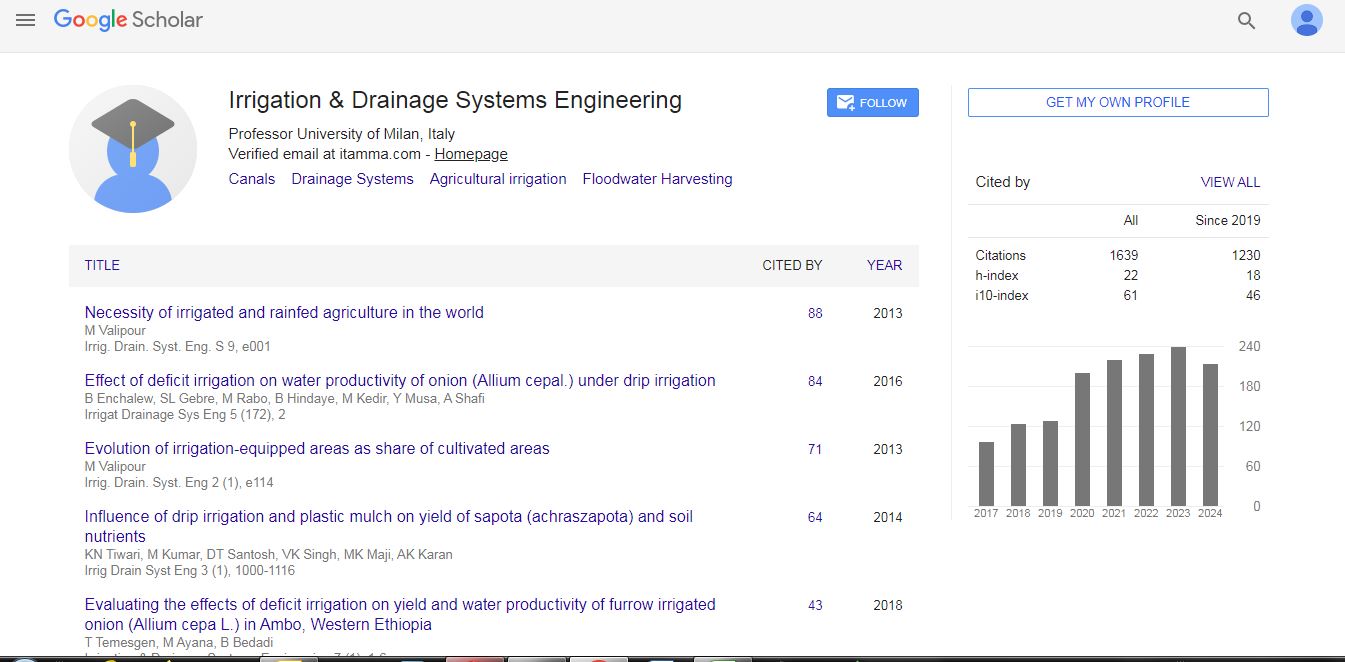
Irrigation & Drainage Systems Engineering received 835 citations as per Google Scholar report