Short Communication - (2025) Volume 14, Issue 4
Received: 01-Aug-2025, Manuscript No. jme-26-185221;
Editor assigned: 04-Aug-2025, Pre QC No. P-185221;
Reviewed: 18-Aug-2025, QC No. Q-185221;
Revised: 22-Aug-2025, Manuscript No. R-185221;
Published:
29-Aug-2025
, DOI: 10.37421/2169-0022.2025.14.738
Citation: Al-Harthy, Saeed. ”Advancements In Nanomaterials For
Reduced Wear And Friction.” J Material Sci Eng 14 (2025):738.
Copyright: © 2025 Al-Harthy S. This is an open-access article distributed under the terms of the Creative Commons Attribution License, which permits unrestricted use,
distribution and reproduction in any medium, provided the original author and source are credited.
The field of advanced materials research is increasingly focused on developing solutions for enhanced tribological performance, aiming to reduce wear and friction in various engineering applications. Significant efforts are being directed towards the design and characterization of composite materials that exhibit superior surface properties. Novel ceramic and polymer matrix composites, often incorporating nanoscale reinforcements, are at the forefront of this research, promising substantial improvements in material durability and operational efficiency. The synergistic effects of these reinforcements play a crucial role in enhancing surface hardness, reducing the coefficient of friction, and improving wear resistance under diverse tribological conditions, with processing parameters critically influencing microstructure and resultant performance [1].
In parallel, the development of self-lubricating coatings has emerged as a critical area, particularly for applications where conventional lubrication methods are challenging or impractical. Coatings based on layered materials like molybdenum disulfide (MoS2) combined with polymer matrices and ceramic nanoparticles have demonstrated remarkable effectiveness. The tailored microstructure of these coatings is key to achieving significant reductions in friction and wear. The inherent lubricity of MoS2, coupled with the wear resistance imparted by ceramic fillers, underpins their promising performance for demanding applications [2].
High-temperature tribological applications present unique challenges, necessitating the development of advanced ceramic-matrix composites (CMCs) with exceptional fracture toughness and wear resistance. Research in this domain involves carefully selecting constituent materials, such as zirconium dioxide (ZrO2) and silicon carbide (SiC) particles within an alumina matrix. Controlled microstructural design is paramount for achieving enhanced mechanical properties and understanding the wear mechanisms under sliding conditions, with toughening mechanisms playing a vital role in minimizing material loss [3].
Diamond-like carbon (DLC) coatings have long been recognized for their excellent tribological properties. Recent advancements involve modifying these coatings with metallic nanoparticles to further reduce friction and wear. The incorporation of specific nanoparticles, such as copper, has been shown to significantly lower the coefficient of friction, particularly in vacuum environments, by facilitating the formation of a protective transfer film. These metallic additives are crucial in enhancing the overall tribological characteristics of DLC coatings [4].
Further exploration into MoS2-based composite coatings has revealed their significant potential for friction reduction and wear resistance. Embedding silver nanoparticles within a MoS2 matrix has led to a notable decrease in both the friction coefficient and wear rate. This enhancement is attributed to the synergistic action of MoS2's intrinsic lubricity and silver's ability to form low-shear-strength films at the sliding interface, providing a strong foundation for developing advanced self-lubricating materials [5].
Polymer composites, particularly epoxy-based systems, are also being engineered for improved tribological performance. The strategic incorporation of graphene oxide sheets into epoxy matrices has demonstrably improved mechanical strength and wear resistance. Understanding how the orientation and dispersion of graphene oxide influence the friction coefficient and wear rate is crucial for designing high-performance polymer composites tailored for tribological applications [6].
Hybrid coating systems offer another promising avenue for tribological enhancement. A notable example involves the combination of hard TiAlN with embedded WS2 nanoparticles. This hybrid approach leverages the synergistic effects of a robust matrix and a lubricating phase, resulting in exceptional tribological performance, characterized by low friction coefficients and enhanced wear resistance, even under high-load conditions [7].
Hard coatings such as AlCrN are also benefiting from nanoparticle reinforcement. The introduction of graphene nanoplatelets into AlCrN coatings has been shown to significantly improve toughness and reduce the friction coefficient. The mechanism behind this friction reduction is linked to the self-lubricating effect of graphene at the sliding interface, highlighting its efficacy in tribological applications [8].
Transition metal dichalcogenides (TMDs), including MoS2 and WS2, are also being integrated into diamond-like carbon (DLC) coatings. Doping DLC with these TMDs results in the formation of tribofilms with layered structures. These films exhibit significantly lower shear strength and enhanced self-lubricating capabilities, making the composite coatings highly suitable for a broad spectrum of engineering applications requiring reduced friction and wear [9].
Finally, the tribological properties of nanocomposite coatings are being advanced through the integration of materials like hexagonal boron nitride (h-BN) into established matrices such as titanium nitride (TiN). The inclusion of h-BN nanoparticles effectively reduces the friction coefficient and improves the wear resistance of TiN coatings. This improvement stems from h-BN's ability to form a lubricating layer that mitigates wear, underscoring its utility in enhancing the performance of protective coatings [10].
The development of advanced composite materials for tribological applications is a multifaceted endeavor that involves intricate material design and rigorous characterization. Research has shown that combining novel ceramic and polymer matrices with nanoscale reinforcements, such as graphene and carbon nanotubes, can lead to significant improvements in wear and friction reduction. The synergistic interactions between these reinforcement phases are critical for enhancing surface hardness, lowering the coefficient of friction, and boosting wear resistance across various operating conditions. Furthermore, the precise control over processing parameters is essential for optimizing the microstructure and, consequently, the tribological performance of these advanced composites [1].
In the realm of self-lubricating coatings, MoS2-polymer matrix composites reinforced with ceramic nanoparticles represent a promising technological advancement. These coatings achieve substantial reductions in friction and wear through a meticulously designed microstructure. The self-lubricating mechanism is primarily driven by the layered structure of MoS2, which provides inherent lubricity, complemented by the wear resistance offered by the ceramic fillers. Such engineered coatings are particularly valuable for applications where conventional lubrication is problematic [2].
For high-temperature environments, the focus shifts to ceramic-matrix composites (CMCs) designed to withstand extreme conditions. Studies involving alumina-based CMCs reinforced with zirconium dioxide (ZrO2) and silicon carbide (SiC) particles highlight the importance of tailored microstructures for improved fracture toughness and wear resistance. The research delves into the wear mechanisms occurring under sliding contact, emphasizing how specific toughening mechanisms contribute to minimizing material loss and enhancing durability in high-stress environments [3].
Diamond-like carbon (DLC) coatings are continually being refined to meet increasing performance demands. A key innovation involves the modification of DLC coatings with metallic nanoparticles, such as copper. This doping strategy has proven effective in reducing both friction and wear, particularly in vacuum environments. The mechanism involves the formation of a stable transfer film on the counter-surface, a phenomenon facilitated by the metallic additives, which ultimately improves the tribological characteristics of the DLC coatings [4].
Further research into MoS2-based materials has demonstrated their utility in advanced composite coatings. The incorporation of silver nanoparticles into MoS2 nanocomposite coatings has yielded significant improvements in tribological performance. The combination of MoS2's natural lubricity and silver's capacity to form low-shear-strength films at the interface results in a marked reduction in friction and wear rate, paving the way for next-generation self-lubricating materials [5].
Polymer composites, such as epoxy systems, are also being optimized for tribological applications. The introduction of graphene oxide into epoxy matrices leads to enhanced mechanical strength and wear resistance. Detailed analysis of how the alignment and distribution of graphene oxide sheets influence friction and wear rates provides critical insights for the design of high-performance polymer composites tailored for demanding tribological environments [6].
Hybrid coating systems represent a sophisticated approach to tribological enhancement. Coatings comprising a hard matrix, like TiAlN, embedded with lubricating nanoparticles, such as WS2, exhibit remarkable synergistic effects. This combination leads to superior tribological performance, characterized by exceptionally low friction coefficients and superior wear resistance, even when subjected to high loads, demonstrating the benefits of carefully engineered hybrid structures [7].
Hard coatings like AlCrN are being significantly improved through the integration of graphene nanoplatelets. The addition of graphene enhances the toughness of AlCrN coatings and markedly reduces their friction coefficient. This friction reduction is attributed to the self-lubricating properties of graphene, which forms a lubricating layer at the sliding interface, thereby minimizing material loss and improving surface integrity [8].
Diamond-like carbon (DLC) coatings are also being advanced by incorporating transition metal dichalcogenides (TMDs), including MoS2 and WS2. This doping strategy promotes the formation of a protective tribofilm possessing layered structures. This tribofilm significantly lowers the shear strength at the interface and enhances the self-lubricating capabilities of the DLC coatings, making them highly suitable for a wide range of tribological applications [9].
Lastly, nanocomposite coatings are being developed with materials like hexagonal boron nitride (h-BN) integrated into matrices such as titanium nitride (TiN). The presence of h-BN nanoparticles in TiN coatings leads to a substantial decrease in the friction coefficient and an improvement in wear resistance. The lubricating action of h-BN, which forms a protective layer at the contact interface, effectively mitigates wear and enhances the overall tribological performance of the TiN coating [10].
This collection of research highlights advancements in materials science aimed at reducing wear and friction in various applications. Studies explore polymer nanocomposites reinforced with graphene and carbon nanotubes, self-lubricating MoS2-polymer coatings with ceramic nanoparticles, and advanced ceramic matrix composites designed for high-temperature environments. Innovations in diamond-like carbon coatings modified with metallic nanoparticles and transition metal dichalcogenides are also presented, alongside MoS2-based composites with silver nanoparticles. The benefits of graphene oxide in epoxy composites, hybrid coatings like TiAlN/WS2, graphene-reinforced AlCrN coatings, and TiN/h-BN nanocomposites are investigated. Across these diverse materials, a common theme is the use of nanoscale reinforcements and careful microstructural design to achieve synergistic effects that enhance hardness, reduce friction coefficients, and improve wear resistance, leading to more durable and efficient engineering solutions.
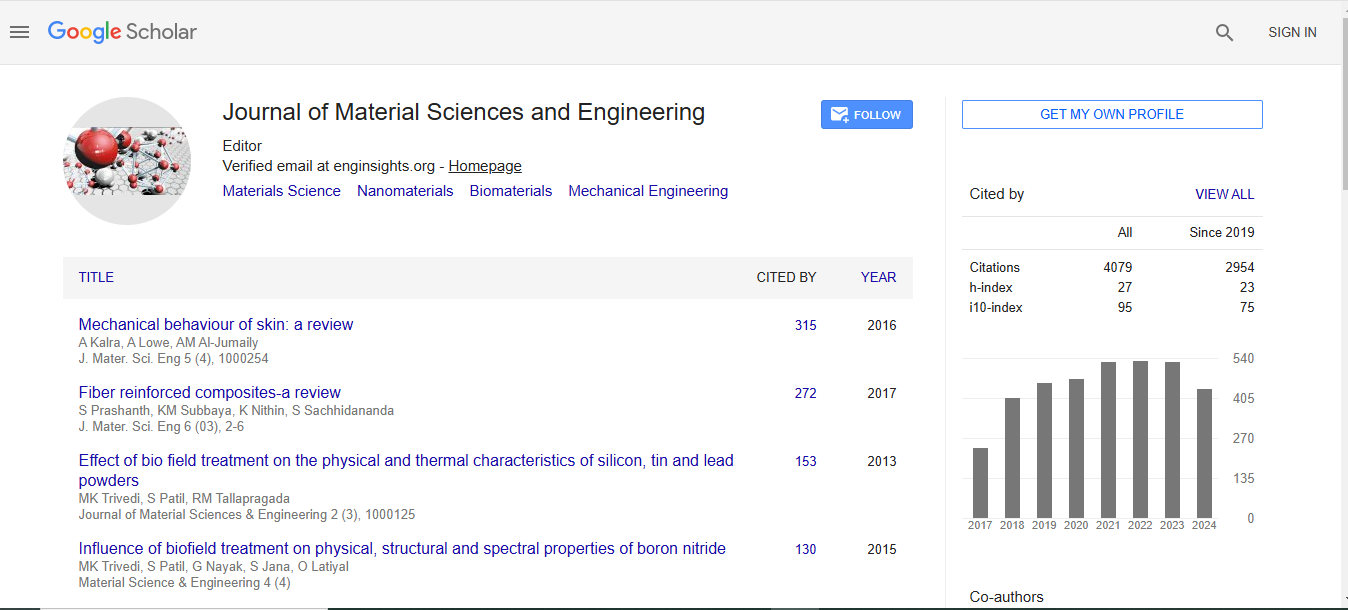
Journal of Material Sciences & Engineering received 3677 citations as per Google Scholar report