Commentary - (2025) Volume 16, Issue 4
Received: 01-Aug-2025, Manuscript No. jbsbe-26-183309;
Editor assigned: 04-Aug-2025, Pre QC No. P-183309;
Reviewed: 18-Aug-2025, QC No. Q-183309;
Revised: 22-Aug-2025, Manuscript No. R-183309;
Published:
29-Aug-2025
, DOI: 10.37421/2165-6210.2025.16.515
Citation: Moretti, Lucas. ”Advancements in Biosensor Transducer Technologies for Ultrasensitive Detection.” J Biosens Bioelectron 16 (2025):515.
Copyright: © 2025 Moretti L. This is an open-access article distributed under the terms of the Creative Commons Attribution License, which permits unrestricted use, distribution and reproduction in any medium, provided the original author and source are credited.
The field of biosensing has witnessed remarkable advancements, driven by the continuous innovation in transducer technologies that form the bedrock of these sensitive detection systems. Nanomaterial-based transducers, such as graphene and quantum dots, are at the forefront, offering significantly enhanced signal amplification and lower detection limits for biosensor applications. Electrochemical biosensors, particularly those incorporating modified electrodes and novel sensing strategies, are proving crucial for the accurate detection of disease biomarkers. Optical biosensors, leveraging surface plasmon resonance (SPR) and fluorescence-based methods, are being refined with advanced materials and nanostructures to achieve unprecedented sensitivity. Piezoelectric transducers are emerging as powerful tools for ultrasensitive biomolecule detection, utilizing advanced materials and microfabrication to respond to minute mass or viscoelastic changes. Field-effect transistors (FETs), especially those based on graphene, are revolutionizing biosensing by enabling highly sensitive, label-free detection through improved signal-to-noise ratios. Microcantilever-based biosensors have seen significant progress, with surface functionalization and nanomaterial integration leading to enhanced sensitivity for a wide range of biomolecular targets. Colorimetric biosensors, particularly those employing gold nanoparticles (AuNPs), offer a promising avenue for visual and instrument-free detection, with applications expanding into food safety and environmental monitoring. Surface acoustic wave (SAW) devices are being utilized as highly sensitive transducers, enabling real-time and label-free detection of biomolecules through mass loading principles. Quantum dots (QDs) are being recognized for their unique optical properties, serving as fluorescent transducers that facilitate sensitive and multiplexed detection of biomolecules with tunable emission characteristics.
Recent breakthroughs in transducer technologies are significantly enhancing the capabilities of biosensors. Innovations in nanomaterials like graphene and quantum dots are leading to biosensors with superior sensitivity and detection limits, particularly in the realm of biosensor transducer development. Modified electrodes, including carbon nanomaterials and conductive polymers, are critical in advancing electrochemical biosensors, improving electron transfer kinetics for more precise biomarker detection. Optical biosensors are benefiting from the integration of advanced optical materials and nanostructures, enabling higher sensitivity and lower detection limits in techniques like SPR and fluorescence. Piezoelectric transducer technology is enabling the creation of highly sensitive biosensors capable of detecting subtle changes in mass or viscoelastic properties, crucial for pathogen and small molecule detection. Field-effect transistors (FETs) are being developed with novel gate materials and architectures for biosensing, aiming to improve signal-to-noise ratios and achieve label-free detection of biological analytes. Microcantilever-based biosensors are being refined through functionalized surfaces and the incorporation of nanomaterials, leading to enhanced sensitivity for various biomolecules and applications in high-throughput analysis. Colorimetric biosensors, utilizing plasmonic nanoparticles such as gold nanoparticles (AuNPs), are enabling visual and instrument-free detection, expanding their use in areas like food safety. Surface acoustic wave (SAW) devices are demonstrating high sensitivity as biosensors by employing surface modifications with recognition elements to detect biomolecules through mass loading. Quantum dots (QDs) are being employed as fluorescent transducers due to their exceptional optical properties, facilitating sensitive and multiplexed detection of biomolecules in various diagnostic applications.
This compilation explores the latest advancements in biosensor transducer technologies. It highlights the role of nanomaterials like graphene and quantum dots in enhancing sensitivity and detection limits. Electrochemical biosensors are improved by modified electrodes, while optical methods like SPR and fluorescence benefit from advanced materials. Piezoelectric, FET-based, and microcantilever biosensors offer ultrasensitive detection capabilities. Colorimetric sensors using gold nanoparticles enable visual detection, and SAW devices provide real-time, label-free analysis. Quantum dots are utilized for their fluorescent properties, enabling sensitive and multiplexed detection. The overarching theme is the drive towards more sensitive, selective, portable, and point-of-care diagnostic devices.
None
None
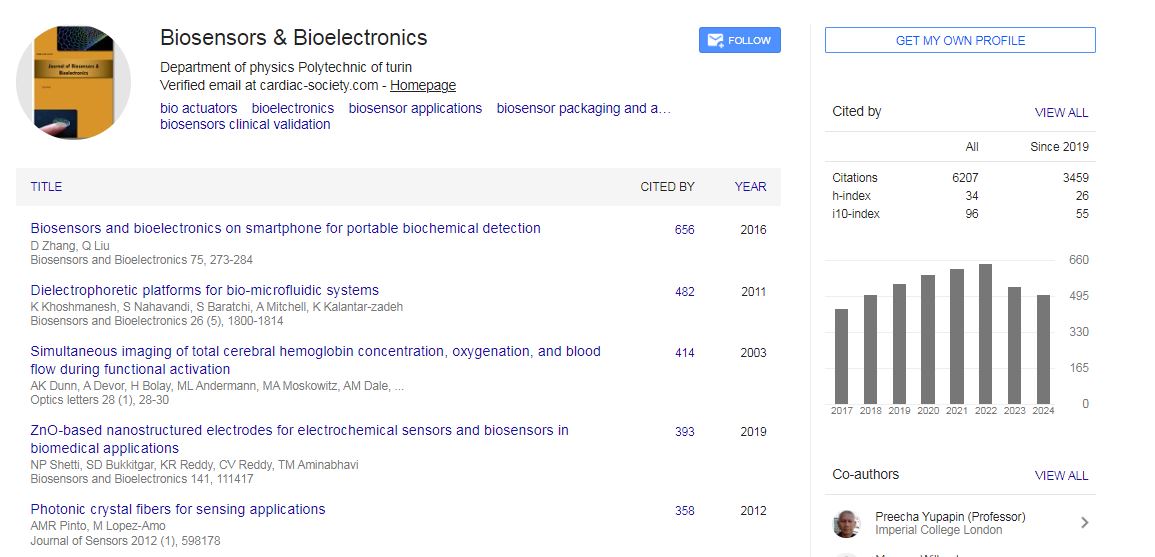
Biosensors & Bioelectronics received 6207 citations as per Google Scholar report