Opinion - (127) Volume 14, Issue 3
Received: 01-May-2025, Manuscript No. jtm-26-185730;
Editor assigned: 05-May-2025, Pre QC No. P-185730;
Reviewed: 19-May-2025, QC No. Q-185730;
Revised: 22-May-2025, Manuscript No. R-185730;
Published:
29-May-2025
, DOI: 10.37421/2167-1222.2025.14.682
Citation: Moreau, Jean-Luc. ”Advancements Improving TBI Diagnosis and Therapy Outcomes.” J Trauma Treat 14 (2025):682.
Copyright: © 2025 Moreau J. This is an open-access article distributed under the terms of the Creative Commons Attribution License, which permits unrestricted use, distribution and reproduction in any medium, provided the original author and source are credited.
Recent advancements in Traumatic Brain Injury (TBI) diagnosis and therapy are significantly enhancing patient outcomes across the spectrum of severity. Innovative imaging techniques, such as diffusion tensor imaging and functional MRI, are proving crucial in characterizing the microstructural and functional consequences of TBI, providing insights into white matter integrity and network disruptions that may not be apparent with conventional imaging [1].
Concurrently, the exploration of novel biomarkers, including proteins like GFAP and UCH-L1, is rapidly advancing the field of TBI diagnosis and prognostication, offering a potentially less invasive approach compared to traditional methods by differentiating TBI from other injuries and predicting outcomes [3].
The management of severe TBI continues to evolve with a pronounced focus on multimodal neuromonitoring and targeted interventions, driven by an improved understanding of the complex cascade of secondary injury mechanisms that allows for the development of more precise therapeutic targets aimed at reducing intracranial pressure and improving cerebral perfusion pressure [2].
Beyond immediate management, neuroprotective strategies targeting excitotoxicity, inflammation, and oxidative stress are under active investigation for TBI, with many agents showing promise in preclinical models, although translating these findings to clinical efficacy remains a significant challenge [5].
Complementary to neuroprotection, regenerative medicine approaches, including stem cell therapy and growth factor administration, offer novel avenues for TBI recovery by promoting neurogenesis, synaptogenesis, and tissue repair, with clinical trials currently ongoing to evaluate the safety and efficacy of these interventions [6].
Understanding and addressing post-TBI sleep disturbances is also critical for improving functional recovery, as the neurobiological underpinnings of these disorders are being elucidated, paving the way for targeted treatments that can significantly impact a patient's quality of life [7].
Furthermore, the development of non-invasive techniques for assessing blood-brain barrier (BBB) integrity after TBI is crucial, as BBB disruption can contribute to secondary injury and neuroinflammation, making its recovery monitoring important for guiding treatment [8].
Emerging research highlights the role of exosomes and their cargo as important mediators of intercellular communication in the context of TBI, capable of transporting proteins, lipids, and nucleic acids that influence inflammatory responses and neuronal repair [9].
In parallel, computational modeling and artificial intelligence (AI) are increasingly being employed to analyze complex TBI data, predict patient outcomes, and optimize treatment strategies, aiding in patient stratification and the identification of individuals who might benefit most from specific interventions [10].
This multi-faceted approach, encompassing improved diagnostics, refined management strategies, and innovative therapeutic avenues, collectively aims to improve the long-term prognosis and quality of life for individuals affected by traumatic brain injury [4].
The diagnosis and treatment of Traumatic Brain Injury (TBI) have seen remarkable progress, leading to enhanced patient outcomes. Innovative imaging modalities, such as diffusion tensor imaging (DTI) and functional MRI, play a critical role in assessing TBI, offering detailed characterization of microstructural and functional damage that may elude conventional imaging methods by revealing white matter integrity and network disruptions [1].
Simultaneously, the discovery and application of biomarkers represent a rapidly developing area in TBI assessment. Proteins like GFAP and UCH-L1 are being investigated for their potential to accurately differentiate TBI from other forms of injury and to predict patient prognosis, providing a less invasive diagnostic alternative to traditional imaging techniques [3].
The management of severe TBI continues to be refined through a focus on multimodal neuromonitoring and precise interventions. A deeper comprehension of the intricate secondary injury mechanisms enables the development of more targeted therapies designed to effectively reduce intracranial pressure and optimize cerebral perfusion pressure [2].
In the realm of therapeutic interventions, neuroprotective strategies are under extensive investigation, aiming to mitigate processes such as excitotoxicity, inflammation, and oxidative stress. While many agents have demonstrated significant promise in preclinical studies, the translation of these findings into successful clinical applications remains a substantial hurdle [5].
Regenerative medicine offers promising new pathways for TBI recovery, utilizing approaches like stem cell therapy and growth factor administration to foster neurogenesis, synaptogenesis, and tissue repair. The efficacy and safety of these interventions are currently being evaluated in ongoing clinical trials [6].
Critically, the management of sleep disturbances following TBI is essential for promoting functional recovery. Research into the neurobiological underpinnings of these disorders is advancing, which is vital for developing targeted treatments that can significantly improve a patient's overall quality of life [7].
The development of non-invasive methods to assess the integrity of the blood-brain barrier (BBB) after TBI is another key area of research, as BBB disruption is a significant contributor to secondary injury and neuroinflammation, making BBB recovery monitoring essential for guiding therapeutic decisions [8].
The role of exosomes in TBI is also gaining attention, as these microvesicles are recognized as important communicators between cells, transporting molecules that influence inflammation and neuronal repair processes [9].
Furthermore, computational modeling and artificial intelligence (AI) are proving invaluable in the analysis of complex TBI data, aiding in outcome prediction and the optimization of treatment strategies by enabling better patient stratification and the identification of individuals most likely to benefit from specific therapies [10].
These multifaceted advancements collectively contribute to a more comprehensive understanding and improved management of TBI [4].
Recent advancements in Traumatic Brain Injury (TBI) diagnosis and therapy are improving patient outcomes. Innovative imaging techniques and biomarkers enhance early detection and prognosis. Novel therapeutic strategies, including neuroprotective agents and regenerative medicine, show promise in mitigating secondary injury and promoting recovery. Management of severe TBI focuses on neuromonitoring and targeted interventions, with a better understanding of secondary injury mechanisms guiding precise therapeutic targets. Biomarker discovery, using proteins like GFAP and UCH-L1, offers a less invasive diagnostic approach. Advanced neuroimaging provides insights into microstructural and functional consequences. Neuroprotection targets excitotoxicity, inflammation, and oxidative stress, though clinical translation remains challenging. Regenerative medicine, including stem cell therapy, aims to promote neurogenesis and tissue repair. Addressing post-TBI sleep disturbances is crucial for functional recovery. Non-invasive assessment of blood-brain barrier integrity is important for guiding treatment. Exosomes are emerging mediators of intercellular communication influencing inflammation and repair. Computational modeling and AI are utilized for data analysis, outcome prediction, and treatment optimization.
None
None
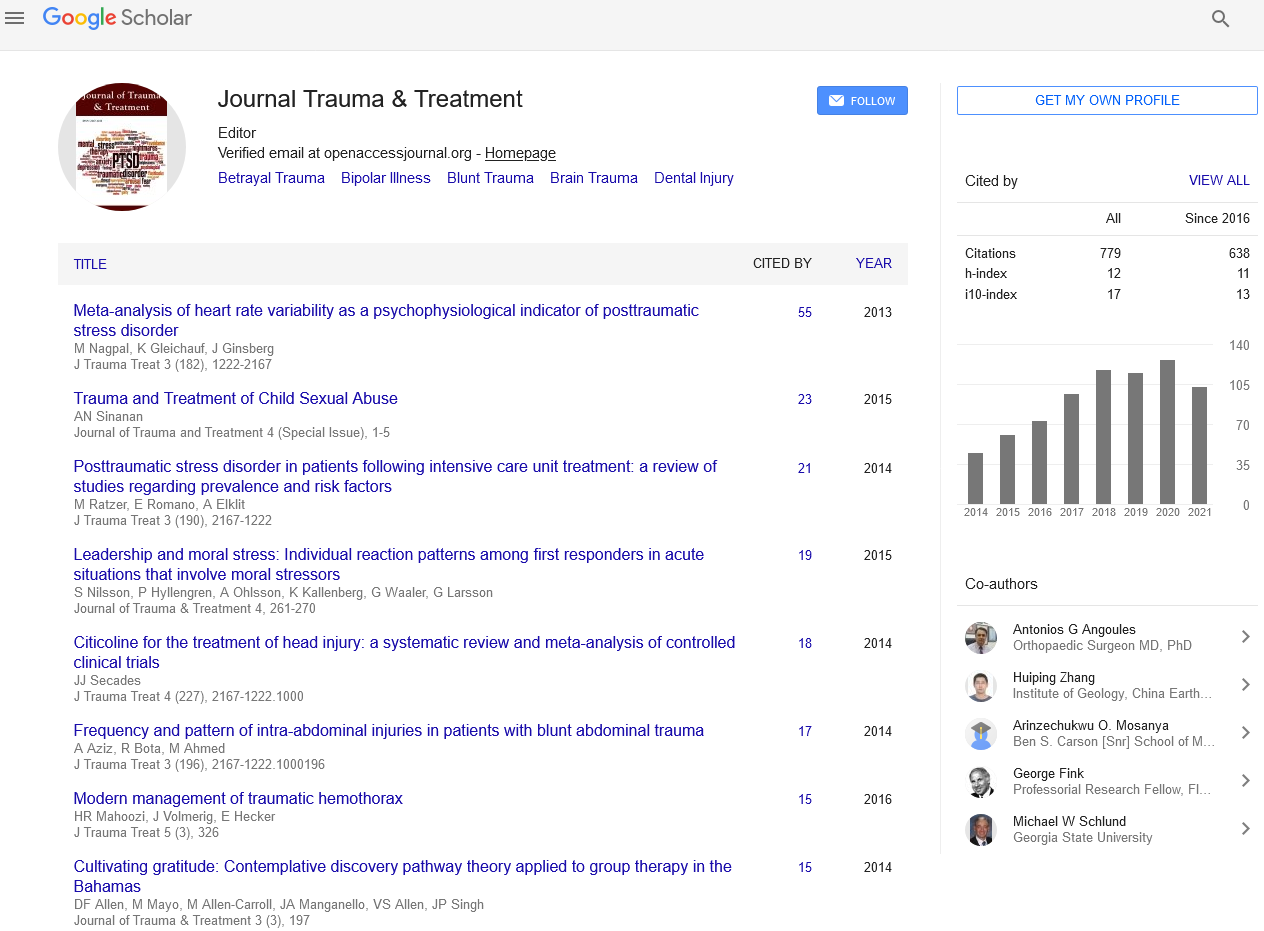
Journal of Trauma & Treatment received 1048 citations as per Google Scholar report