Brief Report - (2025) Volume 16, Issue 2
Received: 01-Apr-2025, Manuscript No. jbmbs-26-183374;
Editor assigned: 03-Apr-2025, Pre QC No. P-183374;
Reviewed: 17-Apr-2025, QC No. Q-183374;
Revised: 22-Apr-2025, Manuscript No. R-183374;
Published:
29-Apr-2025
, DOI: 10.37421/2155-6180.2025.16.261
Citation: Verma, Aisha. ”Advanced Statistics for Biomedical and Biometric Data Analysis.” J Biom Biosta 16 (2025):261.
Copyright: © 2025 Verma A. This is an open-access article distributed under the terms of the Creative Commons Attribution License, which permits unrestricted use, distribution and reproduction in any medium, provided the original author and source are credited.
The analysis of complex biomedical and biometric datasets has become increasingly reliant on sophisticated statistical methodologies to extract meaningful insights from large-scale studies. This necessity spans diverse areas including genetic data analysis, clinical trials, and population health surveys, where advanced models are crucial for understanding intricate biological processes and health outcomes. Machine learning for predictive modeling, Bayesian approaches for uncertainty quantification, and longitudinal data analysis for tracking health over time are key components of this evolving landscape, emphasizing the importance of choosing appropriate statistical techniques to ensure the validity and interpretability of research findings [1].
In the realm of genomics, the development and validation of novel statistical models are paramount for analyzing high-dimensional genomic data, particularly in the context of disease risk prediction. The sheer volume and complexity of genetic information present significant challenges, necessitating methods that integrate bioinformatics and statistical genetics to identify genetic variants associated with specific diseases and estimate individual susceptibility, thereby paving the way for personalized medicine and early disease detection [2].
Survival analysis techniques are fundamental to the study of biometric data, offering critical insights into time-to-event outcomes in clinical settings. Beyond established methods like Kaplan-Meier estimation and Cox proportional hazards models, advanced techniques are being employed to handle time-dependent covariates and competing risks, underscoring the importance of appropriate statistical modeling for accurate prognostication and treatment efficacy assessment in fields such as cardiovascular and oncology research [3].
Bayesian statistical methods offer a powerful framework for the analysis of biometric and biomedical data, distinguished by their ability to incorporate prior information and provide probabilistic statements about model parameters. Their application is broad, encompassing clinical trial design, hierarchical modeling of patient data, and the integration of evidence from multiple studies, offering flexibility in handling complex data structures and a coherent approach to uncertainty [4].
Machine learning techniques are being increasingly leveraged for the analysis of large-scale biometric datasets in health-related applications. Algorithms such as support vector machines, random forests, and deep learning are employed for tasks like disease classification, risk stratification, and patient monitoring, though challenges related to data preprocessing, feature selection, and model interpretability require careful consideration for effective clinical implementation [5].
Analyzing longitudinal biometric data, which tracks changes in health indicators over time, necessitates specialized statistical methods. Techniques for modeling repeated measurements, handling missing data, and accounting for individual variability are essential for applications such as tracking disease progression, evaluating intervention effectiveness, and understanding long-term health outcomes, ensuring robust conclusions from such data [6].
The application of statistical methods to complex population health data, with a focus on biometric markers, is crucial for identifying disease risk factors, assessing intervention impacts, and understanding disease patterns in diverse populations. Techniques including generalized linear models, mixed-effects models, and spatial statistics are integral to large-scale epidemiological studies [7].
Causal inference methods are vital for establishing cause-and-effect relationships from observational studies in biomedical and biometric data analysis. Techniques such as propensity score matching, instrumental variables, and difference-in-differences are employed to understand treatment effects, risk factors, and the impact of healthcare interventions, moving beyond mere association to actionable insights [8].
Statistical modeling plays a pivotal role in personalized medicine, particularly in the analysis of biometric data for tailoring treatments to individual patients. Integrating diverse data sources like genomics, proteomics, and clinical records allows for predictions of treatment response and disease progression, highlighting the statistical challenges in developing and validating personalized predictive models with potential to transform healthcare [9].
The analysis of biometric data from wearable devices presents unique statistical challenges and opportunities for health monitoring. Methods for processing time-series data, detecting anomalies, and developing predictive models for health events are critical, alongside considerations for data quality, privacy, and integration with other health information, promising a transformation in preventive medicine [10].
The landscape of biomedical and biometric data analysis is continually shaped by the advancement and application of sophisticated statistical methodologies. These techniques are indispensable for deciphering the complexities inherent in large-scale studies, encompassing genetic analyses, clinical trials, and population health surveys. The imperative for advanced statistical models extends to extracting meaningful insights from genetic data, understanding the nuances of clinical trials, and interpreting the outcomes of extensive population health surveys. Essential statistical tools in this domain include machine learning for predictive modeling, Bayesian approaches for robust uncertainty quantification, and longitudinal data analysis for meticulously tracking health trajectories over extended periods. The judicious selection of appropriate statistical techniques is underscored as a fundamental requirement for ensuring the scientific validity and clinical interpretability of research findings across these critical fields [1].
A significant area of focus involves the development and rigorous validation of novel statistical models specifically designed for the analysis of high-dimensional genomic data. This is particularly relevant in the context of predicting disease risk, where the sheer volume and intricate nature of genetic information pose substantial analytical hurdles. Emerging methods adeptly integrate bioinformatics with statistical genetics, enabling the precise identification of genetic variants associated with specific diseases and the accurate estimation of an individual's susceptibility. These advancements hold profound implications for the realization of personalized medicine and the enhancement of early disease detection strategies [2].
Within clinical research, the application of survival analysis techniques to biometric data is of paramount importance, especially for understanding time-to-event outcomes. While foundational methods such as Kaplan-Meier estimation and Cox proportional hazards models remain vital, there is a growing emphasis on advanced techniques. These newer methods are adept at addressing complexities like time-dependent covariates and competing risks, thereby reinforcing the critical role of appropriate statistical modeling in achieving accurate prognostication and a precise assessment of treatment efficacy, particularly in the demanding fields of cardiovascular and oncology research [3].
Bayesian statistical methods provide a powerful and flexible paradigm for analyzing biometric and biomedical data. Their inherent strength lies in the capacity to seamlessly incorporate prior knowledge and to generate comprehensive probabilistic statements concerning model parameters. The versatility of Bayesian inference is demonstrated across a spectrum of applications, including the intricate design of clinical trials, the hierarchical modeling of patient data to capture population-level trends and individual variations, and the synthesis of evidence from multiple, disparate studies. This approach offers a coherent and principled framework for managing and quantifying uncertainty within complex data structures [4].
In the contemporary health informatics landscape, machine learning techniques are increasingly central to the analysis of vast biometric datasets. A diverse array of algorithms, including support vector machines, random forests, and sophisticated deep learning architectures, are being applied to critical health-related tasks. These encompass the accurate classification of diseases, the stratification of patient risk profiles, and the continuous monitoring of patient well-being. However, the effective deployment of these methods is contingent upon addressing significant challenges related to data preprocessing, optimal feature selection, and ensuring the interpretability of complex models, particularly when translating findings into tangible clinical practice [5].
The analysis of longitudinal biometric data, which inherently captures changes in health indicators over time, requires specialized statistical approaches. Methodologies designed for modeling repeated measurements, effectively managing missing data points, and accounting for the inherent variability among individuals are crucial. These statistical frameworks are applied to vital areas such as tracking the progression of chronic diseases, evaluating the effectiveness of therapeutic interventions, and identifying the key factors that influence long-term health outcomes. The application of proper statistical frameworks is essential for deriving robust and reliable conclusions from such temporally rich datasets [6].
Statistical methods are instrumental in the analysis of complex population health data, with a particular emphasis on the interpretation of biometric markers. These methods facilitate the identification of critical risk factors for various diseases, enable the assessment of the population-level impact of public health interventions, and provide a deeper understanding of disease patterns within diverse demographic groups. A range of statistical techniques, including generalized linear models, mixed-effects models, and spatial statistics, are reviewed for their applicability and utility in large-scale epidemiological research [7].
Causal inference methods represent a sophisticated approach to analyzing biomedical and biometric data, specifically addressing the challenging task of establishing definitive cause-and-effect relationships from observational studies. The statistical toolkit includes techniques such as propensity score matching, instrumental variables analysis, and difference-in-differences estimation. These methods are pivotal for gaining a deeper understanding of treatment effects, identifying true risk factors, and accurately assessing the impact of healthcare interventions in clinical and public health settings [8].
Statistical modeling is a cornerstone of personalized medicine, enabling the tailoring of medical treatments to the unique characteristics of individual patients through the analysis of their biometric data. This involves integrating a wide array of data sources, including genomic sequences, proteomic profiles, and detailed clinical records, to predict individual responses to therapies and to anticipate disease progression. The development and validation of these personalized predictive models present significant statistical challenges, yet their potential to revolutionize healthcare delivery is immense [9].
Analyzing biometric data generated by wearable devices for health monitoring presents a unique set of statistical challenges and opportunities. Specialized methods are required for processing high-frequency time-series data, detecting subtle anomalies that may indicate health issues, and developing predictive models for potential health events. Crucial considerations include managing data quality, ensuring robust privacy safeguards, and effectively integrating sensor-derived data with other relevant health information, highlighting the transformative potential of wearable technology in preventive medicine through advanced statistical analysis [10].
This collection of research explores the critical role of advanced statistical methodologies in analyzing complex biomedical and biometric data. Key areas of focus include machine learning for predictive modeling, Bayesian approaches for uncertainty quantification, and longitudinal data analysis for tracking health outcomes. Specific applications discussed involve high-dimensional genomic data for disease risk prediction, survival analysis for time-to-event data in clinical settings, and causal inference methods for establishing cause-and-effect relationships. The papers also highlight the use of statistical modeling in personalized medicine and the analysis of data from wearable devices for health monitoring. Challenges related to data complexity, interpretability, and privacy are addressed, emphasizing the growing importance of robust statistical frameworks in advancing healthcare and medical research.
None
None
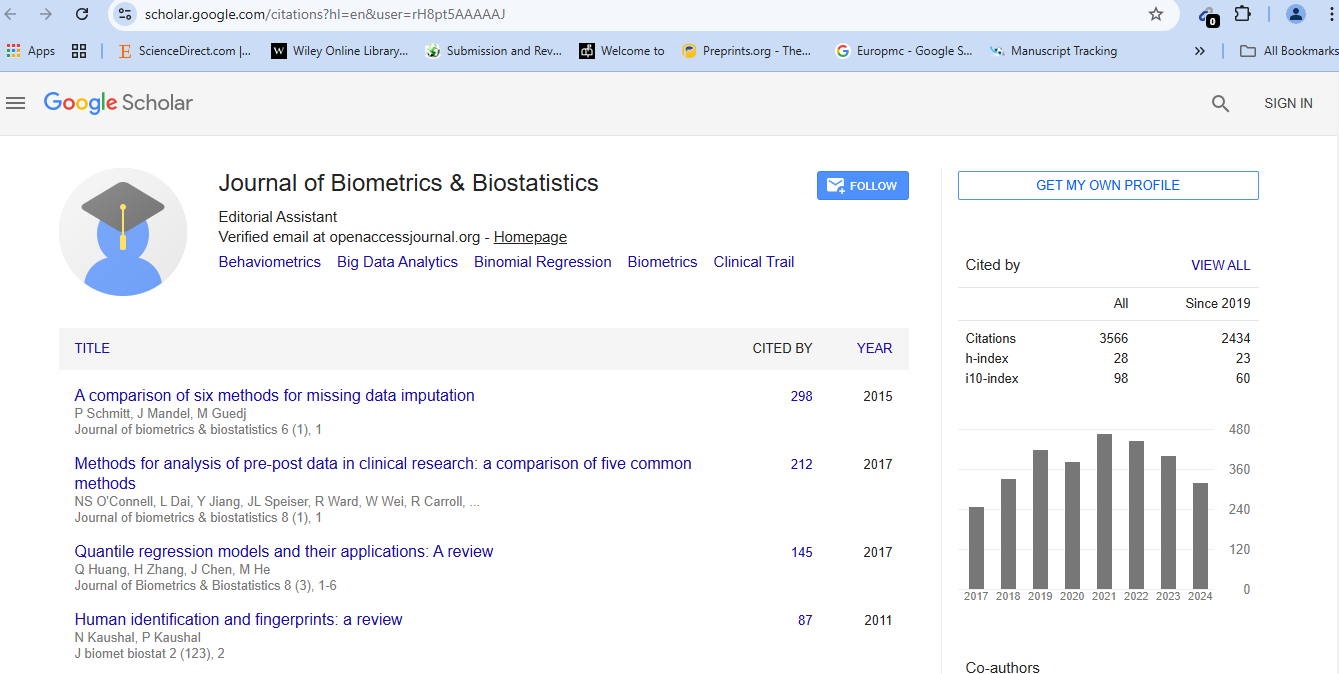
Journal of Biometrics & Biostatistics received 3496 citations as per Google Scholar report