Opinion - (2025) Volume 13, Issue 5
Received: 01-Oct-2025, Manuscript No. jaat-26-183179;
Editor assigned: 03-Oct-2025, Pre QC No. P-183179;
Reviewed: 17-Oct-2025, QC No. Q-183179;
Revised: 22-Oct-2025, Manuscript No. R-183179;
Published:
29-Oct-2025
, DOI: 10.37421/2329-6542.2025.13.376
Citation: Torres, Diego. ”Advanced Sensors: Driving Future Space Science Exploration.” J Astrophys Aerospace Technol 13 (2025):376.
Copyright: © 2025 Torres D. This is an open-access article distributed under the terms of the Creative Commons Attribution License, which permits unrestricted use, distribution and reproduction in any medium, provided the original author and source are credited.
The field of space science is undergoing a period of unprecedented advancement, largely driven by the development and application of sophisticated sensor and detector technologies. These instruments are the eyes and ears of our exploration, enabling us to probe the cosmos with ever-increasing precision and sensitivity. This review delves into the critical role of advanced sensors and detectors in facilitating groundbreaking discoveries across various domains of space science, highlighting the technological leaps that underpin our current and future endeavors in understanding the universe. Next-generation infrared detectors are a pivotal area of development, particularly for the detailed characterization of exoplanet atmospheres. Their enhanced quantum efficiency and reduced noise levels in the mid- and far-infrared spectrum allow for more precise measurements of atmospheric composition, opening new avenues for the detection of potential biosignatures. The need for detectors that can withstand the rigors of long-duration space missions remains a paramount design consideration. The study of high-energy phenomena in astrophysics is critically dependent on advancements in X-ray and gamma-ray detectors. Innovations in detector materials and architectures, such as monolithic silicon and germanium detectors, alongside novel telescope designs like coded-aperture and Compton telescopes, are providing unprecedented energy and spatial resolution. This allows for detailed investigation of transient events and the origin of cosmic rays. The challenges inherent in developing radiation-hardened detectors for deep space missions are substantial. This involves extensive research in materials science, the implementation of advanced fabrication techniques, and the design of sophisticated shielding strategies. Ensuring the longevity and consistent performance of detectors in high-radiation environments, such as planetary magnetospheres or during solar energetic particle events, is crucial for mission success. Spectroscopic imagers represent a significant technological advancement for planetary science missions. The integration of advanced optical filters, microbolometers, and hyperspectral imaging capabilities empowers scientists with the ability to perform detailed mapping of surface compositions, identify subsurface water ice, and study atmospheric dynamics on other celestial bodies. Advanced micro-shutter array technology is revolutionizing infrared spectroscopy in space. This technology facilitates highly flexible and efficient multiplexed spectroscopy, which is essential for large-scale surveys aimed at discovering exoplanets or conducting in-depth studies of stellar populations within our own galaxy. The integration of machine learning algorithms with detector systems is transforming real-time data processing and anomaly detection in space missions. This synergy enhances the efficiency of data downlink and enables faster identification of scientifically significant events or potential instrument malfunctions, streamlining mission operations. While primarily a terrestrial pursuit, advancements in gravitational wave detection technologies, particularly in quantum metrology and precise interferometry, are directly informing the design of future space-based gravitational wave observatories. These cutting-edge techniques promise to unlock new observational windows into the most energetic events in the cosmos. Progress in uncooled bolometer arrays for spaceborne thermal imaging is vital for a range of scientific objectives. These detectors are indispensable for characterizing planetary thermal emission, monitoring solar activity, and discerning faint infrared signals from distant astronomical objects, benefiting from improvements in sensitivity and power efficiency. Future missions to the outer solar system demand advanced detector systems capable of high reliability, extreme temperature operation, and efficient data acquisition. The development of novel semiconductor materials and detector architectures is key to enduring the harsh conditions and long travel times associated with exploring distant icy moons and gas giants.
Advanced sensors and detectors play a fundamental role in enabling groundbreaking discoveries in space science, spanning a wide array of disciplines from exoplanet research to astrophysics and planetary exploration. The continuous evolution of detector technology, characterized by improvements in spectral and spatial resolution, enhanced sensitivity, and increased radiation hardness, is essential for the success of instruments operating in the challenging environments of space. These advancements are critical for instruments designed to operate in harsh space environments. The realm of exoplanet atmosphere characterization is being significantly advanced by next-generation infrared detectors. These detectors, with their improved quantum efficiency and reduced noise levels in the mid- and far-infrared ranges, facilitate more precise measurements of atmospheric composition, thereby aiding in the discovery of potential biosignatures. A key requirement for these instruments is the development of robust detector designs capable of withstanding the demands of long-duration space missions. Astrophysical observatories rely heavily on advancements in X-ray and gamma-ray detectors for their scientific capabilities. Innovations in detector technologies, including monolithic silicon and germanium detectors, as well as coded-aperture and Compton telescope designs, are providing unprecedented energy and spatial resolution. These advancements are crucial for studying transient phenomena such as supernovae, active galactic nuclei, and understanding the origin of cosmic rays. The development of radiation-hardened detectors is a critical aspect of deep space exploration. This involves extensive research into materials science, the application of advanced fabrication techniques, and the implementation of sophisticated shielding strategies to ensure the long-term performance and reliability of detectors in high-radiation environments. Examples include environments like Jupiter's magnetosphere or during solar energetic particle events. For planetary science missions, novel spectroscopic imagers are being designed and calibrated to enable detailed studies of planetary surfaces and atmospheres. The integration of advanced optical filters, microbolometers, and hyperspectral imaging capabilities allows for detailed mapping of surface composition, the detection of subsurface water ice, and the study of atmospheric dynamics on other planets and moons. Micro-shutter array technology represents a significant stride in infrared spectroscopy for space applications. This technology enables highly flexible and efficient multiplexed spectroscopy, which is instrumental for missions focused on surveying large numbers of stars for exoplanets or conducting detailed investigations of stellar populations within the Milky Way. Machine learning algorithms are increasingly being integrated with detector systems for real-time data processing and anomaly detection in space missions. This approach enhances the efficiency of data downlink and allows for more rapid identification of scientifically interesting events or instrument malfunctions, thereby improving mission operations. While gravitational wave detectors are often ground-based, advancements in related sensor technologies, particularly in quantum metrology and precise interferometry, are shaping the design of future space-based gravitational wave observatories. These sophisticated measurement techniques are essential for detecting the faint signals of cosmic gravitational waves. Uncooled bolometer arrays are crucial for thermal imaging applications in space. These detectors are vital for studying the thermal emission from planets, monitoring solar activity, and detecting faint infrared signals from distant astronomical objects, benefiting from advances in sensitivity and reduced power consumption. Future missions targeting the outer solar system require highly advanced detector systems. These systems must possess high reliability, the ability to operate under extreme temperature conditions, and support efficient data acquisition. The development of novel semiconductor materials and detector architectures is key to meeting these demanding requirements.
This collection of research highlights the pivotal role of advanced sensors and detectors in modern space science. Key areas of innovation include improved infrared detectors for exoplanet atmosphere analysis, high-energy detectors for astrophysical observatories, and radiation-hardened detectors for deep space exploration. Spectroscopic imagers are advancing planetary surface and atmosphere studies, while micro-shutter arrays enhance infrared spectroscopy for exoplanet surveys. The integration of machine learning with detectors is enabling real-time data processing and anomaly detection. Furthermore, advancements in gravitational wave detection technologies are influencing future space-based observatories, and uncooled bolometer arrays are crucial for thermal imaging. The development of robust detector systems capable of withstanding extreme conditions remains a central focus for future missions, particularly those venturing to the outer solar system.
None
None
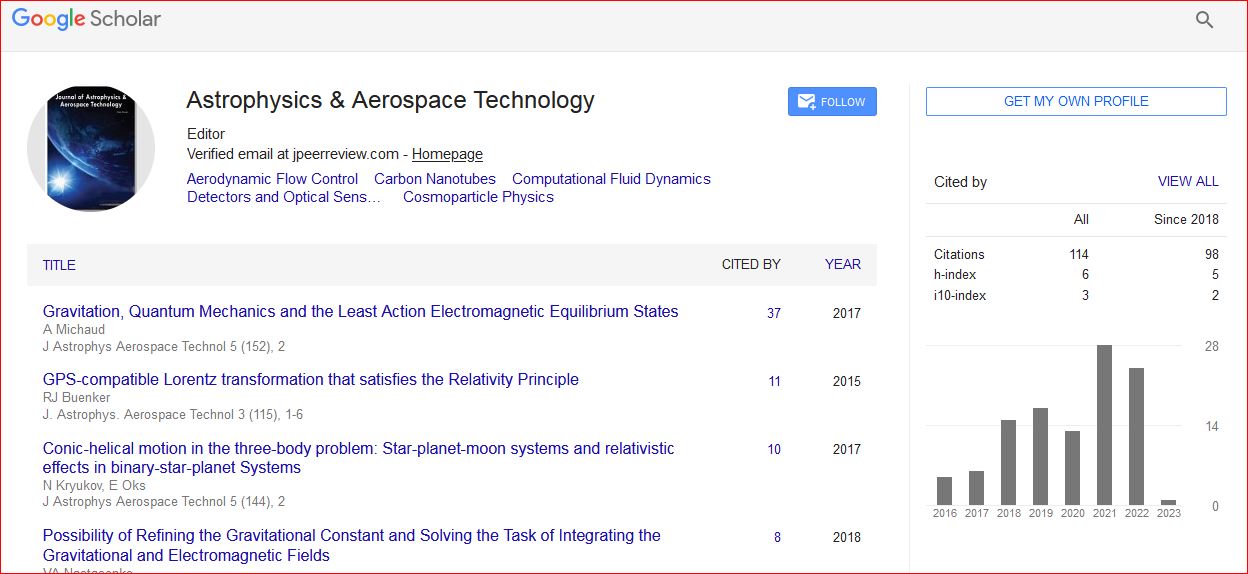
Astrophysics & Aerospace Technology received 114 citations as per Google Scholar report