Short Communication - (2025) Volume 15, Issue 4
Received: 02-Aug-2025, Manuscript No. jeat-26-188642;
Editor assigned: 04-Aug-2025, Pre QC No. P-188642;
Reviewed: 18-Aug-2025, QC No. Q-188642;
Revised: 25-Aug-2025, Manuscript No. R-188642;
Published:
01-Sep-2025
, DOI: 10.37421/2161-0525.2025.15.863
Citation: Smith, John. ”Advanced River Water Toxin Monitoring:
Sensitive, Field-Deployable Solutions.” J Environ Anal Toxicol 15 (2025):863.
Copyright: © 2025 Smith J. This is an open-access article distributed under the terms of the Creative Commons Attribution License, which permits unrestricted use, distribution
and reproduction in any medium, provided the original author and source are credited.
The increasing prevalence of toxic substances in river water necessitates the development and application of advanced analytical techniques for their detection and quantification. These substances, including heavy metals, pesticides, and pharmaceuticals, pose significant environmental and health risks, underscoring the critical need for sensitive and selective monitoring methods. Research in this area is actively exploring various spectroscopic, chromatographic, and electrochemical approaches, evaluating their respective strengths, limitations, and real-world applicability for effective pollution surveillance [1].
The on-site detection of heavy metal ions in river water is a crucial aspect of water quality management. Electrochemical sensors have emerged as a promising solution due to their high sensitivity, selectivity, and portability, offering a viable alternative to traditional laboratory-based techniques. Novel electrode materials and sensor designs are being developed to enhance detection limits for pollutants such as lead, cadmium, and mercury, thereby contributing to more effective pollution control strategies [2].
Pharmaceuticals and personal care products (PPCPs) represent a significant class of emerging contaminants in river water, posing substantial risks to aquatic ecosystems and human health. Advanced techniques like liquid chromatography coupled with tandem mass spectrometry (LC-MS/MS) are instrumental in achieving the sensitive detection and high specificity required to identify and quantify these compounds. Method optimization for extraction and analysis is paramount to achieving low detection limits and informing regulatory measures [3].
The rapid and cost-effective monitoring of pesticides in river water is another critical concern for environmental protection. Biosensors, particularly enzyme-based and antibody-based designs, offer a promising alternative to conventional analytical methods by providing real-time data and reducing the need for complex sample preparation. Their efficacy in detecting widely used pesticides, such as organophosphates, is crucial for establishing early warning systems and implementing effective pollution management in riverine environments [4].
There is a clear and growing trend towards decentralized and field-based monitoring of toxic substances in rivers. The development of portable analytical devices is paramount to facilitating in-situ measurements, enabling immediate response to pollution events, and shifting away from reliance on laboratory-bound analyses. Research is exploring various portable technologies, including microfluidic devices, portable mass spectrometers, and colorimetric kits, to improve the accessibility and efficiency of water quality assessment and environmental surveillance [5].
Molecularly imprinted polymers (MIPs) are gaining prominence as selective recognition elements in sensors designed for the detection of toxic organic pollutants in river water. Their ability to create tailor-made cavities for specific target analytes ensures high selectivity and stability, even in complex environmental matrices. The synthesis and characterization of MIPs for detecting compounds like polycyclic aromatic hydrocarbons (PAHs) and endocrine disruptors are advancing the development of robust and reliable monitoring tools [6].
Surface-enhanced Raman spectroscopy (SERS) offers remarkable sensitivity enhancement for the ultra-trace detection of toxic substances in river water. This technique allows for the detection of analytes at extremely low concentrations without the need for extensive sample pre-concentration. Optimization of plasmonic substrates and SERS parameters is key to its application in analyzing heavy metals, pesticides, and other organic pollutants, presenting a powerful tool for environmental monitoring [7].
Aptasensors, which utilize aptamers (short DNA or RNA molecules) for highly specific and high-affinity binding to target molecules, are emerging as a sensitive and reagent-free analytical platform for environmental monitoring. Their development for detecting heavy metals and small organic molecules in river water provides a promising alternative to traditional antibody-based sensors, enhancing the capability for environmental surveillance [8].
The integration of nanotechnology with advanced separation techniques is crucial for improving the monitoring of toxic substances in river water. Nanomaterials are employed to enhance sample pre-concentration efficiency and the sensitivity of detection methods. The synergistic use of nano-based extraction techniques with chromatographic and spectroscopic analyses has demonstrated significant improvements in detection limits and overall analytical performance for a wide range of pollutants [9].
Microplastics and their associated chemical contaminants are recognized as significant emerging pollutants in river water, capable of adsorbing and transporting toxic substances. The challenges and prospects of monitoring these complex pollutants require the development and standardization of diverse analytical methods, including microscopy, spectroscopy, and chromatography, for effective identification, quantification, and integrated environmental assessment [10].
The detection and quantification of toxic substances in river water are paramount for safeguarding environmental and public health. Advanced analytical techniques are continually being refined to meet the challenge of identifying and measuring pollutants such as heavy metals, pesticides, and pharmaceuticals. Research into spectroscopic, chromatographic, and electrochemical methods highlights their potential and limitations in real-world monitoring scenarios, with a particular focus on emerging contaminants and the development of field-deployable systems for rapid assessment [1].
Electrochemical sensors represent a significant advancement in the on-site detection of heavy metal ions in river water. Their inherent advantages of high sensitivity, selectivity, and portability are critical for effective water quality management. The ongoing development of novel electrode materials and innovative sensor designs aims to further improve detection limits for key pollutants like lead, cadmium, and mercury, thereby enhancing pollution control strategies [2].
The pervasive presence of pharmaceuticals and personal care products (PPCPs) in river water necessitates sophisticated analytical approaches. Liquid chromatography coupled with tandem mass spectrometry (LC-MS/MS) has proven to be highly effective in achieving the required sensitivity and specificity for the detection of these emerging contaminants. Optimization of extraction and analytical protocols is vital for obtaining reliable data that informs regulatory actions aimed at mitigating risks to aquatic ecosystems and human health [3].
Pesticides, widely used in agriculture, pose a considerable threat to river water quality. Biosensors offer a compelling alternative to traditional laboratory methods by enabling rapid and cost-effective monitoring. The research and development of enzyme-based and antibody-based biosensors are crucial for real-time detection of pesticides such as organophosphates, contributing to early warning systems and more effective pollution management [4].
There is a concerted effort to move analytical monitoring from laboratory settings to the field. This shift is driven by the need for portable analytical devices that enable in-situ measurements and facilitate immediate responses to pollution incidents. The exploration of various portable technologies, including microfluidic devices, portable mass spectrometers, and colorimetric kits, promises to democratize and improve the efficiency of water quality surveillance [5].
Molecularly imprinted polymers (MIPs) are being utilized to create highly selective sensors for toxic organic pollutants in river water. These custom-designed polymers offer robust recognition capabilities, even in complex environmental samples, making them ideal for detecting analytes like polycyclic aromatic hydrocarbons (PAHs) and endocrine disruptors. Their application signifies a substantial step towards developing more reliable and stable monitoring tools [6].
Surface-enhanced Raman spectroscopy (SERS) provides an exceptional level of sensitivity for detecting trace amounts of toxic substances in river water. By utilizing plasmonic substrates, SERS enables ultra-trace analysis without the need for laborious pre-concentration steps. The ongoing refinement of SERS parameters and substrate selection is crucial for its broad application in monitoring heavy metals, pesticides, and organic pollutants [7].
Aptasensors are emerging as a valuable tool for the specific detection of toxic compounds in river water. These sensors leverage the unique binding properties of aptamers to achieve high affinity and specificity. The development of aptasensors for detecting heavy metals and small organic molecules offers a reagent-free and sensitive analytical platform, representing a significant advancement in environmental monitoring capabilities [8].
Nanotechnology plays a pivotal role in enhancing the analytical performance for monitoring toxic substances in river water. The integration of nanomaterials into separation and detection processes significantly improves sample pre-concentration efficiency and overall analytical sensitivity. This synergy between nanotechnology and advanced separation techniques, when coupled with chromatography and spectroscopy, leads to substantial improvements in detecting a wide array of pollutants [9].
The comprehensive monitoring of microplastics and their associated chemical contaminants in river water presents complex analytical challenges. The ability of microplastics to act as carriers for toxic substances necessitates integrated analytical approaches that combine methods like microscopy, spectroscopy, and chromatography. Standardization of sampling and analysis is crucial for accurate assessment and effective management of these emerging pollutants [10].
This compilation of research highlights advanced analytical techniques for monitoring toxic substances in river water, addressing critical environmental and health concerns. It covers a range of methods, from sophisticated spectroscopic and chromatographic approaches like LC-MS/MS and SERS to emerging technologies such as electrochemical sensors, biosensors, aptasensors, and portable devices. The use of molecularly imprinted polymers and nanotechnology-enhanced methods demonstrates significant progress in achieving higher sensitivity and selectivity for pollutants including heavy metals, pesticides, pharmaceuticals, and microplastics. The overarching theme is the shift towards more rapid, sensitive, and field-deployable analytical solutions to improve water quality management and pollution control.
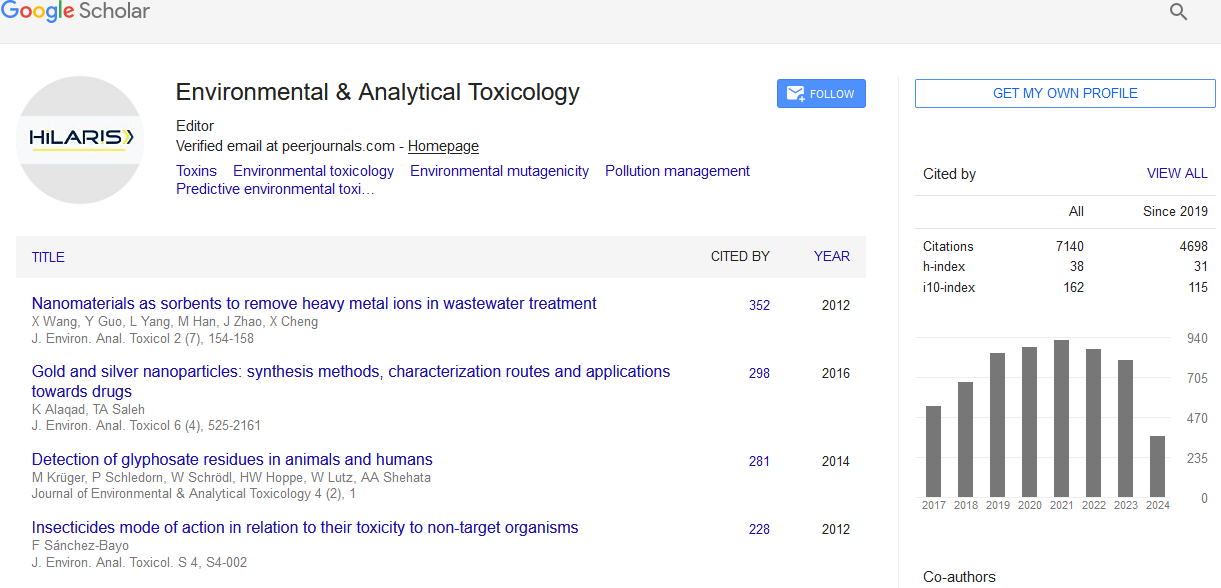
Environmental & Analytical Toxicology received 6818 citations as per Google Scholar report