Perspective - (2025) Volume 16, Issue 4
Received: 01-Aug-2025, Manuscript No. csj-26-183456;
Editor assigned: 04-Aug-2025, Pre QC No. P-183456;
Reviewed: 18-Aug-2025, QC No. Q-183456;
Revised: 22-Aug-2025, Manuscript No. R-183456;
Published:
29-Aug-2025
, DOI: 10.37421/2160-3494.2025.16.471
Citation: Torres, Felipe. ”Advanced Quantum Chemistry Methods For Complex Systems.” Chem Sci J 16 (2025):471.
Copyright: © 2025 Torres F. This is an open-access article distributed under the terms of the Creative Commons Attribution License, which permits unrestricted use, distribution and reproduction in any medium, provided the original author and source are credited.
The field of quantum chemistry has witnessed remarkable advancements in recent years, driven by the continuous development of sophisticated theoretical methods and algorithms. These computational tools are indispensable for dissecting the intricate electronic structures and dynamics of molecules, which underpin a vast array of chemical and physical phenomena. The ability to accurately predict properties such as reaction pathways, spectroscopic signatures, and material characteristics at the atomic level empowers researchers to design novel molecules and materials with tailored functionalities [1].
Understanding electron correlation, a fundamental quantum mechanical effect, remains a central challenge in electronic structure theory. Various methods have been proposed and refined to capture these complex interactions, each with its own strengths and limitations. The performance evaluation of these methods is crucial for determining their suitability for specific applications and for guiding the development of even more accurate and efficient computational approaches [2].
Intermolecular interactions, though weaker than intramolecular bonds, play a pivotal role in many areas of chemistry and biology. The accurate theoretical description of these forces, including van der Waals forces, hydrogen bonding, and pi-pi stacking, is essential for understanding molecular recognition, self-assembly, and the behavior of condensed phases. The development of robust quantum chemical methods for these interactions is an ongoing area of active research [3].
The integration of artificial intelligence, particularly machine learning (ML), with traditional quantum chemistry methods represents a paradigm shift in computational chemistry. ML models can be trained on data generated by high-level quantum chemical calculations to predict molecular properties and energies with unprecedented speed, thereby accelerating the discovery of new materials and molecules [4].
Excited-state properties, such as those involved in photochemistry and molecular electronics, often require specialized theoretical treatment. Time-dependent density functional theory (TD-DFT) has emerged as a powerful and widely used method for studying these properties. However, challenges remain in accurately describing certain types of excited states, necessitating the development of improved TD-DFT functionals and algorithms [5].
For systems containing heavy elements, relativistic effects become significant and cannot be neglected in accurate electronic structure calculations. These effects, arising from the high velocities of electrons in such atoms, can profoundly influence bonding, reactivity, and spectroscopic properties. The development and application of relativistic quantum chemical methods are therefore critical for understanding the chemistry of these elements [6].
Strongly correlated electronic systems, characterized by significant electron-electron repulsion, pose a substantial challenge for standard quantum chemical methods. Active space methods, such as CASSCF, are designed to handle these systems by explicitly treating the electrons in a limited set of orbitals, providing accurate descriptions of phenomena like bond breaking and formation [7].
The choice of basis set is a critical factor influencing the accuracy and computational cost of quantum chemical calculations. Different types of basis sets, ranging from simpler atomic basis sets to more complex correlation-consistent sets, offer varying levels of accuracy. Careful selection of an appropriate basis set is essential for obtaining reliable results for diverse molecular systems [8].
Quantum Monte Carlo (QMC) methods offer a stochastic approach to solving the electronic Schrödinger equation, providing a pathway to highly accurate calculations of electronic structure. These methods are particularly adept at treating electron correlation and have been applied successfully to challenging systems where other methods may struggle, serving as a benchmark for theoretical accuracy [9].
Analyzing the electronic structure of very large molecular systems, such as biomolecules and supramolecular assemblies, presents a significant computational hurdle. Fragment-based quantum chemical methods offer a viable solution by dividing the large system into smaller, manageable fragments, allowing for high-level quantum chemical treatment while efficiently accounting for inter-fragment interactions [10].
The application of advanced quantum chemistry and electronic structure methodologies is a cornerstone of modern molecular science, enabling the deep exploration of complex molecular behaviors. Density functional theory (DFT) and coupled-cluster (CC) approaches, in particular, stand out for their ability to accurately predict diverse molecular properties, including reaction mechanisms, spectroscopic characteristics, and material performance. The pursuit of computational efficiency, through strategies like parallelization and the creation of novel basis sets, is paramount for extending these investigations to larger and more intricate systems relevant to fields such as catalysis and drug discovery [1].
A comprehensive evaluation of various electronic structure methodologies is essential for their effective application in quantum chemistry. Methods such as configuration interaction (CI) and many-body perturbation theory (MBPT) are employed to accurately describe electron correlation effects in demanding molecular systems. A comparative analysis focusing on both accuracy and computational expense is invaluable, suggesting that hybrid techniques, which judiciously combine the strengths of different theoretical frameworks, can offer optimal solutions for specific computational tasks, such as the characterization of excited states and the study of strong correlation phenomena [2].
The accurate description of intermolecular interactions is a critical area within quantum chemistry, essential for understanding molecular assembly and function. The reliability of dispersion-corrected DFT functionals and explicitly correlated coupled-cluster methods in capturing the nuances of van der Waals forces, hydrogen bonding, and pi-pi stacking is paramount. These findings hold significant implications for advancements in areas like molecular recognition, crystal engineering, and the development of advanced soft materials [3].
The synergy between quantum chemistry and machine learning (ML) is revolutionizing computational efficiency in electronic structure calculations. By training ML models on data derived from high-fidelity quantum chemical computations, researchers can achieve remarkable speed and accuracy in predicting molecular properties and energies. This convergence of computational techniques is paving the way for high-throughput screening and the expedited design of novel functional materials [4].
Specialized theoretical approaches are often required for the accurate computation of excited-state properties. Time-dependent density functional theory (TD-DFT) is a widely adopted method for this purpose. Ongoing research efforts are focused on addressing challenges related to the description of charge-transfer excitations and Rydberg states through the incorporation of refined exchange-correlation functionals and improved basis sets, providing practical guidance for photochemistry and molecular electronics research [5].
In the study of heavy elements, the inclusion of relativistic effects in electronic structure calculations is a non-negotiable requirement for achieving accurate predictions. Methods based on the Dirac equation, such as Dirac-Hartree-Fock and relativistic DFT, are employed to evaluate the properties of organometallic compounds and other heavy element systems. The rigorous accounting for relativistic contributions is indispensable for a thorough understanding of bonding, reactivity, and spectroscopic features in these systems [6].
For molecular systems exhibiting strong electron correlation, such as those involved in bond breaking/formation processes or transition metal complexes, active space methods are particularly well-suited. Techniques like the complete active space self-consistent field (CASSCF) and its derivatives have demonstrated efficacy in overcoming the limitations of single-reference methods, providing accurate descriptions of complex electronic behaviors [7].
The selection of an appropriate basis set is a crucial decision that directly impacts the accuracy and computational feasibility of quantum chemical calculations. A critical assessment of various basis sets, including atomic natural orbital (ANO) and augmented correlation-consistent sets, provides valuable insights into their performance. Guidelines for selecting basis sets that balance accuracy and computational cost are indispensable for a wide range of applications, from small molecule studies to the analysis of extended systems [8].
Quantum Monte Carlo (QMC) methods, encompassing variational and diffusion Monte Carlo techniques, offer a powerful route to extremely accurate electronic structure calculations. Their inherent ability to efficiently handle electron correlation makes them ideal for challenging systems, including transition metal compounds and solid-state materials, often serving as a benchmark against which other computational methods are compared [9].
Analyzing the electronic structure of large molecular systems, such as complex biomolecules and supramolecular assemblies, presents significant computational challenges. Fragment-based quantum chemical methods offer a pragmatic solution by partitioning the system into smaller, treatable fragments. This approach allows for the application of high-level quantum chemical treatments to individual fragments while accurately incorporating inter-fragment interactions, thereby achieving a favorable balance between accuracy and computational expense [10].
This collection of research papers delves into advanced quantum chemistry and electronic structure methods for understanding complex molecular systems. Studies explore the applications of density functional theory (DFT), coupled-cluster (CC) approaches, configuration interaction (CI), and many-body perturbation theory (MBPT) for predicting reaction pathways, spectroscopic properties, and electron correlation. The importance of accurate intermolecular interaction descriptions using dispersion-corrected DFT and explicitly correlated CC methods is highlighted. The integration of machine learning (ML) with quantum chemistry accelerates calculations for materials discovery, while efficient TD-DFT methods are developed for excited-state properties. Research also addresses relativistic effects in heavy element calculations, active space methods for strongly correlated systems, and the critical role of basis set selection. Quantum Monte Carlo (QMC) methods are presented for high-accuracy calculations, and fragment-based quantum chemistry is explored for large molecular systems, offering strategies to enhance computational efficiency and accuracy across diverse chemical challenges.
None
None
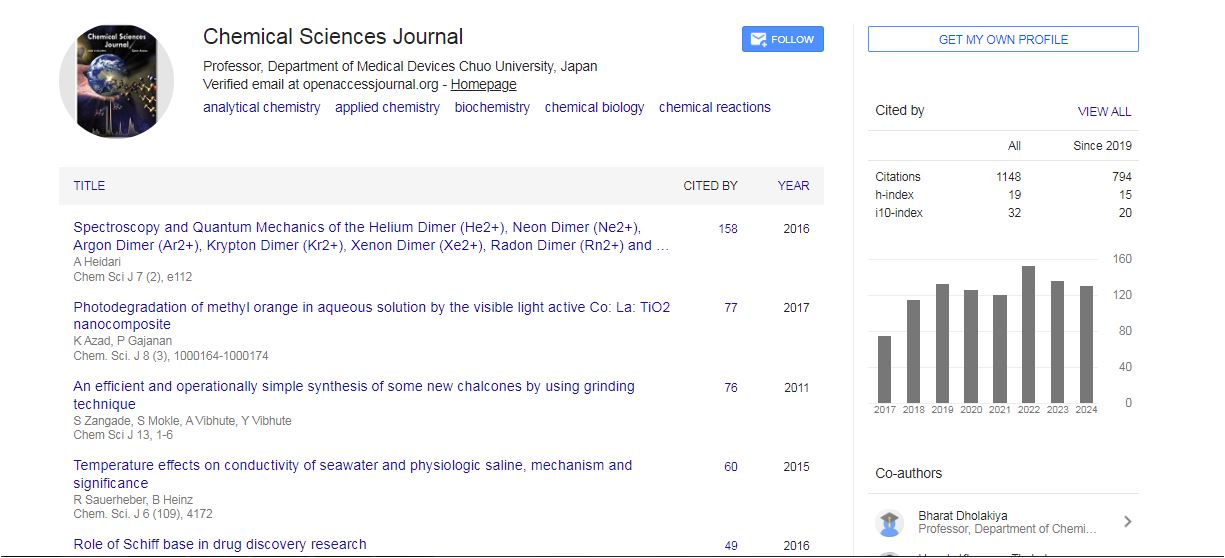
Chemical Sciences Journal received 912 citations as per Google Scholar report