Brief Report - (2025) Volume 10, Issue 5
Received: 01-Sep-2025, Manuscript No. apn-26-179343;
Editor assigned: 03-Sep-2025, Pre QC No. P-179343;
Reviewed: 14-Sep-2025, QC No. Q-179343;
Revised: 22-Sep-2025, Manuscript No. R-179343;
Published:
29-Sep-2025
, DOI: 10.37421/2573-0347.2025.10.457
Citation: González, MarÃa. âAdvanced Practice Nurses: Driving Patient Safety and Quality.â J Adv Practice Nurs 10 (2025):457.
Copyright: © 2025 González M. This is an open-access article distributed under the terms of the Creative Commons Attribution License, which permits unrestricted use,
distribution and reproduction in any medium, provided the original author and source are credited.
Advanced practice nurses (APNs) are recognized as pivotal figures in the contemporary healthcare landscape, playing a critical role in enhancing patient safety through a multifaceted approach that encompasses clinical practice, leadership, and advocacy. Their expertise is instrumental in driving the implementation of evidence-based practices, a cornerstone of modern healthcare quality and safety initiatives. APNs are adept at leading quality improvement projects, diligently working to identify areas for enhancement and subsequently implementing data-driven solutions to optimize patient care processes and outcomes. Furthermore, their advocacy for systemic changes within healthcare organizations is crucial for fostering environments that prioritize patient well-being and minimize risks. These roles extend beyond direct patient care, involving significant contributions to interdisciplinary collaboration, where they act as vital links between various healthcare professionals to ensure seamless and safe patient management. APNs also play an indispensable role in educating both healthcare staff and patients, thereby empowering individuals and promoting a deeper understanding of health conditions and treatment plans. This educational focus is particularly important in areas such as medication safety, where APNs meticulously work to reduce errors and adverse drug events through comprehensive reconciliation processes. Their involvement in fall prevention programs is another critical area, where they conduct thorough risk assessments and coordinate care to mitigate the incidence of falls and subsequent injuries. Moreover, APNs are at the forefront of combating healthcare-associated infections, leveraging their knowledge to strengthen surveillance, prevention strategies, and the management of these prevalent issues. Collectively, these contributions underscore the indispensable role of APNs in cultivating a culture of safety that ultimately leads to improved patient outcomes and a more robust healthcare system.
Advanced practice nurses are central to enhancing patient safety by implementing evidence-based practices, leading quality improvement projects, and advocating for systemic changes. Their roles extend to direct patient care, interdisciplinary collaboration, and education, all aimed at reducing errors and improving outcomes. Initiatives often focus on areas like medication safety, fall prevention, and infection control, with advanced practice nurses acting as key drivers of these efforts [1].
Implementing standardized protocols for medication reconciliation by advanced practice nurses significantly reduces adverse drug events. This process, often involving detailed patient history and comprehensive drug review, ensures accuracy and completeness, especially during transitions of care. Collaboration with pharmacists and other healthcare providers is essential for the success of these initiatives [2].
Advanced practice nurses play a crucial role in developing and implementing fall prevention programs in healthcare settings. Their ability to conduct thorough patient risk assessments, coordinate interdisciplinary care plans, and educate staff and patients contributes to a reduction in falls and related injuries. Continuous monitoring and evaluation of these programs are key to their effectiveness [3].
The integration of advanced practice nurses into infection control teams strengthens surveillance, prevention, and management of healthcare-associated infections. Their expertise in epidemiology, microbiology, and evidence-based interventions allows them to lead initiatives that improve hand hygiene compliance, optimize antibiotic stewardship, and reduce the incidence of multidrug-resistant organisms [4].
Patient education delivered by advanced practice nurses is a cornerstone of patient safety, empowering individuals to actively participate in their care. Topics range from understanding medication regimens and managing chronic conditions to recognizing warning signs and utilizing healthcare resources effectively. This empowers patients and reduces preventable complications [5].
Advanced practice nurses contribute to a culture of safety by promoting open communication and a non-punitive approach to error reporting. They facilitate root cause analyses and implement strategies to prevent recurrence of adverse events. This leadership fosters an environment where safety is prioritized and continuous improvement is the norm [6].
The implementation of early warning scores and rapid response systems, often coordinated by advanced practice nurses, has been shown to improve patient outcomes by enabling timely intervention for deteriorating patients. These systems standardize the identification of at-risk individuals and facilitate prompt clinical response [7].
Advanced practice nurses are instrumental in driving quality improvement projects focused on patient safety, using data to identify areas for improvement and implement evidence-based solutions. Their leadership in these projects leads to measurable enhancements in patient care processes and outcomes [8].
The collaborative practice models involving advanced practice nurses, physicians, and other healthcare professionals are crucial for comprehensive patient safety. Effective communication and shared decision-making within these teams minimize diagnostic errors and ensure coordinated, safe patient management [9].
Advanced practice nurses are essential in promoting evidence-based practice adoption, which is directly linked to improved patient safety. By critically appraising research and integrating findings into clinical workflows, they ensure that patient care is informed by the latest and most effective interventions [10].
Advanced practice nurses (APNs) are vital to patient safety, employing evidence-based practices, leading quality improvement, and advocating for systemic change. Their roles encompass direct care, interdisciplinary collaboration, and education, all focused on error reduction and outcome enhancement. Specific initiatives led by APNs target medication safety through reconciliation, fall prevention via risk assessment and care planning, and infection control through robust surveillance and stewardship. APNs empower patients through education, fostering active participation in care and reducing preventable complications. They champion a culture of safety by promoting open communication and non-punitive error reporting, facilitating root cause analyses. The integration of early warning scores and rapid response systems by APNs improves timely intervention for deteriorating patients. Furthermore, APNs drive quality improvement projects using data to implement effective solutions and enhance patient care processes. Collaborative practice models involving APNs ensure comprehensive safety through effective communication and shared decision-making, minimizing errors. Finally, APNs are key to promoting evidence-based practice adoption, ensuring patient care is informed by the latest research.
None
None
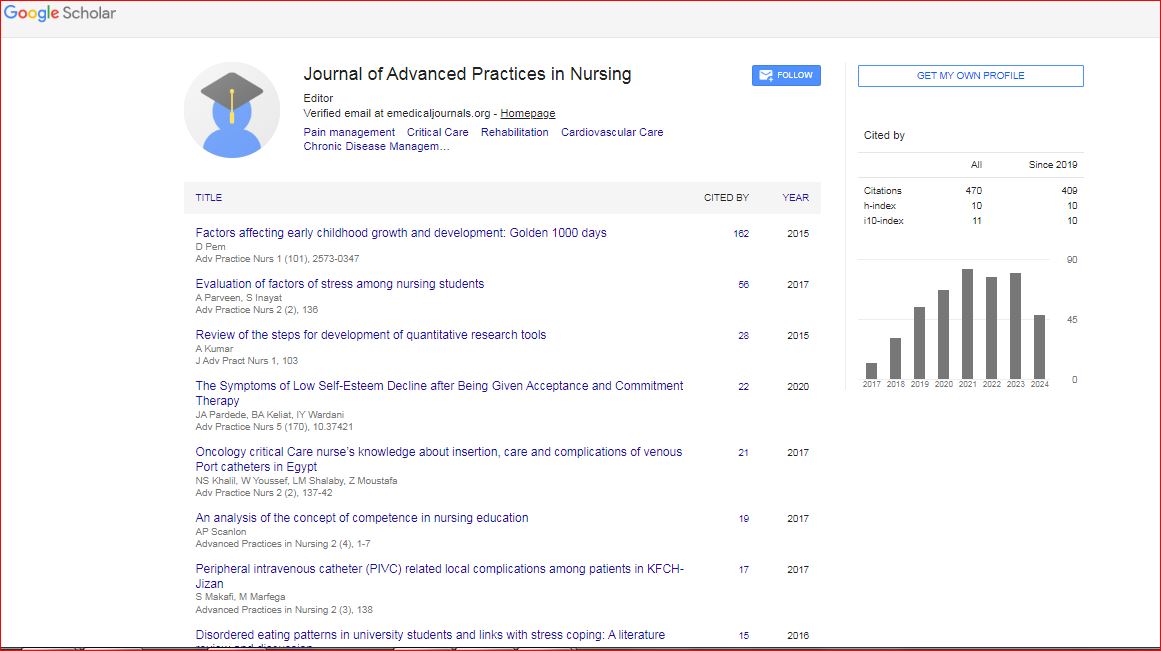
Journal of Advanced Practices in Nursing received 410 citations as per Google Scholar report