Short Communication - (2025) Volume 15, Issue 5
Received: 01-Sep-2025, Manuscript No. jbpbt-25-178526;
Editor assigned: 03-Sep-2025, Pre QC No. P-178526;
Reviewed: 17-Sep-2025, QC No. Q-178526;
Revised: 22-Sep-2025, Manuscript No. R-178526;
Published:
29-Sep-2025
, DOI: 10.37421/2155-9821.2025.15.702
Citation: Chatterjee, Nikhil A.. ”Advanced Non-Viral Transfection for Bioprocessing.” J Bioprocess Biotech 15 (2025): 702.
Copyright: © 2025 Chatterjee A. Nikhil This is an open-access article distributed under the terms of the Creative Commons Attribution License, which permits unrestricted use,
distribution and reproduction in any medium, provided the original author and source are credited.
The optimization of high-efficiency transfection techniques is of paramount importance in the realm of bioprocess applications, particularly for scalable biomanufacturing processes involved in the production of therapeutic proteins, cell-based therapies, and vaccine development. Advances in non-viral gene delivery methods, such as electroporation and microfluidic-based approaches, are offering enhanced cell viability and transfection rates compared to conventional viral vectors. The adaptation of these technologies for industrial-scale production necessitates addressing challenges related to cost-effectiveness, reproducibility, and regulatory compliance, with the selection of the appropriate technique being contingent upon cell type, scale, and specific application requirements [1].
Investigating the intricate mechanisms of cell membrane permeabilization during transfection, particularly through physical methods like electroporation, allows for fine-tuning gene transfer efficiency in mammalian cells critical for bioprocessing. This involves optimizing waveform parameters and buffer compositions to mitigate cellular stress while maximizing DNA uptake, underscoring the necessity of comprehending cell physiology for reproducible bioprocess outcomes [2].
The utility of microfluidic devices for high-throughput and scalable transfection within bioprocess settings is being increasingly assessed. These platforms provide precise control over fluid dynamics and cell-particle interactions, leading to improved transfection efficiency and reduced reagent consumption, thus enabling rapid screening of cell lines and optimization of culture conditions in biologic development [3].
As the demand for recombinant protein production in biopharmaceutical manufacturing grows, the challenges associated with scaling up transfection processes become more pronounced. A critical evaluation of various physical and chemical transfection strategies, comparing their strengths and weaknesses in terms of cost, efficiency, and biosafety at industrial scales, is essential. The development of robust and reproducible transfection protocols suitable for GMP environments remains a key focus [4].
The application of sonoporation, a transfection technique mediated by sound waves, is being explored for enhanced gene delivery across diverse cell types relevant to bioprocessing. Examining the influence of ultrasonic parameters, such as frequency and intensity, on cell viability and transfection efficiency suggests sonoporation as a promising, non-invasive method for efficient genetic modification in biopharmaceutical applications [5].
Addressing the persistent need for improved transfection efficiency and reduced toxicity has spurred the development of novel nanoparticle-based delivery systems. Research into lipid-based nanoparticles and polymeric micelles designed for specific cell targeting and efficient intracellular delivery of nucleic acids aims to overcome cellular barriers, leading to higher transfection rates and better product yields in bioprocessing [6].
A comparative analysis of different transfection methods, encompassing chemical, physical, and viral approaches, is crucial for the efficient production of monoclonal antibodies (mAbs) in CHO cells. A detailed examination of transfection efficiency, cell growth kinetics, and mAb productivity for each method provides valuable guidance for selecting the most suitable strategy for large-scale mAb manufacturing [7].
The application of hydrodynamic transfection for large-volume gene delivery in bioprocess applications is being investigated. This method, which utilizes fluid flow to facilitate gene entry into cells, offers advantages for scaling up and has the potential for generating cell lines with stable gene integration, a critical factor for long-term biomanufacturing [8].
Innovations in electroporation systems are being tailored for industrial-scale bioprocessing, focusing on advanced electrode designs and pulse control to optimize cell electropermeabilization for enhanced transfection efficiency and viability in large cell volumes. This research facilitates the transition from laboratory-scale to manufacturing-scale electroporation for therapeutic protein production [9].
Finally, the integration of transfection technologies into continuous bioprocessing is being explored to achieve sustained production of biologics. This involves examining the challenges and opportunities of implementing dynamic gene delivery methods, such as flow electroporation and microfluidics, within continuous manufacturing platforms to enhance productivity and enable process intensification [10].
The current landscape of biopharmaceutical manufacturing relies heavily on efficient gene delivery techniques to optimize the production of therapeutic proteins, cell-based therapies, and vaccines. Recent advancements have focused on non-viral methods, including electroporation and microfluidics, which demonstrate superior cell viability and transfection rates compared to traditional viral vectors. These emerging technologies are being actively adapted for industrial-scale applications, necessitating robust solutions for cost-effectiveness, reproducibility, and regulatory adherence. The selection of an appropriate transfection method is critically dependent on factors such as cell type, desired scale of production, and specific application needs, highlighting the complexity of optimizing these processes [1].
The fundamental process of cell membrane permeabilization during transfection is a key area of investigation, particularly concerning physical methods like electroporation. Fine-tuning electroporation parameters is essential for enhancing gene transfer efficiency in mammalian cells vital for bioprocessing. This optimization involves meticulous adjustments to waveform characteristics and buffer compositions to minimize cellular stress and maximize DNA uptake, emphasizing the importance of understanding cellular physiology for achieving reproducible bioprocess outcomes [2].
Microfluidic devices are proving to be valuable tools for high-throughput and scalable transfection in bioprocess environments. Their ability to precisely control fluid dynamics and cell-particle interactions translates into improved transfection efficiency and reduced reagent consumption. This precision allows for accelerated screening of cell lines and more effective optimization of culture conditions during the development of biologics [3].
Scaling up transfection processes for the industrial-scale production of recombinant proteins presents significant challenges. A thorough comparative analysis of various physical and chemical transfection strategies is imperative, evaluating their respective merits and drawbacks in terms of cost, efficiency, and biosafety at manufacturing scales. The development and implementation of robust, reproducible transfection protocols are crucial for reliable operation within GMP environments [4].
Sonoporation, a transfection technique that utilizes sound waves, is emerging as a promising non-invasive approach for improving gene delivery across a range of cell types relevant to bioprocessing. Research is focused on understanding how ultrasonic parameters, such as frequency and intensity, impact cell viability and transfection efficiency, suggesting its potential for efficient genetic modification in biopharmaceutical applications [5].
Driven by the need for enhanced efficiency and reduced toxicity in transfection, the development of advanced nanoparticle-based delivery systems is a significant area of research. Engineered nanoparticles, including lipid-based formulations and polymeric micelles, are being designed for targeted cellular delivery of nucleic acids. These systems aim to overcome biological barriers, thereby increasing transfection rates and improving product yields in bioprocessing applications [6].
For the production of monoclonal antibodies (mAbs) in CHO cells, a comprehensive comparative evaluation of diverse transfection methods is essential. This includes assessing chemical, physical, and viral approaches, with a detailed analysis of transfection efficiency, cell growth kinetics, and mAb productivity. Such comparisons provide critical guidance for selecting the optimal transfection strategy for large-scale mAb manufacturing [7].
Hydrodynamic transfection is being explored for its applicability in large-volume gene delivery within bioprocesses. This method leverages fluid flow to facilitate gene entry into cells, offering distinct advantages for scalability. Its potential for generating cell lines with stable gene integration is particularly significant for long-term biomanufacturing endeavors [8].
Innovations in electroporation systems are being specifically developed to meet the demands of industrial-scale bioprocessing. These advancements involve sophisticated electrode designs and pulse control mechanisms aimed at optimizing cell electropermeabilization. The goal is to achieve higher transfection efficiencies and improved cell viability when working with large cell volumes, facilitating the transition from laboratory-scale research to manufacturing applications [9].
Furthermore, the integration of transfection technologies into continuous bioprocessing workflows is being investigated to enable sustained and intensified production of biologics. This includes exploring dynamic gene delivery methods like flow electroporation and microfluidics within continuous manufacturing platforms, addressing the associated challenges and opportunities for enhanced productivity [10].
This collection of research highlights advancements in transfection techniques crucial for bioprocess applications and scalable biomanufacturing. The focus is on non-viral methods such as electroporation, microfluidics, sonoporation, hydrodynamic transfection, and nanoparticle-based delivery systems, which offer improved efficiency and reduced toxicity compared to traditional viral vectors. These studies explore optimization strategies, including parameter tuning, device design, and material engineering, to enhance gene delivery in various cell types, particularly for therapeutic protein, cell therapy, and vaccine production. The overarching theme is the development of robust, reproducible, and scalable transfection protocols suitable for industrial-scale manufacturing, including considerations for continuous bioprocessing and GMP compliance. Comparative analyses of different methods are also presented to guide the selection of optimal strategies for specific applications like monoclonal antibody production.
None
None
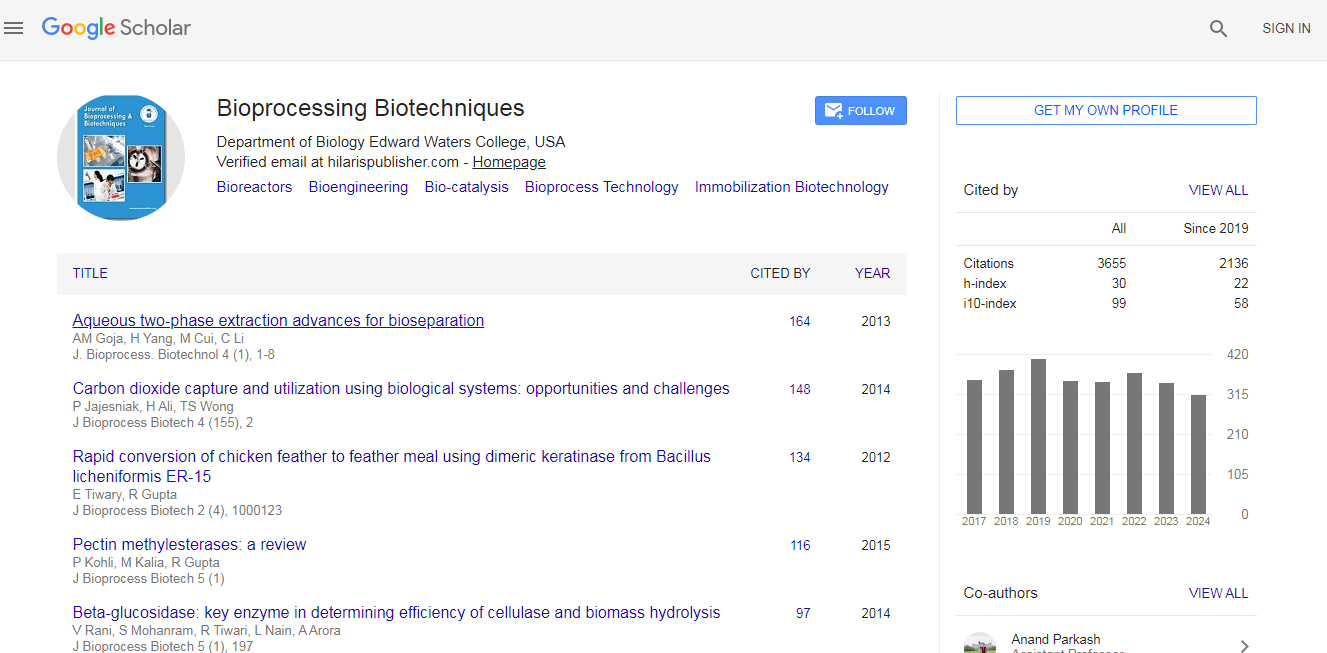
Journal of Bioprocessing & Biotechniques received 3351 citations as per Google Scholar report