Brief Report - (2025) Volume 12, Issue 6
Received: 01-Dec-2025, Manuscript No. jreac-26-185804;
Editor assigned: 03-Dec-2025, Pre QC No. P-185804;
Reviewed: 17-Dec-2025, QC No. Q-185804;
Revised: 22-Dec-2025, Manuscript No. R-185804;
Published:
29-Dec-2025
, DOI: 10.37421/2380-2391.2025.12.466
Citation: Herrera, Miguel. ”Advanced Methods for Environmental Health Risk Assessment.” J Environ Anal Chem 12 (2025):466.
Copyright: © 2025 Herrera M. This is an open-access article distributed under the terms of the Creative Commons Attribution License, which permits unrestricted use,
distribution and reproduction in any medium, provided the original author and source are credited
Assessing environmental health risks is a critical endeavor for safeguarding public well-being, necessitating robust analytical methodologies to identify and quantify contaminants and their potential impacts [1].
The field of environmental science is increasingly reliant on advanced analytical techniques to detect and measure emerging contaminants in water sources, ensuring that water quality assessments are comprehensive and accurate [2].
Nanotechnology offers novel approaches to environmental health risk assessment, with the development of nanomaterials for sensing and remediation holding significant promise for characterizing and mitigating contaminant behavior in various environmental matrices [3].
Statistical modeling and data analysis are indispensable tools for interpreting complex environmental health data, providing frameworks for uncertainty analysis, exposure modeling, and the integration of diverse datasets to derive reliable risk estimations [4].
The analysis of air pollutants and their subsequent impact on respiratory health is a major focus, with various sampling and analytical techniques employed to measure airborne hazards and link them to epidemiological data for risk assessment in urban settings [5].
Evaluating persistent organic pollutants (POPs) in food matrices presents unique analytical challenges, requiring specialized methodologies for extraction, cleanup, and instrumental analysis to ensure accurate dietary exposure assessments and inform regulatory frameworks [6].
The development of biosensors for the rapid and sensitive detection of environmental toxins represents a significant advancement, offering on-site monitoring capabilities that facilitate timely risk assessment and intervention for health-relevant contaminants [7].
Assessing exposure to endocrine-disrupting chemicals (EDCs) demands sophisticated analytical methods, including advanced sample preparation and highly sensitive detection techniques, to accurately measure these compounds and their metabolites, which are crucial for understanding their health impacts [8].
Understanding heavy metal contamination in soils and its uptake by plants requires meticulous analytical approaches, including sample digestion and advanced spectroscopic techniques, with a strong emphasis on speciation analysis to accurately determine bioavailability and toxicity [9].
Microbial risks in drinking water are a significant public health concern, addressed through a combination of traditional and molecular analytical methodologies for rapid and accurate identification of pathogens and indicator organisms, ensuring water safety [10].
The foundational principle of environmental health risk assessment lies in the meticulous identification and quantification of environmental contaminants and their potential health impacts through detailed analytical methodologies [1].
Advanced chromatographic and spectrometric techniques, such as LC-MS/MS and GC-MS, are at the forefront of detecting emerging contaminants in water resources, underscoring the critical need for method validation and stringent quality control to ensure accurate risk assessment [2].
Nanotechnology is revolutionizing environmental health risk assessment through the design of innovative nanomaterials intended for contaminant sensing and remediation, although challenges remain in fully characterizing their behavior within environmental matrices and assessing exposure [3].
Statistical approaches and sophisticated modeling techniques are essential for the interpretation of analytical data in environmental health risk assessments, offering methods for uncertainty analysis and exposure modeling to provide robust frameworks for informed decision-making [4].
The analysis of air pollutants employs a range of sampling and analytical techniques to measure particulate matter, volatile organic compounds, and other airborne hazards, with findings directly linked to epidemiological data to assess health risks in populated areas [5].
Persistent organic pollutants (POPs) in food matrices necessitate specialized analytical strategies, encompassing robust extraction, cleanup procedures, and advanced instrumental analysis, to achieve accurate dietary exposure assessments and inform public health policies [6].
Biosensors are emerging as a promising tool for environmental toxin detection, utilizing biomolecular recognition elements and signal transduction mechanisms for rapid, on-site monitoring of contaminants to facilitate timely risk assessment and effective intervention [7].
Endocrine-disrupting chemicals (EDCs) pose significant environmental health challenges, requiring sophisticated analytical methods, including advanced sample preparation and highly sensitive detection, to accurately measure these compounds and their metabolites, which is critical for understanding their health effects [8].
Assessing heavy metal contamination in soil and plant systems relies on precise analytical methods for sample digestion and analysis, employing techniques like ICP-MS and AAS, with a particular focus on speciation analysis to accurately gauge bioavailability and toxicity [9].
Microbial risk assessment in drinking water is addressed through a dual approach, combining traditional culture-based methods with modern molecular techniques such as qPCR and metagenomics for swift and accurate identification of pathogens, thereby safeguarding public health [10].
Environmental health risk assessment relies on sophisticated analytical methodologies to identify and quantify contaminants, understand their impacts, and inform policy decisions. Advanced techniques like chromatography and spectrometry are crucial for detecting emerging contaminants in water, while nanotechnology offers innovative solutions for sensing and remediation. Statistical modeling aids in interpreting complex data for accurate risk estimations. The analysis of air pollutants, persistent organic pollutants in food, and heavy metals in soil and plants employs specialized methods to assess exposure and toxicity. Biosensors provide rapid on-site detection of toxins, and advanced techniques are vital for measuring endocrine-disrupting chemicals. Microbial risks in drinking water are assessed using both traditional and molecular methods to ensure public health.
None
None.
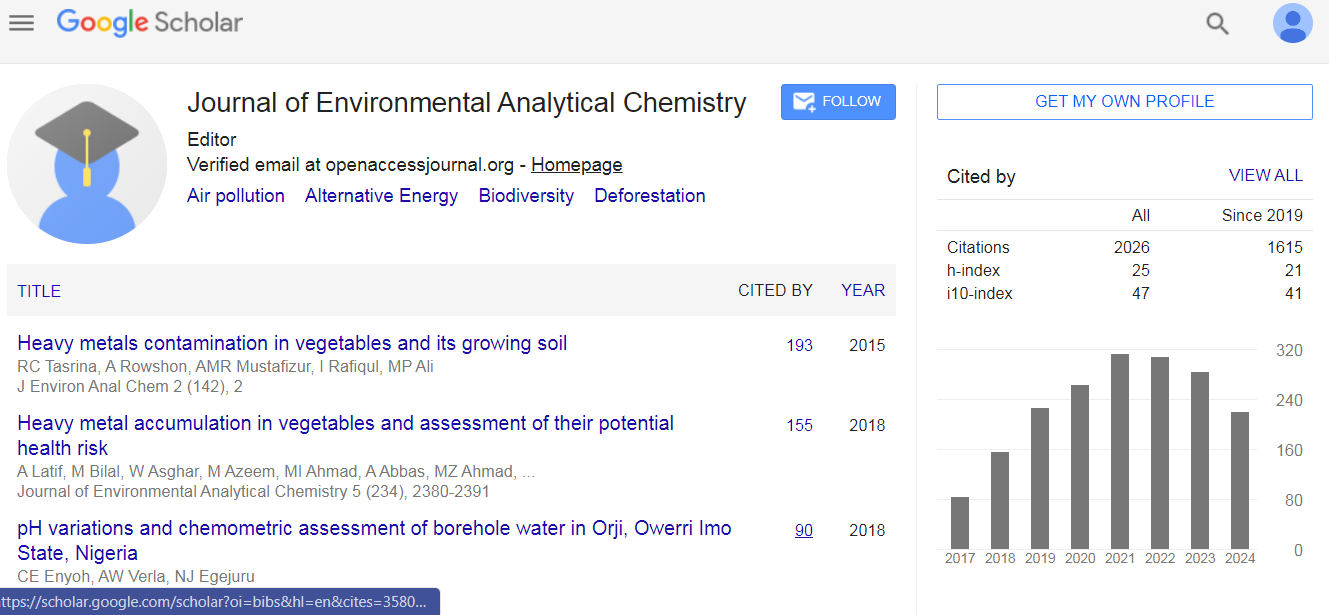
Journal of Environmental Analytical Chemistry received 1781 citations as per Google Scholar report