Opinion - (2025) Volume 14, Issue 3
Received: 01-Jun-2025, Manuscript No. idse-26-182809;
Editor assigned: 03-Jun-2025, Pre QC No. P-182809;
Reviewed: 17-Jun-2025, QC No. Q-182809;
Revised: 23-Jun-2025, Manuscript No. R-182809;
Published:
30-Jun-2025
, DOI: 10.37421/2168-9768.2025.14.491
Citation: Binh, Nguyen Thanh. ”Advanced Irrigation, Drainage
for Sustainable Agriculture.” Irrigat Drainage Sys Eng 14 (2025):491.
Copyright: © 2025 Binh T. Nguyen This is an open-access article distributed under the terms of the Creative Commons Attribution License, which permits unrestricted use,
distribution and reproduction in any medium, provided the original author and source are credited.
The advancement of agricultural practices is critically dependent on the efficient management of water resources, a challenge amplified by growing global food demands and the increasing impacts of climate change. Optimizing irrigation and drainage systems is paramount to ensuring crop productivity while conserving water, a finite and precious resource. Modern agricultural systems are increasingly incorporating advanced technologies to achieve these goals, moving towards more sustainable and productive farming methods across diverse environments. The design and performance of agricultural irrigation systems are undergoing significant transformation, with a strong emphasis on integrating cutting-edge technologies. The primary objective is to enhance water use efficiency and, consequently, improve crop yields. Furthermore, robust drainage systems play an indispensable role in preventing common agricultural problems like waterlogging and soil salinization, thereby fostering sustainable agriculture in varied climatic conditions [1].
Subsurface drainage systems have emerged as a critical component in managing waterlogged agricultural lands. Research in this area focuses on understanding the impact of different subsurface drainage designs on soil moisture levels and crop productivity. By quantifying the benefits of well-designed drainage networks, it becomes clear how improved aeration and nutrient availability can lead to substantial increases in the yield of various agricultural crops [2].
In parallel, the development of smart irrigation systems represents a significant technological leap in water management. These systems leverage sensor networks and real-time data analysis to enable precise water application. The dynamic adjustment of irrigation schedules, informed by soil moisture data and weather forecasts, has demonstrated remarkable potential for substantial water savings and reduced energy consumption, aligning with conservation goals [3].
The reclamation of saline-sodic soils, a persistent challenge in many agricultural regions, can be effectively addressed through engineered drainage systems. These systems are designed to leach harmful salts and improve soil structure, thereby restoring the productivity of degraded land. Case studies provide empirical evidence of the effectiveness of various drainage techniques in this crucial endeavor [4].
Furthermore, hydrological modeling of irrigation and drainage networks offers a powerful tool for optimizing water distribution and minimizing water losses. Advanced simulation tools enable researchers and practitioners to predict system performance under diverse climatic and operational conditions, thereby supporting informed water management decisions and enhancing overall efficiency [5].
The energy footprint of agricultural operations is another area receiving considerable attention, particularly concerning irrigation pumping systems. Research into the energy efficiency of different pump selection strategies and operational optimization provides valuable insights for reducing energy consumption and the associated carbon emissions in irrigation practices [6].
Climate change presents a formidable challenge to agricultural systems, necessitating adaptive strategies in the design of irrigation and drainage infrastructure. Analyzing projected changes in precipitation and temperature allows for the development of resilient and effective systems capable of withstanding environmental shifts and ensuring continued agricultural productivity [7].
The performance and uniformity of water application are critical factors in the efficiency of sprinkler irrigation systems. Investigating different sprinkler types and their performance under varied field conditions helps in minimizing losses due to evaporation and wind drift, leading to more precise and effective water delivery [8].
Beyond conventional engineering solutions, ecological approaches are also gaining traction, particularly in treating agricultural drainage water. Constructed wetlands offer a promising method for removing nutrients and pollutants from drainage water. Understanding their design parameters is key to integrating these sustainable, ecological solutions into broader drainage management strategies [9].
Finally, the adoption of modern irrigation and drainage technologies in smallholder farming systems is influenced by a complex interplay of economic viability and social acceptance. Analyzing these factors and developing targeted strategies is essential for successful implementation and the realization of sustained benefits for a significant portion of the world's agricultural producers [10].
The evolution of agricultural irrigation and drainage systems is intrinsically linked to the drive for enhanced efficiency and sustainability. These systems are increasingly incorporating sophisticated technologies to optimize water usage, a critical factor in crop production and resource conservation. The integration of advanced tools allows for more precise management, leading to higher crop yields and a reduced environmental footprint. These innovations are essential for meeting the demands of a growing global population while mitigating the effects of climate change. Optimizing the design and performance of agricultural irrigation systems involves a comprehensive approach that includes the integration of advanced technologies. The goal is to significantly improve water use efficiency and bolster crop yields. Crucially, well-designed drainage systems are vital for preventing issues like waterlogging and soil salinization. This proactive approach underpins sustainable agricultural practices, ensuring resilience across a spectrum of climatic conditions [1].
In waterlogged agricultural environments, the design of subsurface drainage systems plays a pivotal role in modulating soil moisture regimes and boosting crop productivity. Research quantifies the advantages of optimized drainage networks, which enhance soil aeration and nutrient availability. These improvements directly translate into considerable yield increases for a variety of important agricultural crops, highlighting the importance of tailored drainage solutions [2].
The advent of smart irrigation systems, featuring sensor networks and real-time data analysis, marks a significant advancement in precision agriculture. These systems enable dynamic adjustments to irrigation schedules based on live soil moisture data and weather predictions. This data-driven approach leads to substantial water savings and a reduction in energy consumption, making irrigation more efficient and environmentally sound [3].
Engineered drainage systems are instrumental in the challenging task of reclaiming saline-sodic soils for agricultural purposes. These systems are designed to effectively leach excess salts and improve the physical structure of the soil. Performance analysis and case studies demonstrate the efficacy of various drainage techniques in restoring degraded lands and enhancing their productivity for farming [4].
Hydrological modeling provides a powerful framework for optimizing the performance of irrigation and drainage networks. By simulating water distribution and identifying potential loss points, these models aid in making informed decisions about water management. Advanced simulation tools allow for the prediction of system behavior under various scenarios, contributing to more efficient water resource allocation [5].
The energy efficiency of agricultural irrigation pumping systems is a key consideration for reducing operational costs and environmental impact. Evaluating different pump selection strategies and optimizing operating schedules can lead to significant energy savings. This focus on energy efficiency contributes to a lower carbon footprint for agricultural operations [6].
Climate change necessitates a re-evaluation of the design requirements for agricultural irrigation and drainage systems. By analyzing projected shifts in precipitation patterns and temperature, adaptive design strategies can be developed. These strategies aim to ensure that irrigation and drainage systems remain resilient and effective in the face of evolving environmental conditions [7].
The effectiveness of sprinkler irrigation systems hinges on their performance and the uniformity of water application across fields. Different sprinkler types exhibit varied performance characteristics, and understanding these differences is crucial for minimizing losses due to evaporation and wind drift. This knowledge supports the selection of optimal sprinkler technologies for diverse field conditions [8].
Constructed wetlands offer an innovative and environmentally friendly approach to treating agricultural drainage water. These systems are effective in removing excess nutrients and pollutants, thereby improving water quality. Research into their design and operational parameters provides valuable insights for integrating ecological solutions into agricultural drainage management [9].
For smallholder farming systems, the successful adoption of modern irrigation and drainage technologies depends on their economic viability and social acceptance. Understanding the factors that influence adoption rates and developing appropriate strategies for implementation are crucial for ensuring that these technologies provide sustained benefits to farmers [10].
This collection of research highlights advancements in agricultural irrigation and drainage systems, focusing on enhancing water use efficiency, crop yield, and soil health. Key areas of exploration include the integration of advanced technologies like smart irrigation systems and sensor networks for precise water application, leading to significant water and energy savings. The role of subsurface drainage in managing waterlogged and saline-sodic soils is emphasized, with engineered systems and constructed wetlands offering solutions for land reclamation and water treatment. Hydrological modeling aids in optimizing water distribution and minimizing losses, while adaptive design strategies are crucial for addressing the impacts of climate change. Energy efficiency in pumping systems and the economic and social factors influencing technology adoption in smallholder farms are also critically examined, all contributing to more sustainable and productive agricultural practices.
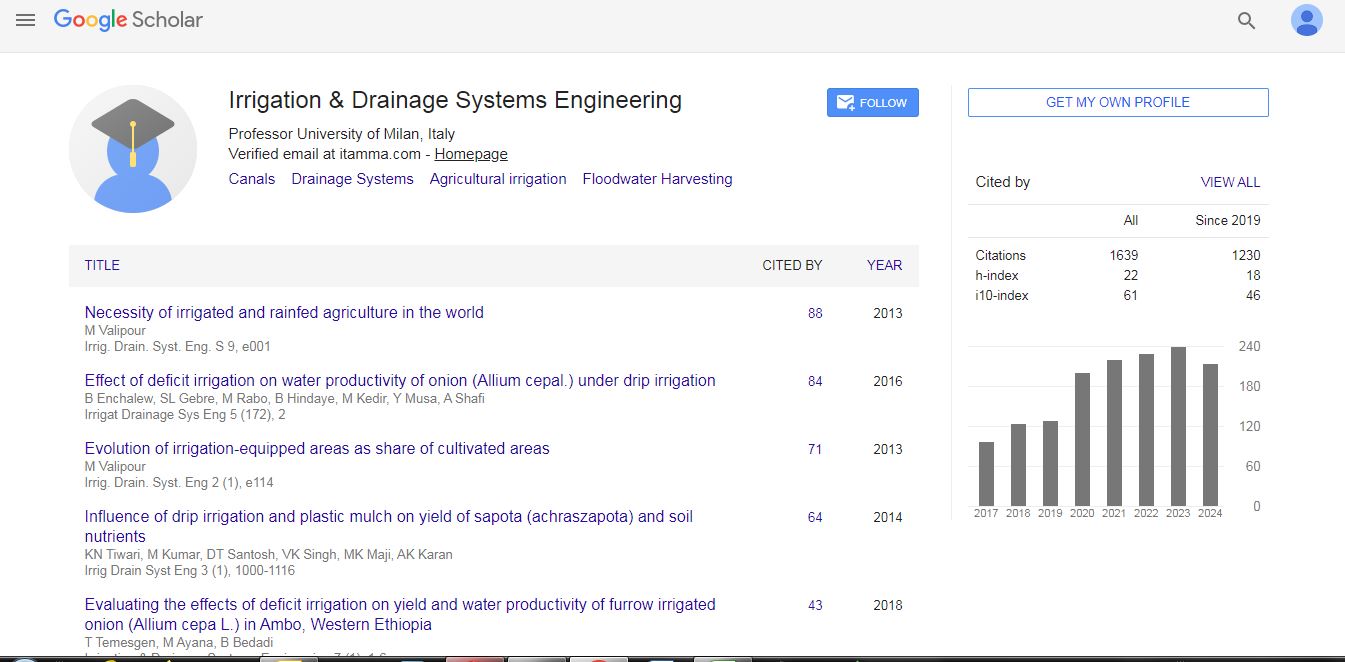
Irrigation & Drainage Systems Engineering received 835 citations as per Google Scholar report