Commentary - (2025) Volume 14, Issue 6
Received: 01-Dec-2025, Manuscript No. jsp-26-182289;
Editor assigned: 03-Dec-2025, Pre QC No. P-182289;
Reviewed: 17-Dec-2025, QC No. Q-182289;
Revised: 22-Dec-2025, Manuscript No. R-182289;
Published:
29-Dec-2025
, DOI: 10.37421/2165-7939.2025.14.755
Citation: Pacheco, Eduardo L.. ”Advanced Imaging Biomarkers for Spine Degeneration Assessment.” J Spine 14 (2025):755.
Copyright: © 2025 Pacheco L. Eduardo This is an open-access article distributed under the terms of the Creative Commons Attribution License, which permits unrestricted use, distribution and reproduction in any medium, provided the original author and source are credited.
Imaging biomarkers have emerged as indispensable tools for the objective assessment of spine degeneration, offering profound insights into the progression and severity of conditions such as osteoarthritis, disc herniation, and spinal stenosis. These quantitative measures facilitate a deeper understanding of pathological processes, enabling more precise diagnoses and personalized treatment strategies [1].
Advanced imaging modalities, including Magnetic Resonance Imaging (MRI), Computed Tomography (CT), and Positron Emission Tomography (PET) scans, when coupled with sophisticated quantitative analysis, allow for the accurate measurement of key parameters like intervertebral disc height, cartilage loss, bone marrow edema, and facet joint arthropathy [1].
Such precise quantification is pivotal in predicting clinical outcomes, guiding therapeutic decisions, and effectively monitoring the response to treatments [1].
Quantitative MRI techniques, particularly T2 mapping and diffusion tensor imaging (DTI), have revolutionized the assessment of intervertebral discs by providing valuable insights into their biochemical composition and structural integrity. T2 mapping is adept at distinguishing between healthy and degenerated disc tissue by reflecting water content, a key indicator of disc health [2].
Concurrently, DTI assesses the orientation and integrity of collagen fibers, offering a more detailed understanding of disc pathophysiology that extends beyond simple morphological changes [2].
Radiographic biomarkers, such as vertebral endplate changes known as Modic changes and the formation of osteophytes, continue to hold significant importance in evaluating spinal degeneration. While conventional X-rays can readily detect these changes, advanced CT and MRI techniques provide a more detailed characterization of their extent and evolutionary patterns [3].
The presence and progression of Modic changes have been consistently linked to patient experiences of pain and disability, thereby establishing them as valuable markers for prognostic evaluation and treatment stratification [3].
The role of advanced imaging in the comprehensive evaluation of facet joint osteoarthritis (OA) is substantial. MRI is particularly effective in assessing cartilage degeneration, synovial inflammation, and subchondral bone alterations [4].
In contrast, CT excels in visualizing osteophytes and quantifying joint space narrowing, offering complementary insights [4].
Furthermore, emerging techniques like contrast-enhanced MRI and ultrasound are demonstrating considerable promise in the early detection of inflammatory changes associated with facet joint OA, opening new avenues for diagnosis and management [4].
Artificial intelligence (AI) and machine learning (ML) are progressively transforming the landscape of imaging biomarker analysis in spine degeneration. These advanced computational technologies are capable of automating the segmentation of complex spinal structures, quantifying degenerative changes with remarkable accuracy, and identifying subtle, novel imaging patterns that are intrinsically associated with disease progression [5].
AI-driven predictive models hold significant potential for enabling early risk stratification and facilitating the development of highly personalized treatment planning approaches [5].
PET imaging, especially when employing radiotracers designed to target inflammation or metabolic activity, offers a unique functional perspective on the complex processes of spinal degeneration. For example, 18F-FDG PET can effectively highlight areas exhibiting active inflammation within the facet joints or vertebral bodies, regions that might remain inconspicuous on conventional MRI scans [6].
This functional imaging capability is critically important for accurately differentiating between degenerative and inflammatory etiologies of spinal pain [6].
The application of radiomics, a field focused on extracting a vast array of quantitative features from medical images, is rapidly gaining traction in the study of spine degeneration. Radiomic signatures derived from MRI or CT scans possess the potential to predict disease progression, anticipate treatment response, and even forecast the risk of future spinal events, thereby offering a deeper level of quantitative analysis and predictive power [7].
The establishment of standardized imaging protocols and the development of robust quantitative analysis methodologies are paramount for the successful integration of imaging biomarkers into routine clinical practice. Harmonizing image acquisition and processing procedures across diverse medical centers is essential to ensure the reliability and reproducibility of imaging findings, which in turn will facilitate more effective multicenter research endeavors and clinical trials [8].
Ultrasound elastography is emerging as a promising non-invasive tool for the assessment of biomechanical properties within spinal tissues, encompassing both intervertebral discs and associated musculature. Detected alterations in tissue stiffness, as measured by ultrasound elastography, may exhibit a significant correlation with the specific stage of degeneration and could potentially serve as a valuable complementary imaging biomarker [9].
Ultimately, the successful integration of advanced imaging biomarkers with comprehensive clinical data and patient-reported outcomes is crucial for achieving a holistic and nuanced understanding of spine degeneration. By combining objective imaging findings with subjective symptom reporting, clinicians can achieve a more thorough assessment of the disease's impact on patients' lives and subsequently tailor treatment strategies to meet the unique needs of each individual [10].
Imaging biomarkers represent a critical advancement in the objective evaluation of spinal degeneration, providing essential insights into the progression and severity of conditions such as osteoarthritis, disc herniation, and spinal stenosis. Advanced imaging techniques, including MRI, CT, and PET scans, when integrated with quantitative analysis, enable precise measurement of intervertebral disc height, cartilage integrity, bone marrow edema, and facet joint arthropathy, thereby aiding in outcome prediction and treatment guidance [1].
Quantitative MRI methods, specifically T2 mapping and diffusion tensor imaging (DTI), offer profound insights into the biochemical makeup and structural soundness of intervertebral discs. T2 mapping's ability to reflect water content allows for differentiation between healthy and degenerated disc tissues, while DTI's assessment of collagen fiber orientation and integrity provides a more detailed understanding of disc pathophysiology beyond mere morphological observations [2].
Radiographic biomarkers such as Modic changes in vertebral endplates and osteophyte formation remain vital indicators of spinal degeneration. While conventional radiography can identify these changes, advanced CT and MRI offer more detailed characterization of their extent and evolution. The presence and progression of Modic changes are strongly associated with pain and disability, underscoring their value in prognosis and treatment stratification [3].
Advanced imaging plays a significant role in assessing facet joint osteoarthritis (OA). MRI is adept at evaluating cartilage degeneration, synovial inflammation, and subchondral bone changes, whereas CT excels in visualizing osteophytes and joint space narrowing. Emerging techniques like contrast-enhanced MRI and ultrasound show potential for detecting early inflammatory changes in facet joint OA [4].
Artificial intelligence (AI) and machine learning (ML) are revolutionizing the analysis of imaging biomarkers for spine degeneration by automating structural segmentation, quantifying degenerative changes accurately, and identifying novel patterns associated with disease progression. AI-driven predictive models promise early risk stratification and personalized treatment planning [5].
PET imaging, particularly with radiotracers targeting inflammation or metabolic activity, provides a functional perspective on spinal degeneration. 18F-FDG PET can highlight active inflammation in facet joints or vertebral bodies, which might not be evident on conventional MRI, aiding in differentiating degenerative from inflammatory causes of spinal pain [6].
Radiomics, which involves extracting numerous quantitative features from medical images, is an emerging approach in spine degeneration. Radiomic signatures from MRI or CT scans can potentially predict disease progression, treatment response, and the risk of future spinal events, offering a deeper level of quantitative analysis [7].
Standardized imaging protocols and quantitative analysis methods are crucial for the clinical adoption of imaging biomarkers. Harmonizing image acquisition and processing across institutions ensures the reliability and reproducibility of findings, facilitating multicenter research and clinical trials [8].
Ultrasound elastography is an emerging non-invasive tool for assessing the biomechanical properties of spinal tissues, including discs and muscles. Changes in tissue stiffness detected by elastography may correlate with the stage of degeneration and can serve as a complementary biomarker [9].
The integration of advanced imaging biomarkers with clinical data and patient-reported outcomes is essential for a holistic understanding of spine degeneration. Combining objective imaging with subjective symptom reporting allows for a comprehensive assessment of disease impact and facilitates tailored treatment strategies for individual patients [10].
Imaging biomarkers are essential for objectively assessing spine degeneration, aiding in the diagnosis and management of conditions like osteoarthritis and disc herniation. Advanced techniques such as MRI, CT, and PET scans, coupled with quantitative analysis, precisely measure key parameters like disc height, cartilage loss, and bone edema. Quantitative MRI (T2 mapping, DTI) reveals disc biochemical and structural integrity. Radiographic markers like Modic changes and osteophytes remain important indicators, with their progression linked to pain. Advanced imaging is also crucial for evaluating facet joint osteoarthritis. Artificial intelligence and machine learning are enhancing biomarker analysis for accurate quantification and prediction. PET imaging offers functional insights into inflammation, while radiomics provides predictive signatures. Standardization of imaging protocols is vital for clinical adoption. Ultrasound elastography is emerging as a non-invasive tool for biomechanical assessment. Ultimately, integrating imaging biomarkers with clinical data ensures a comprehensive understanding of degeneration and personalized treatment.
None
None
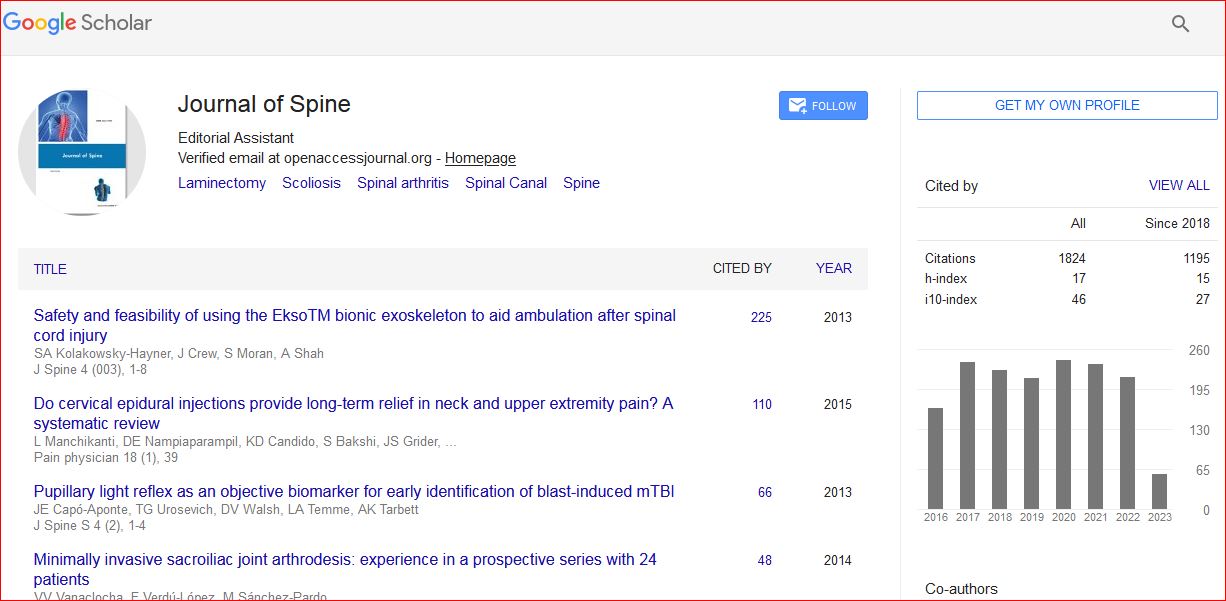
Journal of Spine received 2022 citations as per Google Scholar report