Opinion - (2025) Volume 9, Issue 3
Received: 01-May-2025, Manuscript No. fsb-26-189945;
Editor assigned: 05-May-2025, Pre QC No. P-189945;
Reviewed: 19-May-2025, QC No. Q-189945;
Revised: 22-May-2025, Manuscript No. R-189945;
Published:
29-May-2025
, DOI: 10.37421/2577-0543.2025.9.231
Citation: Collins, Ethan. ”Advanced Formulations for Enhanced Herbal Bioavailability.” J Formul Sci Bioavailab 09 (2025):231.
Copyright: © 2025 Collins E. This is an open-access article distributed under the terms of the Creative Commons Attribution License, which permits unrestricted use, distribution and reproduction in any medium, provided the original author and source are credited.
The advancement of pharmaceutical sciences has been significantly propelled by innovative drug delivery systems, particularly in the realm of herbal medicines. These natural remedies, while possessing considerable therapeutic potential, often face challenges related to poor bioavailability, which limits their clinical efficacy. Addressing these limitations has become a critical area of research, leading to the development of sophisticated formulations designed to enhance the absorption and therapeutic outcomes of herbal compounds. One of the primary strategies employed to overcome the inherent challenges of herbal medicines is the utilization of nanotechnology. Nanocarriers, lipid-based systems, and solid dispersions are among the key formulation approaches that have shown promise in improving the bioavailability of these natural products. By effectively encapsulating or dispersing active herbal ingredients, these systems can significantly increase drug concentrations at the target site, leading to enhanced therapeutic effects and potentially a reduction in the required dosage. The efficacy of solid dispersion technology in enhancing the bioavailability of poorly water-soluble phytoconstituents has been a subject of considerable investigation. The creation of amorphous solid dispersions is a well-established method for improving the dissolution rate and subsequent absorption of such compounds. This approach represents a promising avenue for the development of effective herbal medicines with optimized pharmacokinetic profiles, ensuring better therapeutic outcomes. Liposomes have emerged as versatile drug delivery vehicles with a notable capacity for improving the bioavailability of various natural compounds. Their unique structure allows for the encapsulation of both hydrophilic and lipophilic drugs, thereby enhancing solubility and cellular uptake. This versatility makes liposomes particularly suitable for delivering challenging herbal compounds effectively, as demonstrated by their application in delivering berberine. Cyclodextrin inclusion complexes offer another valuable strategy for enhancing the solubility and oral bioavailability of herbal constituents. By forming complexes with molecules like quercetin, cyclodextrins can reduce hydrophobicity, leading to improved dissolution and absorption. This method provides a stable and effective means for delivering polyphenolic compounds, which are abundant in many medicinal plants and often suffer from poor bioavailability. Nanoemulsion-based drug delivery systems have also shown significant potential in improving the oral bioavailability of complex herbal compounds. These systems, characterized by a large surface area and thermodynamic stability, facilitate improved absorption of active ingredients such as ginsenosides. The development of such nanoemulsions represents a novel approach to overcoming delivery barriers for these intricate saponins. Polymeric nanoparticles have been explored as advanced carriers for enhancing the oral bioavailability of potent natural products. These nanoparticles can protect sensitive drug molecules from degradation within the gastrointestinal tract and facilitate their cellular uptake, thereby improving therapeutic efficacy. The application of polymer-based nanocarriers is particularly relevant for delivering challenging natural products like paclitaxel. Self-microemulsifying drug delivery systems (SMEDDS) represent a sophisticated formulation strategy aimed at improving the oral absorption of poorly soluble compounds. Upon contact with gastrointestinal fluids, SMEDDS readily form fine microemulsions, which enhance dissolution and permeability. The significant improvement in the bioavailability of resveratrol through SMEDDS formulations underscores the effectiveness of this approach. Specialized lipid-based formulations, such as phytosomes, have been developed to address the bioavailability limitations of certain herbal constituents. Phytosomes enhance the absorption of lipophilic compounds by forming complexes with phospholipids, which promotes better cellular uptake and ultimately improves therapeutic efficacy. This approach has proven effective in enhancing the pharmacokinetic parameters of compounds like silymarin. Mesoporous silica nanoparticles (MSNs) offer unique advantages as carriers for lipophilic herbal compounds due to their large surface area and high porosity. These characteristics facilitate efficient drug loading and controlled release, leading to significantly improved oral bioavailability and therapeutic activity. The application of MSNs in delivering compounds like honokiol highlights their potential in pharmaceutical development.
The critical need to enhance the bioavailability of herbal medicines has spurred the development of advanced formulation strategies, with nanotechnology playing a pivotal role. Systems such as nanocarriers, lipid-based formulations, and solid dispersions are instrumental in overcoming challenges like poor solubility and degradation, thereby increasing the concentration of active compounds at their intended sites of action. This ultimately leads to improved therapeutic efficacy and potentially more convenient dosing regimens. Solid dispersion technology has proven to be highly effective in elevating the bioavailability of phytoconstituents that exhibit poor water solubility. The creation of amorphous solid dispersions is a well-established technique that significantly augments the dissolution rate and subsequent absorption of these compounds. Consequently, this method offers a robust pathway for formulating potent herbal medicines with superior pharmacokinetic profiles. Liposomes stand out as exceptionally versatile drug delivery vehicles, adept at enhancing the bioavailability of a wide spectrum of natural products. Their unique lamellar structure allows for the efficient encapsulation of both hydrophilic and lipophilic substances, which in turn boosts solubility and facilitates enhanced cellular uptake. This inherent adaptability makes liposomes ideal for the effective delivery of challenging herbal compounds, as evidenced by their successful application in berberine delivery. Cyclodextrin inclusion complexes represent another significant approach to augmenting the solubility and oral bioavailability of herbal compounds. Through the formation of complexes with molecules like quercetin, cyclodextrins effectively mitigate hydrophobicity, resulting in improved dissolution and absorption rates. This technique provides a stable and efficient method for the delivery of polyphenolic compounds abundant in medicinal plants, which often present bioavailability hurdles. Nanoemulsion-based drug delivery systems have demonstrated considerable promise in boosting the oral bioavailability of complex herbal constituents. These systems, characterized by their expansive surface area and inherent thermodynamic stability, promote superior absorption of active ingredients like ginsenosides. The advancement of such nanoemulsion formulations signifies an innovative strategy for surmounting delivery impediments associated with these intricate saponins. Polymeric nanoparticles are being increasingly investigated as sophisticated carriers designed to improve the oral bioavailability of potent natural pharmaceuticals. These nanoparticles serve to shield labile drug molecules from gastrointestinal degradation and promote their cellular internalization, thereby leading to augmented therapeutic benefits. The deployment of polymer-based nanocarriers is particularly consequential for the delivery of challenging natural products such as paclitaxel. Self-microemulsifying drug delivery systems (SMEDDS) constitute an advanced formulation paradigm engineered to ameliorate the oral absorption of sparingly soluble compounds. Upon interaction with gastrointestinal fluids, SMEDDS readily generate fine oil-in-water microemulsions, which consequently enhance dissolution and permeability. The observed substantial enhancement in resveratrol bioavailability via SMEDDS formulations underscores the efficacy of this innovative strategy. Specialized lipid-based delivery platforms, exemplified by phytosomes, have been meticulously developed to address the bioavailability constraints of specific herbal components. Phytosomes improve the absorption of lipophilic constituents by forming complexes with phospholipids, a process that facilitates enhanced cellular entry and consequently elevates therapeutic efficacy. This methodology has been demonstrably effective in optimizing the pharmacokinetic profiles of compounds like silymarin. Mesoporous silica nanoparticles (MSNs) present distinctive advantages as carriers for lipophilic herbal agents, owing to their extensive surface area and high degree of porosity. These attributes enable efficient drug loading and foster controlled release mechanisms, culminating in markedly enhanced oral bioavailability and therapeutic activity. The successful application of MSNs in delivering compounds such as honokiol illustrates their considerable potential in pharmaceutical innovation. Solid lipid nanoparticles (SLNs) are being utilized to formulate and enhance the oral bioavailability of herbal extracts with poor solubility. These nanoparticles act as protective carriers for the bioactive constituents, leading to improved stability, higher encapsulation efficiency, and subsequent absorption. This research demonstrates the utility of SLNs for delivering complex herbal matrices, ensuring more effective therapeutic delivery.
This compilation of research highlights various advanced formulation strategies aimed at significantly improving the oral bioavailability of herbal medicines. Techniques discussed include nanotechnology-based approaches such as nanocarriers, liposomes, nanoemulsions, polymeric nanoparticles, mesoporous silica nanoparticles, and solid lipid nanoparticles. Additionally, solid dispersion technology, cyclodextrin inclusion complexes, and self-microemulsifying drug delivery systems (SMEDDS) are explored. These methods collectively address challenges like poor solubility, degradation, and low absorption of active compounds from natural sources, leading to enhanced therapeutic efficacy and improved pharmacokinetic profiles for a range of medicinal agents.
None
None
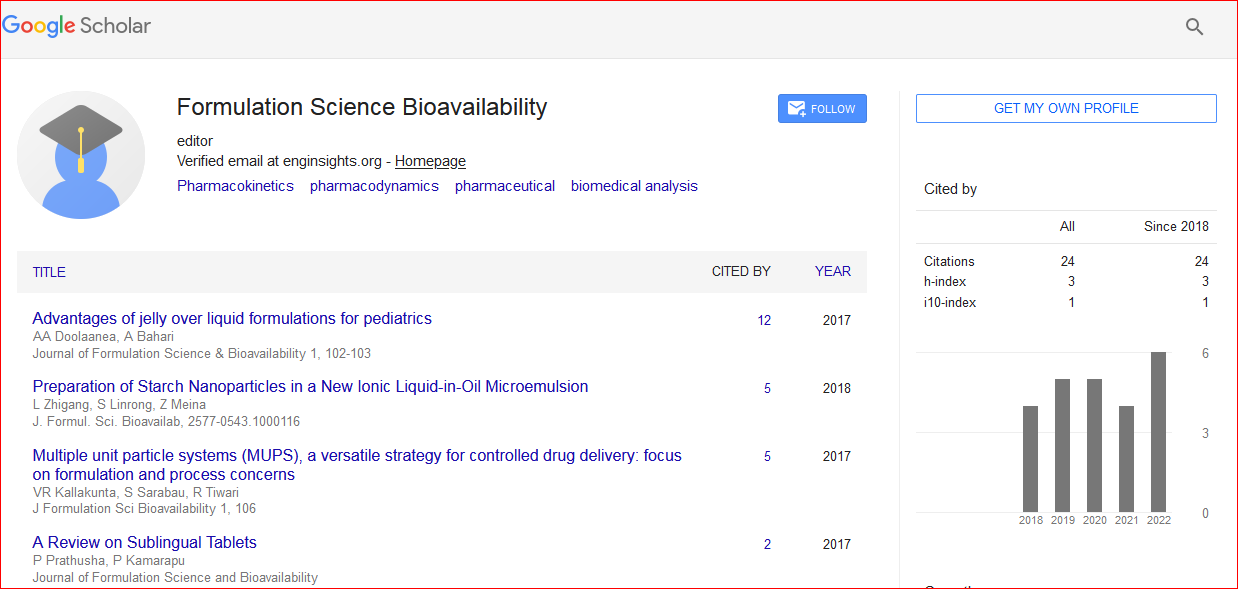
Journal of Formulation Science & Bioavailability received 23 citations as per Google Scholar report