Perspective - (2025) Volume 14, Issue 2
Received: 01-Apr-2025, Manuscript No. idse-26-182780;
Editor assigned: 03-Apr-2025, Pre QC No. P-182780;
Reviewed: 17-Apr-2025, QC No. Q-182780;
Revised: 22-Apr-2025, Manuscript No. R-182780;
Published:
29-Apr-2025
, DOI: 10.37421/2168-9768.2025.14.483
Citation: Verma, Rajesh Kumar. ”Advanced Engineering for
Smart Irrigation and Drainage.” Irrigat Drainage Sys Eng 14 (2025):483.
Copyright: © 2025 Verma K. Rajesh This is an open-access article distributed under the terms of the Creative Commons Attribution License, which permits unrestricted use,
distribution and reproduction in any medium, provided the original author and source are credited.
The optimization of irrigation and drainage systems is a critical area of focus within modern agriculture, aiming to enhance water use efficiency, improve crop yields, and ensure long-term soil health. Advanced engineering strategies are being developed and implemented to address these challenges, leveraging technological advancements and sophisticated design principles. Precision agriculture technologies, including remote sensing and the Internet of Things (IoT), play a pivotal role in real-time monitoring of soil moisture and crop requirements, directly contributing to significant water savings and increased productivity [1].
Machine learning algorithms are increasingly being applied to optimize irrigation scheduling, enabling predictive models that forecast optimal irrigation timing and volume based on historical weather data, soil moisture readings, and crop physiological parameters. This approach promises substantial gains in water use efficiency and reductions in energy costs associated with irrigation systems [2].
For agricultural lands suffering from waterlogging, advanced subsurface drainage systems are essential. These systems employ innovative designs for network layout, pipe materials, and installation techniques to efficiently remove excess water, thereby preventing waterlogging and salinization, which are detrimental to soil health and agricultural productivity [3].
The integration of remote sensing and Geographic Information Systems (GIS) offers powerful tools for monitoring and managing irrigation water resources. Satellite imagery and drone-based sensing provide accurate data on crop health, soil moisture, and evapotranspiration rates, which are then analyzed spatially using GIS for informed decision-making in water allocation and irrigation scheduling at various scales [4].
Sprinkler irrigation systems are another area of significant engineering focus, with research evaluating various components like nozzle types and operating pressures to achieve uniform water distribution and minimize losses due to evaporation and wind drift. Tailoring system designs to specific crop needs and environmental conditions is key to maximizing water use efficiency and energy savings [5].
Artificial intelligence (AI) is transforming smart irrigation controllers by enabling systems that learn from real-time environmental data and historical performance. These AI-powered systems can make highly adaptive and efficient irrigation decisions, leading to reduced water consumption and improved crop health through precise irrigation [6].
Efficient drip irrigation systems are also a subject of detailed engineering analysis, focusing on emitter design, filtration, and system layout to optimize water and nutrient delivery. The integration of fertigation, the simultaneous application of fertilizers with irrigation water, further enhances crop productivity and resource efficiency [7].
The application of sensor networks and the Internet of Things (IoT) enables real-time monitoring and control of irrigation systems. Interconnected sensors collect critical data on soil moisture, temperature, and humidity, which is wirelessly transmitted to central control units for automated and adaptive irrigation adjustments, improving water management and crop performance [8].
In the context of drainage, the performance of various drainage materials and configurations is being evaluated to reduce soil compaction and enhance water infiltration. The careful selection of materials and designs for subsurface drainage systems is crucial for long-term functionality, preventing clogging, and maintaining optimal soil moisture conditions [9].
Finally, the integration of weather forecasting and hydrological modeling provides a proactive approach to irrigation and drainage management. By anticipating water needs and potential waterlogging issues through advanced predictions and models, agricultural systems can optimize water resource allocation, prevent crop damage, and enhance resilience to climate variability [10].
The engineering strategies for optimizing irrigation and drainage systems encompass a broad range of technologies and methodologies aimed at achieving agricultural sustainability. Precision agriculture, utilizing remote sensing and IoT devices, allows for precise monitoring of soil moisture and crop needs, leading to optimized water application and improved crop yields. The integration of smart control systems and data analytics facilitates dynamic irrigation scheduling, minimizing water waste and energy consumption. Moreover, advanced drainage techniques, such as subsurface drainage, are crucial for preventing waterlogging and salinization, thereby enhancing soil health and overall agricultural productivity [1].
Machine learning algorithms are demonstrating significant potential in revolutionizing irrigation scheduling. Predictive models, trained on comprehensive datasets including historical weather patterns, soil moisture levels, and crop-specific physiological data, can accurately forecast optimal irrigation timing and water volume. This sophisticated approach not only enhances water use efficiency but also contributes to substantial reductions in operational costs, particularly those related to energy consumption for pumping. The seamless integration of these predictive models into automated irrigation systems further amplifies their impact [2].
The design and performance of advanced subsurface drainage systems are critical for managing waterlogged agricultural lands. Innovative approaches to drainage network layout, the selection of appropriate pipe materials, and refined installation techniques are employed to maximize water removal efficiency while minimizing disruption to the soil structure. These engineered solutions play a vital role in improving soil aeration, effectively controlling salinity, and ultimately boosting the productivity of agricultural lands. A thorough cost-benefit analysis often underpins the adoption of these long-term solutions [3].
Remote sensing and Geographic Information Systems (GIS) are indispensable tools for the effective monitoring and management of irrigation water resources. By harnessing satellite imagery and data from drone-based sensors, it is possible to obtain precise information regarding crop health, soil moisture content, and evapotranspiration rates. The application of GIS enables the spatial analysis and visualization of this critical data, empowering informed decision-making for equitable water allocation and optimized irrigation scheduling across diverse agricultural landscapes, ultimately reducing environmental impact [4].
In the realm of sprinkler irrigation, engineering design principles are paramount for achieving enhanced water use efficiency. Research focuses on evaluating various components, including different types of nozzles and optimal operating pressures, to ensure uniform water distribution and to mitigate water loss through evaporation and wind drift. The development of systems specifically tailored to the unique requirements of different crops and prevailing environmental conditions is essential for maximizing water application efficiency and achieving significant energy savings [5].
The application of Artificial Intelligence (AI) in the development of smart irrigation controllers represents a significant leap forward. AI-powered systems possess the capability to continuously learn from real-time environmental data, such as weather conditions, soil moisture levels, and indicators of plant stress, as well as historical irrigation performance data. This adaptive learning allows for highly precise and efficient irrigation decisions, significantly reducing water consumption and promoting improved crop health by delivering the right amount of water at the opportune moment [6].
Engineering aspects of drip irrigation systems are being meticulously studied to optimize water and nutrient delivery to crops. This includes detailed analysis of emitter design, the selection of appropriate filtration systems, and the strategic layout of the irrigation network. The research also explores the synergistic integration of fertigation, which involves the simultaneous application of fertilizers along with irrigation water, leading to enhanced crop productivity and more efficient use of agricultural resources [7].
Sensor networks and the Internet of Things (IoT) are instrumental in enabling real-time monitoring and control of irrigation systems. The deployment of interconnected sensors allows for continuous measurement of key parameters, including soil moisture, ambient temperature, humidity, and water flow rates. This data is then wirelessly transmitted to a central control unit, facilitating automated and adaptive adjustments to irrigation schedules. The benefits derived from this approach include more effective water management, reduced labor costs, and ultimately, improved crop performance [8].
The evaluation of drainage materials and configurations is crucial for improving soil water management practices. Studies compare the efficacy of various materials, such as gravel and geotextiles, alongside different perforated pipe configurations within subsurface drainage systems. The objective is to minimize soil compaction and enhance water infiltration, ensuring that the selected drainage solutions provide long-term functionality, prevent the common issue of clogging, and maintain optimal soil moisture levels conducive to healthy plant growth [9].
Integrating weather forecasting with hydrological modeling offers a sophisticated approach to proactive irrigation and drainage management. By leveraging advanced weather predictions in conjunction with detailed soil and crop models, it becomes possible to anticipate future water requirements and identify potential risks of waterlogging. This comprehensive, integrated strategy optimizes water resource allocation, safeguards crops from damage, and enhances the overall resilience of agricultural systems in the face of increasing climate variability [10].
This collection of research explores advanced engineering strategies for optimizing agricultural irrigation and drainage systems. It highlights the use of precision agriculture technologies like remote sensing and IoT for real-time monitoring, leading to water savings and improved yields. Machine learning and AI are employed for intelligent irrigation scheduling and smart controllers, optimizing water use and crop health. Advanced subsurface drainage systems are detailed for managing waterlogged soils, preventing salinization, and enhancing soil health. The integration of GIS and remote sensing aids in water resource management, while specific system designs for sprinklers and drip irrigation focus on uniform water and nutrient delivery. The importance of drainage materials and configurations for soil water management is also discussed, alongside the proactive benefits of integrating weather forecasting with hydrological modeling for resilient agricultural systems.
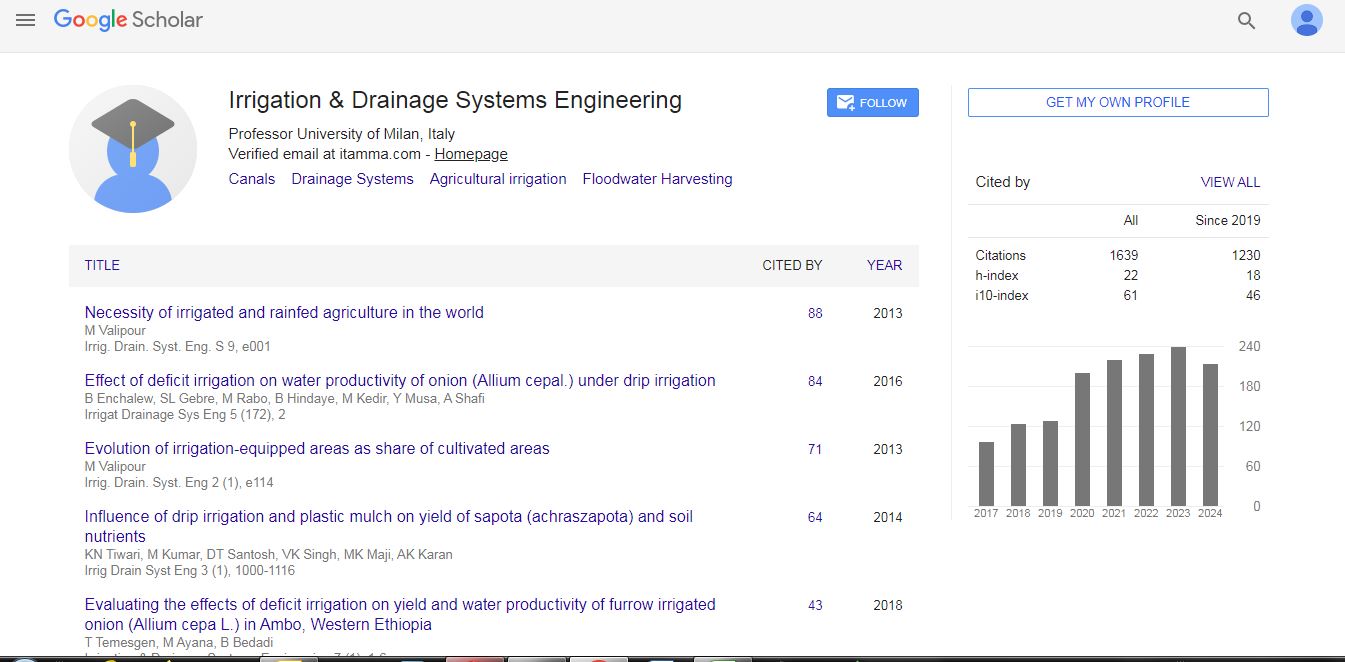
Irrigation & Drainage Systems Engineering received 835 citations as per Google Scholar report