Commentary - (2025) Volume 15, Issue 4
Received: 02-Aug-2025, Manuscript No. jeat-26-188638;
Editor assigned: 04-Aug-2025, Pre QC No. P-188638;
Reviewed: 18-Aug-2025, QC No. Q-188638;
Revised: 25-Aug-2025, Manuscript No. R-188638;
Published:
01-Sep-2025
, DOI: 10.37421/2161-0525.2025.15.859
Citation: Tan, Mei Ling. ”Advanced Detection Methods for Food
and Environmental Contaminants.” J Environ Anal Toxicol 15 (2025):859.
Copyright: © 2025 Tan L. Mei This is an open-access article distributed under the terms of the Creative Commons Attribution License, which permits unrestricted use,
distribution and reproduction in any medium, provided the original author and source are credited.
The field of analytical chemistry has witnessed significant advancements in recent years, driven by the increasing demand for precise and reliable methods to detect a wide array of substances in complex matrices. These advancements are crucial for ensuring public health, environmental safety, and the integrity of food supply chains. Early research focused on establishing foundational techniques for identifying known contaminants [1].
As our understanding of potential threats evolved, so did the analytical methodologies, leading to more sophisticated approaches for trace-level detection [2].
The development of novel sensor technologies, in particular, has opened new avenues for rapid and on-site analysis, reducing the reliance on centralized laboratory testing [3].
Simultaneously, environmental monitoring has been bolstered by the application of sensitive spectroscopic techniques capable of identifying even minute concentrations of hazardous materials in water bodies [4].
The complexity of food matrices has also necessitated the refinement of analytical tools, enabling the simultaneous determination of multiple problematic compounds within a single analysis, thereby improving efficiency and comprehensiveness [5].
Furthermore, the emergence of new environmental challenges, such as microplastic pollution, has spurred the development of specialized analytical frameworks to understand the associated risks [6].
In parallel, the drive for accessible and cost-effective screening tools has led to the creation of portable assays suitable for field deployment, providing immediate feedback on potential contamination [7].
The ongoing evolution of analytical strategies is also addressing persistent environmental pollutants, which pose long-term risks due to their recalcitrant nature and potential for bioaccumulation [8].
The pursuit of higher sensitivity and specificity continues, with innovations in biosensor technology offering promising solutions for the detection of biological contaminants [9].
Finally, ensuring the authenticity and safety of food products remains a paramount concern, leading to the application of advanced mass spectrometry techniques for the detection of adulteration and fraud [10].
Recent advancements in analytical techniques have profoundly impacted our ability to detect toxic compounds in food and environmental samples. One significant area of progress involves chromatography coupled with mass spectrometry, which offers high sensitivity and selectivity for identifying a diverse range of contaminants, including pesticides and heavy metals [1].
The development of electrochemical sensors, often enhanced with nanomaterials, represents another crucial breakthrough, enabling rapid and sensitive detection of specific analytes like pesticide residues in vegetables [2].
For environmental monitoring, surface-enhanced Raman spectroscopy (SERS) has emerged as a powerful tool for detecting heavy metal ions in water samples with remarkable sensitivity and ease of sample preparation [3].
In the realm of food safety, liquid chromatography-tandem mass spectrometry (LC-MS/MS) has become indispensable for the simultaneous determination of multiple mycotoxins in cereal products, ensuring compliance with stringent safety regulations [4].
The growing concern over microplastics has led to the development of analytical frameworks, such as gas chromatography-mass spectrometry (GC-MS), to identify and quantify adsorbed pollutants on these particles in drinking water [5].
For field-based screening, portable colorimetric assays have been developed for the rapid detection of organophosphate pesticides in fruit juices, offering a low-cost and accessible solution [6].
Analytical strategies for persistent organic pollutants (POPs) in environmental matrices continue to be refined, addressing the challenges posed by their low concentrations and complex backgrounds [7].
The application of biosensors, particularly those utilizing aptamers, has shown great promise for the rapid and sensitive detection of foodborne pathogens, enhancing food safety protocols [8].
The persistent nature of per- and polyfluoroalkyl substances (PFAS) has necessitated the development of advanced analytical methods to monitor their presence in various environmental compartments due to their potential health impacts [9].
Lastly, gas chromatography-isotope ratio mass spectrometry (GC-IRMS) is being employed for food authentication and adulteration detection, providing a robust method to ensure the integrity of food supply chains by analyzing isotopic signatures [10].
This collection of research highlights significant advancements in analytical techniques for detecting toxic compounds and contaminants in food and environmental samples. Innovations span highly sensitive chromatographic-mass spectrometric methods, novel electrochemical and aptamer-based biosensors, and surface-enhanced Raman spectroscopy for various analytes including pesticides, heavy metals, mycotoxins, microplastic-associated pollutants, and foodborne pathogens. The focus is on improving detection limits, reducing analysis time, and developing portable or on-site detection systems. Gas chromatography-isotope ratio mass spectrometry is also utilized for food authentication. These developments are crucial for public health, environmental safety, and ensuring food integrity.
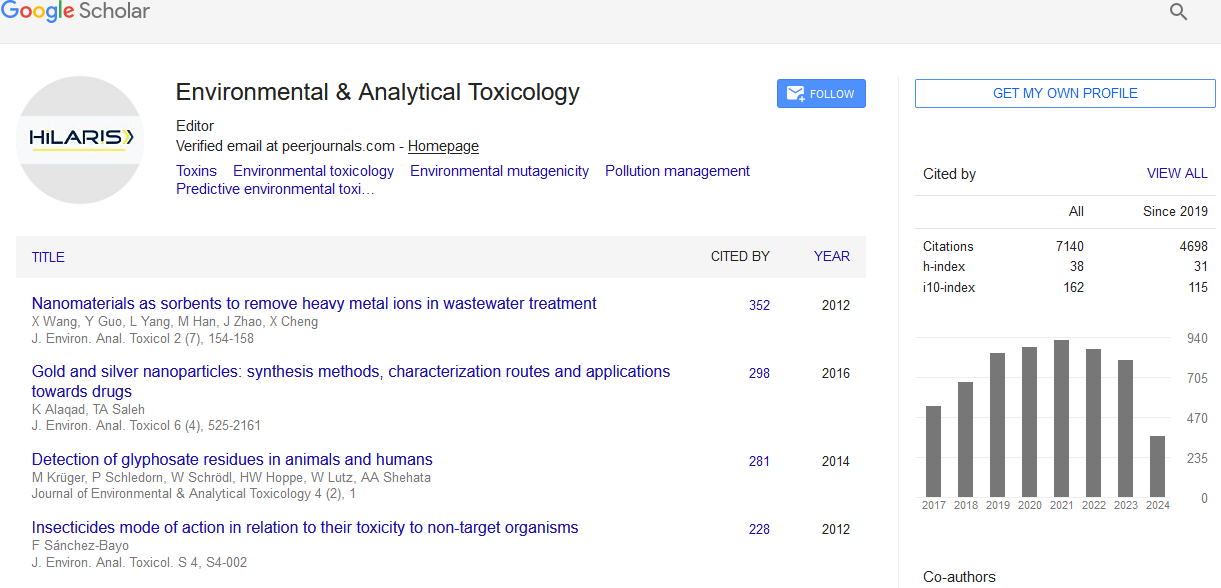
Environmental & Analytical Toxicology received 6818 citations as per Google Scholar report