Perspective - (2025) Volume 17, Issue 6
Received: 01-Dec-2025, Manuscript No. jbabm-26-182370;
Editor assigned: 03-Dec-2025, Pre QC No. P-182370;
Reviewed: 17-Dec-2025, QC No. Q-182370;
Revised: 22-Dec-2025, Manuscript No. R-182370;
Published:
29-Dec-2025
, DOI: 10.37421/1948-593X.2025.17.528
Citation: Santos, Ricardo F. ”Advanced Bioanalysis: Key to Systems Biology Understanding.” J Bioanal Biomed 17 (2025):528.
Copyright: © 2025 Santos F .Ricardo This is an open-access article distributed under the terms of the Creative Commons Attribution License, which permits unrestricted use, distribution and reproduction in any medium, provided the original author and source are credited.
Systems biology endeavors to unravel the intricacies of biological systems through the application of advanced bioanalytical methodologies. These approaches are crucial for dissecting complex biological networks and gaining a comprehensive understanding of cellular and organismal functions. High-throughput omics technologies, encompassing genomics, transcriptomics, proteomics, and metabolomics, are at the forefront of this endeavor, providing vast datasets that require sophisticated integration and modeling techniques to yield meaningful insights. The continuous development and application of novel bioanalytical tools are paramount for measuring biomolecules with enhanced sensitivity and specificity, thereby facilitating a deeper comprehension of disease mechanisms and the identification of potential therapeutic targets. By integrating bioanalytical data within systems-level models, researchers can achieve predictive capabilities, which are indispensable for the advancement of personalized medicine. The field is continually evolving, with new techniques and analytical strategies emerging to address the challenges of biological complexity. Mass spectrometry (MS)-based proteomics has emerged as a vital tool in systems biology, instrumental in mapping protein-protein interactions and elucidating signaling pathways. Recent advancements in quantitative proteomics have significantly enhanced the ability to detect subtle alterations in protein expression and post-translational modifications in response to diverse biological stimuli. The inherent complexity of proteomic analysis is being effectively managed through the innovation of novel sample preparation techniques and sophisticated data analysis algorithms, which are critical for constructing comprehensive protein interaction networks pertinent to cellular processes and disease states. The precision offered by these advanced proteomic techniques allows for a more detailed understanding of molecular mechanisms. Metabolomics offers a dynamic snapshot of the cellular metabolic state, providing indispensable insights into both physiological conditions and pathological states. The development of highly sensitive and selective bioanalytical methods is central to both untargeted and targeted metabolomic studies. A key focus is the integration of metabolomic data with other omics layers to construct intricate metabolic networks and to accurately understand metabolic flux within biological systems. The ongoing advancement of analytical techniques, particularly gas chromatography-mass spectrometry (GC-MS) and liquid chromatography-tandem mass spectrometry (LC-MS/MS), is instrumental in identifying robust biomarkers for the early detection of diseases and for monitoring the efficacy of therapeutic interventions. This comprehensive approach aids in understanding disease progression. The synergistic integration of transcriptomic data with other bioanalytical data layers is foundational for achieving a holistic understanding of biological systems. High-throughput sequencing technologies are central to analyzing gene expression patterns, enabling researchers to infer regulatory networks, identify critical transcription factors, and comprehend cellular responses to various perturbations. Significant challenges remain in data normalization, analysis, and integration with proteomic and metabolomic datasets, yet addressing these issues is crucial for the development of more comprehensive systems-level models. Such integrated analyses are essential for a complete biological picture. Single-cell bioanalysis represents a transformative advancement in systems biology, enabling the detailed dissection of cellular heterogeneity. Emerging single-cell technologies, including single-cell RNA sequencing (scRNA-seq), single-cell proteomics, and single-cell metabolomics, allow for the precise characterization of cell-to-cell variability in gene expression, protein abundance, and metabolic profiles. This granular level of detail is essential for understanding complex biological processes such as development, immune responses, and disease progression. The integration of single-cell data with systems-level models holds immense promise for uncovering cell-type-specific mechanisms and fundamental regulatory principles that govern biological systems. This offers a new perspective on cellular function. The development of robust bioanalytical assays for biomarker discovery is fundamentally important for translating systems biology findings into tangible clinical applications. Immunoassay technologies, including enzyme-linked immunosorbent assays (ELISA) and multiplex assays, play a critical role in the accurate quantification of protein biomarkers in biological fluids. Furthermore, microfluidic-based bioanalytical platforms are enabling rapid, high-throughput analyses with significantly reduced sample consumption. The imperative for rigorous assay validation and standardization is emphasized to ensure the reliability of biomarker detection within complex biological matrices. These assays are vital for diagnostics. Efficient and accurate methods for analyzing complex biological pathways are a prerequisite for systems biology research, with bioinformatics tools playing an indispensable role in this domain. Computational approaches for integrating multi-omics data, including algorithms for network inference, pathway analysis, and statistical modeling, are actively being developed. The primary challenge lies in effectively managing the immense volume of data generated by modern bioanalytical techniques and extracting salient biological information. The critical importance of open-source software and widely accessible databases in accelerating systems biology research is underscored in this context. These tools facilitate data sharing and collaboration. The inherent dynamic nature of biological systems necessitates the use of temporal bioanalytical measurements to effectively capture transient events and cellular responses over extended periods. Time-resolved omics techniques, such as time-course transcriptomics, proteomics, and metabolomics, are being increasingly employed. These approaches facilitate the study of dynamic processes, including cell signaling, drug response, and disease progression, through carefully designed experimental protocols and analytical strategies. The incorporation of temporal data into systems models enables a more accurate and realistic representation of the dynamic behavior of biological systems. Understanding time-dependent changes is key. Advanced bioanalytical imaging techniques are becoming increasingly integral to systems biology, providing the capability to visualize molecular events within their native cellular and tissue contexts. Correlative light and electron microscopy (CLEM) and super-resolution microscopy methods are particularly valuable for studying protein localization and interactions in situ. The ability to bridge the gap between molecular resolution and spatial organization is crucial for comprehending complex cellular functions and the underlying mechanisms of disease. Continued innovation in fluorescent probes and imaging modalities is essential for progress in this rapidly evolving area. Imaging provides spatial context. Chemoproteomics offers a potent strategy within systems biology for identifying drug targets and elucidating drug mechanisms of action. Chemical probes and affinity-based capture techniques are employed to profile the cellular proteome and pinpoint protein-ligand interactions. These bioanalytical methods can effectively reveal off-target effects and shed light on mechanisms of drug resistance. Integrating chemoproteomic data with other systems-level information is crucial for the development of targeted therapies and the realization of personalized medicine strategies, thereby optimizing treatment outcomes. This approach aids in drug development.
Systems biology fundamentally relies on sophisticated bioanalytical approaches to dissect the complex architecture of biological networks, offering profound insights into cellular and organismal functions. The utilization of high-throughput omics technologies, such as genomics, transcriptomics, proteomics, and metabolomics, when combined with advanced data integration and modeling techniques, provides critical understanding. The continuous advancement of bioanalytical tools designed for high-sensitivity and high-specificity measurement of biomolecules is essential for deepening our knowledge of disease mechanisms and identifying viable therapeutic targets. Furthermore, the integration of these bioanalytical datasets into systems-level models empowers predictive capabilities, a cornerstone for personalized medicine. This interdisciplinary field is driven by technological innovation and computational power. In the realm of systems biology, mass spectrometry (MS)-based proteomics plays a pivotal role in mapping protein-protein interactions and deciphering signaling pathways. The field has witnessed significant progress in quantitative proteomics, enabling the detection of minute changes in protein expression and post-translational modifications that occur in response to various biological stimuli. Addressing the inherent challenges associated with analyzing complex proteomes involves the development of innovative sample preparation methods and advanced data analysis algorithms, which are indispensable for constructing comprehensive protein interaction networks relevant to cellular functions and disease states. The precision of these techniques is crucial for systems-level understanding. Metabolomics offers a unique perspective by providing a snapshot of the cellular metabolic state, thereby yielding critical insights into both physiological processes and pathological conditions. This paper delves into the development of sensitive and selective bioanalytical methodologies for both untargeted and targeted metabolomics. A significant emphasis is placed on integrating metabolomic data with other omics layers to construct detailed metabolic networks and to thoroughly understand metabolic flux. Advances in analytical techniques, including GC-MS and LC-MS/MS, are paramount for the identification of biomarkers that can facilitate early disease detection and monitor therapeutic responses. This provides a biochemical perspective. For a holistic comprehension of biological systems, the integration of transcriptomic data with other bioanalytical data layers is indispensable. High-throughput sequencing technologies are central to the analysis of gene expression patterns, enabling the inference of regulatory networks, the identification of key transcription factors, and the understanding of cellular responses to perturbations. While challenges persist in data normalization, analysis, and integration with proteomic and metabolomic data, their resolution is vital for the development of more comprehensive systems-level models. This integration allows for a multi-dimensional view. Single-cell bioanalysis is revolutionizing systems biology by enabling the detailed examination of cellular heterogeneity. Advanced single-cell technologies, such as single-cell RNA sequencing (scRNA-seq), single-cell proteomics, and single-cell metabolomics, are critical for characterizing cell-to-cell variability in gene expression, protein abundance, and metabolic profiles. This variability is crucial for understanding complex biological processes including development, immunity, and disease progression. The integration of single-cell data into systems-level models holds great promise for uncovering cell-type-specific mechanisms and regulatory principles. This provides a granular view of cellular diversity. The successful translation of systems biology insights into clinical applications hinges on the development of robust bioanalytical assays for biomarker discovery. Immunoassay technologies, including ELISA and multiplex assays, are fundamental for quantifying protein biomarkers in biological fluids. Moreover, microfluidic-based bioanalytical platforms are facilitating rapid, high-throughput analysis with reduced sample requirements. The importance of thorough assay validation and standardization for reliable biomarker detection in complex biological matrices cannot be overstated. These assays are critical for clinical translation. Systems biology necessitates efficient and accurate methods for analyzing intricate biological pathways, and bioinformatics tools are central to this endeavor. This article focuses on computational approaches for integrating multi-omics data, including the development of algorithms for network inference, pathway analysis, and statistical modeling. A significant challenge involves managing the vast quantities of data generated by contemporary bioanalytical techniques and extracting meaningful biological information. The significance of open-source software and databases in advancing systems biology research is highlighted. These computational tools are essential for data interpretation. The dynamic nature of biological systems demands temporal bioanalytical measurements to effectively capture transient events and cellular responses over time. This article examines the application of time-resolved omics techniques, such as time-course transcriptomics, proteomics, and metabolomics. It discusses experimental designs and analytical strategies tailored for studying dynamic processes like cell signaling, drug response, and disease progression. Integrating temporal data into systems models allows for a more precise representation of the temporal dynamics inherent in biological systems. Understanding dynamics is crucial. Advanced bioanalytical imaging techniques are playing an increasingly vital role in systems biology by enabling the visualization of molecular events within their cellular and tissue context. This paper reviews correlative light and electron microscopy (CLEM) and super-resolution microscopy methods, which are instrumental in studying protein localization and interactions in situ. The capacity to bridge the gap between molecular detail and spatial organization is paramount for understanding complex cellular functions and disease mechanisms. The development of novel fluorescent probes and imaging modalities is key to driving progress in this area. Imaging offers spatial context to molecular events. Chemoproteomics provides a powerful approach within systems biology for identifying drug targets and understanding drug mechanisms of action. This article explores the use of chemical probes and affinity-based capture techniques for profiling the cellular proteome and identifying protein-ligand interactions. It emphasizes how these bioanalytical methods can reveal off-target effects and offer insights into drug resistance mechanisms. The integration of chemoproteomic data with other systems-level information is crucial for developing targeted therapies and personalized medicine strategies, ultimately improving patient outcomes. This approach aids in drug development and understanding.
This collection of articles highlights the critical role of advanced bioanalytical approaches in systems biology. It emphasizes high-throughput omics technologies like genomics, transcriptomics, proteomics, and metabolomics, alongside data integration and modeling, for understanding complex biological networks. The development of novel bioanalytical tools is crucial for precise biomolecule measurement, aiding in disease mechanism insight and therapeutic target identification. Mass spectrometry-based proteomics is explored for mapping protein interactions and signaling. Metabolomics provides insights into cellular metabolic states, with advances in GC-MS and LC-MS/MS aiding biomarker discovery. Transcriptomics integration with other omics layers is vital for holistic system understanding. Single-cell bioanalysis revolutionizes systems biology by dissecting cellular heterogeneity. Robust bioanalytical assays for biomarker discovery, including immunoassays and microfluidic platforms, are essential for clinical translation. Bioinformatics tools are indispensable for integrating multi-omics data and inferring biological networks. Temporal bioanalytical measurements capture dynamic biological processes, while bioanalytical imaging visualizes molecular events in context. Chemoproteomics offers a powerful strategy for drug target identification and mechanism elucidation. The overarching theme is the integration of diverse bioanalytical data within systems-level models to achieve predictive capabilities for personalized medicine.
None
None
None
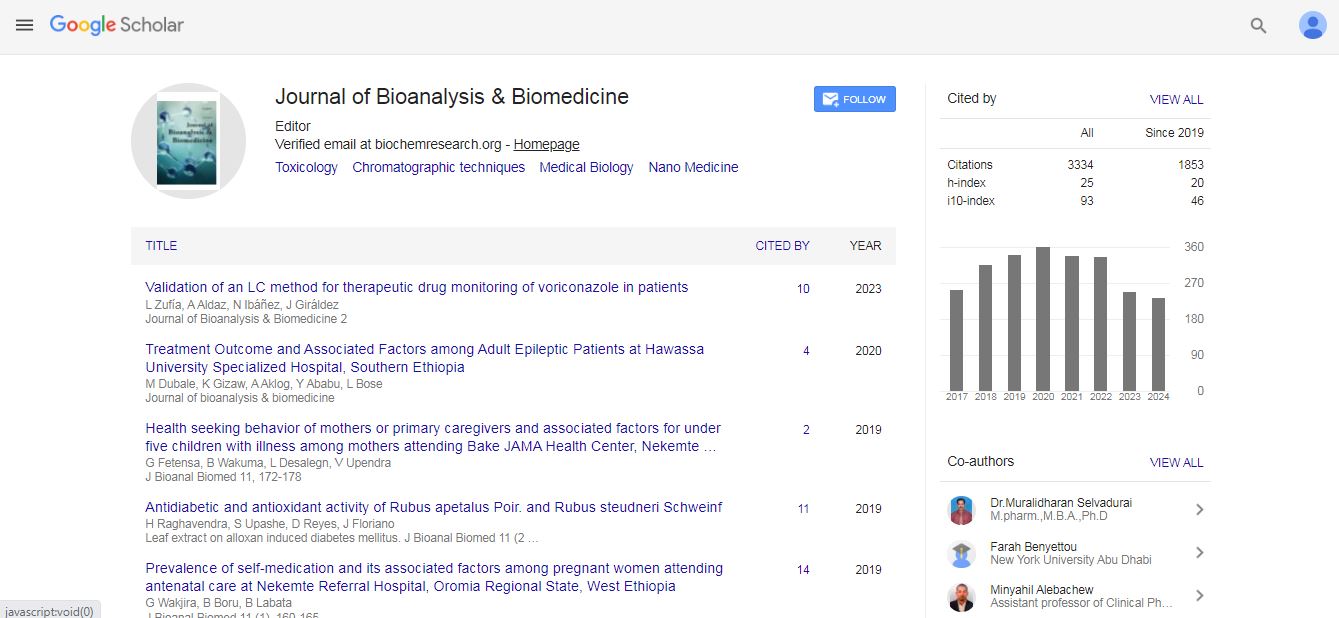
Journal of Bioanalysis & Biomedicine received 3099 citations as per Google Scholar report