Perspective - (2025) Volume 15, Issue 3
Received: 02-Jun-2025, Manuscript No. jeat-26-188606;
Editor assigned: 04-Jun-2025, Pre QC No. P-188606;
Reviewed: 18-Jun-2025, QC No. Q-188606;
Revised: 23-Jun-2025, Manuscript No. R-188606;
Published:
30-Jun-2025
, DOI: 10.37421/2161-0525.2025.15.854
Citation: Fernandez, Miguel. ”Advanced Analytical Methods for
Marine Toxic Metal Contamination.” J Environ Anal Toxicol 15 (2025):854.
Copyright: © 2025 Fernandez M. This is an open-access article distributed under the terms of the Creative Commons Attribution License, which permits unrestricted use,
distribution and reproduction in any medium, provided the original author and source are credited.
The accurate quantification of toxic metals within marine ecosystems is a critical undertaking, demanding precise analytical methodologies to ensure environmental health and safety. These methods are essential for monitoring pollution levels, assessing ecological risks, and informing regulatory policies. The challenges inherent in analyzing these pollutants, particularly at low analyte concentrations and within complex marine matrices, necessitate the use of advanced analytical instrumentation and rigorous protocols [1].
Understanding the varying toxicity of different chemical forms of elements like mercury is paramount for effective environmental management. Speciation analysis, which differentiates between these forms, provides crucial insights into bioavailability and ecological impact. Techniques capable of distinguishing between inorganic and organic mercury, such as Liquid Chromatography coupled with Inductively Coupled Plasma Mass Spectrometry (LC-ICP-MS), are vital for comprehending mercury's behavior in sensitive coastal environments [2].
The bioaccumulation potential of metals in marine primary producers is a significant concern, highlighting the need for methods that can accurately assess metal content in organisms like macroalgae. Integrated approaches utilizing rapid screening techniques like energy-dispersive X-ray fluorescence (EDXRF) followed by precise quantification with ICP-MS offer a comprehensive strategy for investigating metal distribution and enrichment in such organisms influenced by anthropogenic activities [3].
Analyzing elements such as arsenic at ultra-trace levels, especially in pristine marine environments, presents unique analytical hurdles. The development of novel pre-concentration techniques coupled with advanced chromatographic-spectrometric methods like High-Performance Liquid Chromatography-ICP-MS (HPLC-ICP-MS) is crucial for overcoming matrix effects and achieving the low detection limits required for baseline studies and the identification of subtle anthropogenic inputs [4].
The choice of sample preparation, particularly digestion methods, significantly influences the accuracy of trace metal analysis in marine biota. Comparative evaluations of different digestion protocols, such as microwave-assisted digestion versus traditional wet digestion, are essential to understand their impact on analyte recovery and the potential for contamination. This research guides the selection of appropriate procedures for diverse biological matrices in environmental toxicology [5].
Understanding the biogeochemical cycling of elements like rare earth elements (REEs) in marine systems requires sensitive analytical methods for their determination in various marine compartments, including seawater. Techniques employing solid-phase extraction (SPE) for pre-concentration coupled with ICP-MS offer enhanced analytical sensitivity and minimize matrix interference, making them valuable for studying the distribution and behavior of REEs [6].
Ensuring the reliability of analytical data for trace metals in marine biota is crucial for regulatory compliance and ecological risk assessments. Comprehensive quality assurance and quality control (QA/QC) procedures, including the use of certified reference materials, method validation, and inter-laboratory comparisons, are fundamental to guaranteeing data integrity and comparability across different studies and laboratories [7].
Even seemingly straightforward sample collection can introduce significant challenges in trace metal analysis, particularly in marine waters. Meticulous cleaning protocols for sampling equipment and the use of inert materials are imperative to minimize contamination artifacts. These pre-analytical steps are critical for ensuring that measured metal concentrations accurately reflect environmental levels, especially when aiming for very low detection limits [8].
The development of field-deployable analytical tools offers significant advantages for rapid environmental assessments. Portable X-ray fluorescence (pXRF) has emerged as a convenient option for in-situ screening of heavy metals in marine sediments. However, its application necessitates careful calibration and subsequent verification with laboratory-based methods like ICP-MS to ensure accurate quantitative data for regulatory purposes [9].
Investigating the speciation of elements like chromium in marine aerosols is vital for assessing potential health risks. Developing analytical methods that can effectively differentiate between oxidation states, such as Cr(III) and Cr(VI), using techniques like ion chromatography coupled with ICP-MS, is crucial for understanding the environmental fate and toxicological implications of these airborne contaminants in coastal regions [10].
The precise determination of toxic metals in marine environments is a cornerstone of environmental science, enabling robust monitoring and risk assessment. Advanced analytical techniques are indispensable due to the low concentrations of target analytes and the complex chemical composition of marine samples. Inductively Coupled Plasma Mass Spectrometry (ICP-MS) and Atomic Absorption Spectrometry (AAS) stand out for their sensitivity and accuracy, complemented by meticulous sample preparation and stringent quality control measures to ensure high-integrity data crucial for environmental stewardship [1].
A significant focus in marine pollution studies is the speciation analysis of mercury. This is driven by the understanding that mercury's toxicity is heavily dependent on its chemical form, impacting its mobility, bioavailability, and ecosystem effects. The development and validation of analytical methods, such as LC-ICP-MS, are essential for differentiating between various mercury species in coastal waters, thereby providing a more nuanced understanding of its environmental behavior and ecological impact [2].
Marine macroalgae serve as important bioindicators for metal contamination, and their ability to accumulate metals like lead and cadmium underscores the need for effective analytical approaches. The integration of rapid, non-destructive screening methods like EDXRF with precise quantification by ICP-MS provides a powerful toolset for assessing metal distribution and enrichment patterns in these vital primary producers, especially in areas affected by industrial discharge [3].
Analyzing arsenic species at ultra-trace levels in open ocean waters poses considerable analytical challenges, often requiring specialized pre-concentration techniques to overcome matrix interference and achieve extremely low detection limits. The combination of novel sample preparation strategies with advanced chromatographic-spectrometric systems like HPLC-ICP-MS offers a significant advancement for conducting baseline studies and detecting subtle anthropogenic influences on arsenic cycling in these remote marine environments [4].
Sample preparation, particularly the digestion of biological matrices like marine phytoplankton, is a critical step that can profoundly affect the accuracy of trace metal analyses. Research comparing different digestion methodologies, including microwave-assisted and traditional wet digestion, is vital for assessing their impact on analyte recovery and identifying potential sources of contamination. Such comparative studies provide essential guidance for selecting the most appropriate and reliable digestion protocols in environmental toxicology [5].
The determination of trace elements such as rare earth elements (REEs) in seawater necessitates highly sensitive analytical techniques. Solid-phase extraction (SPE) has proven to be an effective pre-concentration method for REEs, significantly enhancing analytical sensitivity and minimizing matrix effects when coupled with ICP-MS. This approach is instrumental in elucidating the complex biogeochemical cycling of these elements within marine ecosystems [6].
Data reliability is paramount in environmental geochemistry, especially when dealing with toxic metals in marine biota. Robust quality assurance and quality control (QA/QC) strategies are indispensable. These include the judicious use of certified reference materials, thorough method validation, and participation in inter-laboratory comparisons, all of which are fundamental to generating dependable data for regulatory purposes and comprehensive ecological risk assessments [7].
Preventing contamination during the sampling process is a critical but often overlooked aspect of trace metal analysis in marine waters. The implementation of meticulous cleaning protocols for sampling equipment and the exclusive use of inert materials are essential to avoid introducing artifacts. These rigorous pre-analytical measures are fundamental to ensuring that the measured concentrations truly represent the environmental levels, particularly when low detection limits are a requirement [8].
While portable analytical instruments like pXRF offer convenience for rapid, in-situ screening of heavy metals in marine sediments, their application requires careful consideration. The study of their performance relative to established laboratory methods like ICP-MS highlights the importance of calibration and verification to ensure the accuracy of quantitative data, especially when compliance with environmental regulations is a primary objective [9].
Investigating the different chemical forms, or speciation, of chromium in marine aerosols is crucial for assessing inhalation risks. The development of analytical methodologies that can effectively differentiate between toxic Cr(VI) and less toxic Cr(III) is paramount. Techniques such as ion chromatography coupled with ICP-MS enable this discrimination, providing essential data for understanding the environmental fate and potential health impacts of airborne chromium in coastal atmospheric environments [10].
This collection of research highlights the critical importance of advanced analytical methodologies for understanding toxic metal contamination in marine ecosystems. Studies cover the precise quantification of metals in sediments, speciation analysis of mercury in coastal waters, and the investigation of metal accumulation in marine macroalgae. Innovative techniques for determining ultra-trace levels of arsenic species and the efficient pre-concentration of rare earth elements are discussed. Furthermore, the research emphasizes crucial aspects of sample preparation, including the comparative evaluation of digestion methods for marine biota, and the indispensable role of quality assurance and quality control measures to ensure data reliability. The potential for contamination from sampling equipment is addressed, alongside the utility and limitations of field screening techniques like portable X-ray fluorescence. Finally, the importance of speciation analysis for elements like chromium in marine aerosols is explored, underscoring the multifaceted challenges and sophisticated solutions employed in marine metal analysis.
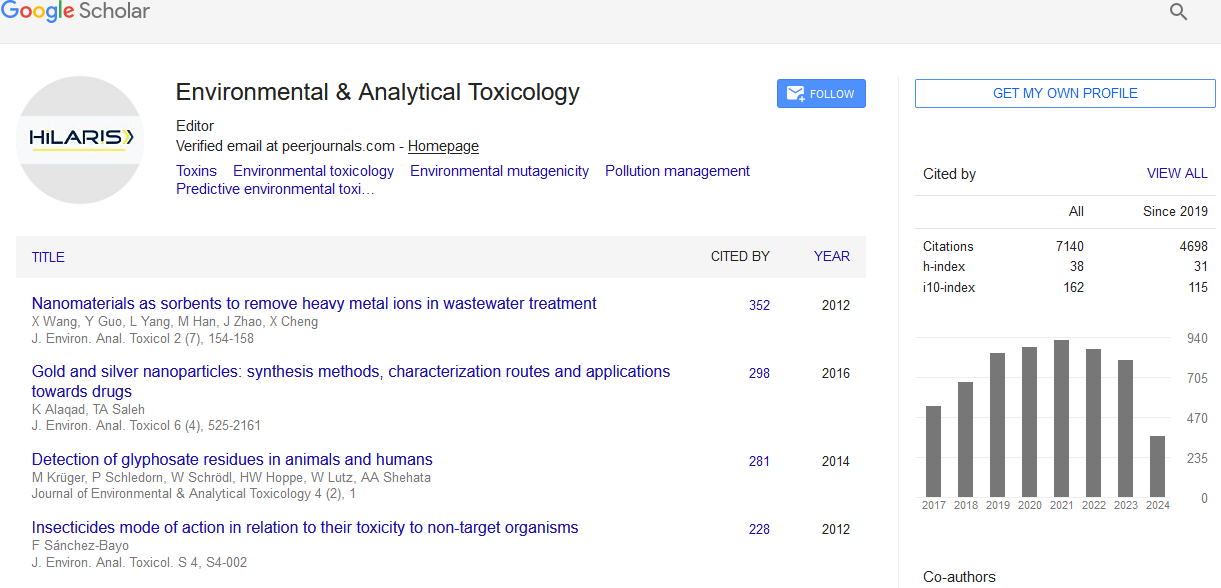
Environmental & Analytical Toxicology received 6818 citations as per Google Scholar report