Commentary - (2025) Volume 14, Issue 4
Received: 01-Jul-2025, Manuscript No. aim-25-177757;
Editor assigned: 03-Jul-2025, Pre QC No. P-177757;
Reviewed: 17-Jul-2025, QC No. Q-177757;
Revised: 22-Jul-2025, Manuscript No. R-177757;
Published:
29-Jul-2025
, DOI: 10.37421/2427-5162.2025.14.577
Citation: Rao, Ananya. "Adaptogens: Mastering Stress for Body and Mind." Alt Integr Med 14 (2025):577.
Copyright: © 2025 Rao A. This is an open-access article distributed under the terms of the Creative Commons Attribution License, which permits unrestricted use, distribution and reproduction in any medium, provided the original author and source are credited.
This article offers a comprehensive overview of adaptogens, exploring their definition and examining the molecular mechanisms through which they help the body resist stress. It details how these natural compounds modulate the neuroendocrine-immune system, impacting cellular and systemic responses to various stressors. The authors emphasize the potential of adaptogens in managing stress-related disorders [1].
This review discusses how adaptogens can offer both performance and health benefits, particularly for athletes facing physical and mental stress. It explores their mechanisms in improving resilience, reducing fatigue, and supporting overall well-being, highlighting the compounds potential to aid stress adaptation beyond just athletic contexts [2].
This comprehensive review delves into the therapeutic potential of Ashwagandha Withania somnifera in managing various brain disorders. It details the plants adaptogenic properties, explaining how its bioactive compounds can modulate neurological pathways, reduce oxidative stress, and exert neuroprotective effects, thereby enhancing resilience to stress and improving cognitive function [3].
This critical review examines Rhodiola rosea extracts, highlighting their adaptogenic properties and potential to enhance stress resilience. It discusses the various bioactive compounds responsible for its effects, outlining the mechanisms through which it improves physical and mental performance, reduces fatigue, and helps the body adapt to different stressors [4].
This review explores the adaptogenic potential of various medicinal plants, focusing on their multifaceted effects against stress. It details how these plants contribute to neuroprotection and immunomodulation, thereby bolstering the bodys capacity to cope with diverse stressors and enhance overall resilience [5].
This systematic review evaluates clinical trials investigating how adaptogens influence the bodys stress response. It synthesizes evidence on their ability to improve resilience, modulate physiological and psychological stress markers, and support mental well-being, providing insights into their practical applications [6].
This systematic review and metaanalysis assesses the efficacy of Ashwagandha Withania somnifera in treating anxiety. It provides robust evidence for its anxiolytic properties, detailing how this adaptogen can significantly reduce anxiety symptoms and enhance stress resilience, offering a natural therapeutic option [7].
This systematic review investigates Panax ginsengs role as an adaptogen, specifically focusing on its impact on stress and fatigue. It compiles evidence demonstrating ginsengs ability to enhance mental and physical performance, reduce perceived stress, and combat fatigue, thereby contributing to improved stress resilience [8].
This review focuses on the adaptogenic activity of various medicinal plants, specifically their role in counteracting stressinduced neuroinflammation and oxidative stress. It details how these natural compounds protect neuronal health and function, thereby contributing significantly to stress resilience and overall brain well-being [9].
This review details the neuropharmacological and neuroprotective properties of Bacopa monnieri, an established adaptogen. It explains how Bacopa supports cognitive function and enhances stress resilience by modulating neurotransmitter systems, reducing oxidative stress, and promoting neuronal health, making it relevant for stress management [10].
This article offers a comprehensive overview of adaptogens, exploring their definition and examining the molecular mechanisms through which they help the body resist stress. It details how these natural compounds modulate the neuroendocrine-immune system, impacting cellular and systemic responses to various stressors. The authors emphasize the potential of adaptogens in managing stress-related disorders [1]. This review discusses how adaptogens can offer both performance and health benefits, particularly for athletes facing physical and mental stress. It explores their mechanisms in improving resilience, reducing fatigue, and supporting overall well-being, highlighting the compounds potential to aid stress adaptation beyond just athletic contexts [2]. This comprehensive review delves into the therapeutic potential of Ashwagandha Withania somnifera in managing various brain disorders. It details the plants adaptogenic properties, explaining how its bioactive compounds can modulate neurological pathways, reduce oxidative stress, and exert neuroprotective effects, thereby enhancing resilience to stress and improving cognitive function [3]. This critical review examines Rhodiola rosea extracts, highlighting their adaptogenic properties and potential to enhance stress resilience. It discusses the various bioactive compounds responsible for its effects, outlining the mechanisms through which it improves physical and mental performance, reduces fatigue, and helps the body adapt to different stressors [4]. This review explores the adaptogenic potential of various medicinal plants, focusing on their multifaceted effects against stress. It details how these plants contribute to neuroprotection and immunomodulation, thereby bolstering the bodys capacity to cope with diverse stressors and enhance overall resilience [5]. This systematic review evaluates clinical trials investigating how adaptogens influence the bodys stress response. It synthesizes evidence on their ability to improve resilience, modulate physiological and psychological stress markers, and support mental well-being, providing insights into their practical applications [6]. This systematic review and metaanalysis assesses the efficacy of Ashwagandha Withania somnifera in treating anxiety. It provides robust evidence for its anxiolytic properties, detailing how this adaptogen can significantly reduce anxiety symptoms and enhance stress resilience, offering a natural therapeutic option [7]. This systematic review investigates Panax ginsengs role as an adaptogen, specifically focusing on its impact on stress and fatigue. It compiles evidence demonstrating ginsengs ability to enhance mental and physical performance, reduce perceived stress, and combat fatigue, thereby contributing to improved stress resilience [8]. This review focuses on the adaptogenic activity of various medicinal plants, specifically their role in counteracting stressinduced neuroinflammation and oxidative stress. It details how these natural compounds protect neuronal health and function, thereby contributing significantly to stress resilience and overall brain well-being [9]. This review details the neuropharmacological and neuroprotective properties of Bacopa monnieri, an established adaptogen. It explains how Bacopa supports cognitive function and enhances stress resilience by modulating neurotransmitter systems, reducing oxidative stress, and promoting neuronal health, making it relevant for stress management [10].
Adaptogens are a class of natural compounds that significantly enhance the body's capacity to adapt and resist various stressors, encompassing both physical and psychological challenges. Their primary mechanisms involve modulating the intricate neuroendocrine-immune system, leading to optimized cellular and systemic responses under stress. Extensive research underscores their diverse therapeutic potential, including the management of stress-related disorders, alleviation of fatigue, and overall promotion of well-being. Key adaptogens, such as Ashwagandha (Withania somnifera), Rhodiola rosea, Panax ginseng, and Bacopa monnieri, have been rigorously investigated. Ashwagandha demonstrates particular efficacy in mitigating brain disorders, reducing oxidative stress, and exhibiting notable anxiolytic properties. Rhodiola rosea is recognized for its ability to boost physical and mental performance, while Panax ginseng effectively combats perceived stress and chronic fatigue. Furthermore, a broad spectrum of medicinal plants exhibits significant neuroprotective and immunomodulatory effects, actively counteracting neuroinflammation induced by stress. Bacopa monnieri is specifically highlighted for its neuropharmacological actions, supporting cognitive function and neuronal health. Clinical research, including systematic reviews and meta-analyses, consistently validates the practical applications of adaptogens in enhancing physiological resilience and positively influencing psychological stress markers across diverse populations.
None
None
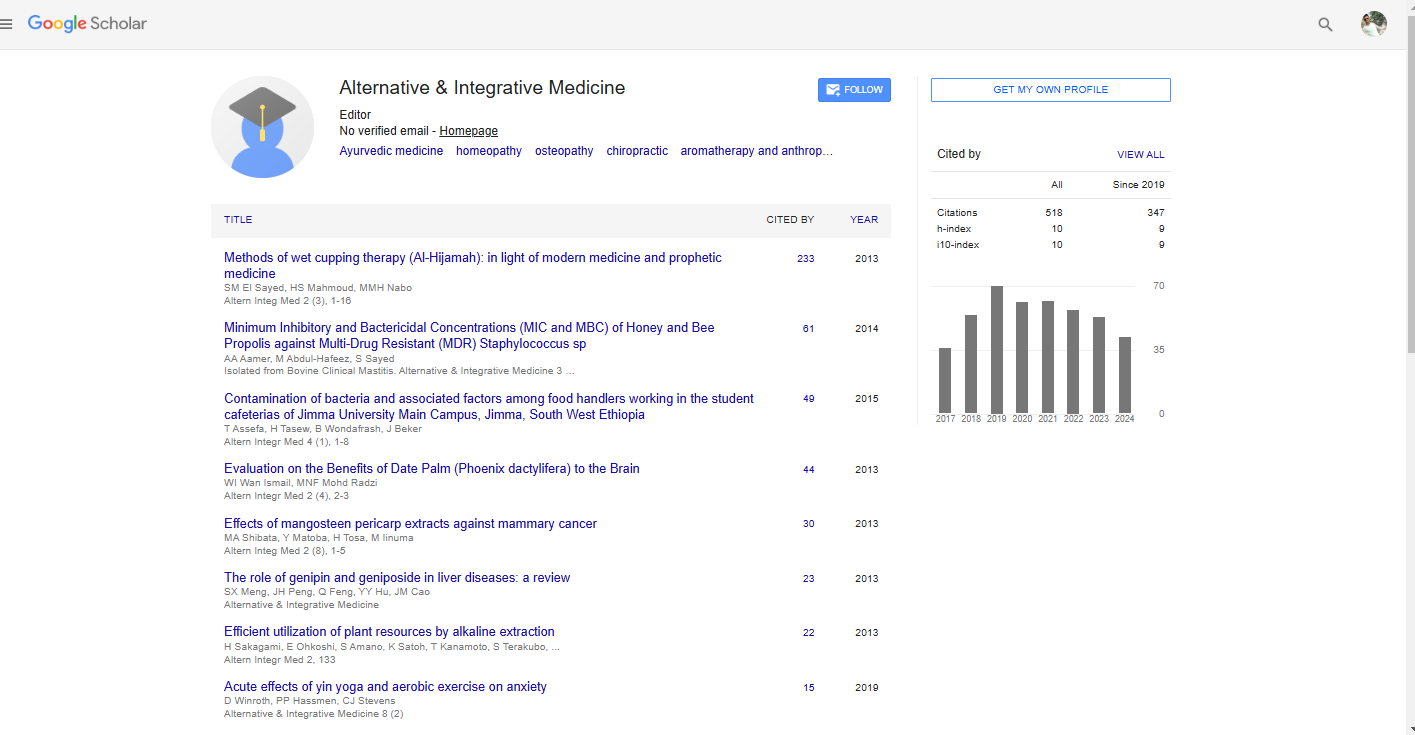
Alternative & Integrative Medicine received 476 citations as per Google Scholar report