Research Article - (2025) Volume 13, Issue 1
Received: 18-Oct-2024, Manuscript No. JND-24-150400;
Editor assigned: 21-Oct-2024, Pre QC No. JND-24-150400 (PQ);
Reviewed: 06-Nov-2024, QC No. JND-24-150400;
Revised: 04-Feb-2025, Manuscript No. JND-24-150400 (R);
Published:
11-Feb-2025
, DOI: 10.4172/2329-6895.13.1.633
Citation: Yegencik, Beliz, Beth Bell, and Emre Deniz. "A Rapid Review and Meta-Analysis of School-Based Interventions Targeting the Core Difficulties of ADHD and Accompanying Impairments (2018-2023)." J Neurol Disord 13 (2025): 633.
Copyright: © 2025 Yegencik B, et al. This is an open-access article distributed under the terms of the creative commons attribution license which permits unrestricted use, distribution and reproduction in any medium, provided the original author and source are credited.
Children with Attention Deficit and Hyperactivity Disorder (ADHD) experience various challenges that affect their quality of life such as difficulties in concentrating on tasks, staying still or seated, and controlling impulsive actions. Such challenges become more apparent once children reach school age due to increased daily tasks that require attention and impulse control. Thus, school-based interventions have been one of the key strategies to improve attentional and behavioural difficulties experienced by these children. While many systematic reviews and meta-analyses have been conducted to test the efficacy of such trials, there has been no systematic investigation of recent trials, showing how these interventions contribute to the earlier discussions. To close this gap in the literature, we conducted a rapid review and meta-analysis of recent randomised controlled trials published between 2018 and 2023. In total, seven trials met the inclusion criteria and were carried into the meta-analysis. Overall, we found that school-based interventions were effective in improving the core difficulties of ADHD (g=.34, .04~.64) and accompanying impairments (g=.47, .07~.86). It is important to note that, similar to previous evaluation studies, we found high levels of heterogeneity in the included school- based interventions. There were also warning signs indicating potential selective-outcome or reporterrelated bias in the meta-analysis of included trials. Overall, school-based interventions are promising to improve the core difficulties of ADHD and accompanying behavioural impairments for school-aged children with ADHD. Implications of high heterogeneity and potential selective outcome/reporter-related bias are further discussed.
Attention deficit hyperactivity disorder • School • Intervention • Meta-analysis
Attention Deficit and Hyperactivity Disorder (ADHD) is defined as difficulties related to concentrating on tasks (i.e., inattention), high levels of activity (i.e., hyperactivity) in which actions are performed before thinking (i.e., impulsivity), and disorganization [1]. According to the Centres for Disease Control and Prevention, ADHD is amongst the most common neurological disorders with a prevalence rate of 11.4% [2]. This rate is significantly higher for boys (15%) compared to girls (8%), suggesting that boys are at significantly higher risk for ADHD and accompanying impairments than girls [3]. However, recent studies also highlight that girls may be underdiagnosed due to several factors such as masking, gender-bias in diagnostic measures, and families being more likely to seek diagnosis for male children than female children [4]. Although ADHD is categorised as a childhood disorder, regardless of the gender differences in the prevalence rates, both girls and boys appear to be at high risk for carrying core difficulties of ADHD into adulthood [5].
Children with ADHD experience various behavioural and emotional difficulties accompanying their core ADHD symptoms [6]. For instance, difficulties in organisational skills, taking turns in games or in conversations, emotion regulation, task avoidance, and disruptive and impulsive behaviours appear to be more commonly experienced by children with ADHD compared to neurotypical children [7]. Additionally, ADHD shares high rates of comorbidity with other neurodevelopmental conditions such as autism spectrum disorder, learning difficulties, specific learning difficulties (e.g., dyslexia), obsessive-compulsive disorder, oppositional defiant disorder, and internalising and externalising disorders [8]. This comorbidity introduces additional challenges for children with ADHD, such as difficulties in peer interactions (e.g., forming and maintaining friendship), impaired social communication skills, and problems in cognitive and language skills. Hence, the core and various accompanying difficulties of ADHD present great challenges to the quality of life for such children.
Difficulties experienced by children with ADHD typically become more evident once children reach school-age [9]. This may be due to an increased number of daily tasks that require attention and impulse-control or due to the late-onset of ADHD in some children [10]. The onset of core ADHD difficulties at school-age put children at increased risk for various impairments including difficulties in performing academic tasks, especially in maths and reading, difficulties with peer interactions, conduct problems, and antisocial behaviours [11]. Such academic and behavioural difficulties experienced by school-aged children with ADHD are linked to increased likelihood of experiencing impairments later in life compared to other children without ADHD [12]. Given that most children with ADHD are being diagnosed at school-age and that teachers play a key role in recognising children’s difficulties, early school-based interventions are likely to be effective in improving core-ADHD difficulties and preventing subsequent behavioural impairments [13].
Researchers and practitioners have developed and delivered various forms of school-based interventions to improve the quality of life for children with ADHD [14]. For instance, one of the well-known multimodal approaches is the Challenging Horizons Program (CHP) which aims to improve common academic (i.e., organisational skills, homework management) and social difficulties (i.e., interpersonal difficulties) experienced by children with ADHD [15]. Similarly, Collaborative Life Skills (CLS) is a home-school collaboration with a focus on social skills, homework problems, and academic competence [16]. Moreover, the Completing Homework by Improving Efficiency and Focus (CHIEF) is an academically oriented intervention with behavioural targets, including time management, organisation, and on-task behavior [17]. Other school-based interventions commonly include psychoeducation for parents, teachers, and peers; cognitive training (e.g., neurofeedback, executive functions); therapeutic approaches (e.g., cognitive behavioural training, mindfulness therapies); and educational programs in schools (e.g., Individualised programs, accommodations) [18].
There have been many attempts to systematically investigate the overall efficacy of the school-based interventions on core ADHD difficulties and accompanying impairments. One of the earliest meta analyses showed that school-based interventions, regardless of the type of the intervention, were effective in reducing behavioural difficulties in such children [19]. Re-reviewing the subsequent literature since their past evaluation, DuPaul, et al. later found mixed findings over the efficacy of such trials, as they found no significant effect size for interventions that are compared to a control group, while reporting significant effects for those without a control group. Subsequent meta analyses have also demonstrated somewhat inconsistent results. For instance, while Richardson, et al. found positive intervention effects on the core difficulties of ADHD (i.e., inattention and hyperactivity/ impulsivity) and accompanying impairments (e.g., externalising problems, school adjustment, academic achievement), a more up-to date evaluation has suggested that some school-based interventions indicate promising findings, the literature has stayed somewhat inconsistent in terms of the efficacy of such trials to improve the quality of life for children with ADHD.
The current study
Despite the abundance of research investigating the efficacy of school-based interventions to improve the core difficulties of ADHD, the past evidence has varied. Additionally, there has been no systematic investigations of the efficacy of recent school-based trials despite the fast-paced literature as, to the best of our knowledge, the most recent review was conducted more than five years ago. This is important as there have been some interventions that were not included in the previous meta-analyses (e.g., TEAMS) and that were recently developed (e.g., CLS-FUERTE) to be adapted to different populations, for which the overall efficacy remains unknown. It is also important to investigate the efficacy of recent trials given the dramatic increase in the prevalence of ADHD since the last evaluation, as this has also provoked many policy changes in school settings which may have reshaped the characteristics of school-based interventions. Furthermore, recent changes in the diagnostic definitions of ADHD, i.e., DSM-V, ICD-11, may have changed the primary focus and nature of such interventions. We believe this, in turn, may have changed the characteristics, and therefore, the efficacy of recent school-based interventions that were not represented in the past reviews and evaluations.
To close this gap in the literature and provide up-to-date evidence, we systematically investigated the efficacy of recent school-based interventions targeting core difficulties of ADHD, namely inattention and hyperactivity/impulsivity, and accompanying behavioural impairments in the educational context. In doing this, we sought to answer the following research questions:
• What are the key characteristics of recent school-based interventions (2018-2023) targeting core difficulties of ADHD and accompanying behavioral impairments?
• How effective are recent school-based interventions in improving core difficulties of ADHD and accompanying behavioral impairments?
• Does the efficacy of such interventions, if at all, sustain at followup?
Target design
This rapid review targeted Randomized Controlled Trials (RCTs), hence, other experimental designs (e.g., quasi-experimental, within/ between-subject, pre and post-test) were kept out of the scope of the current review.
Target sample
Our target sample was school-aged children (starting with the UK school age, 5 to 18) with ADHD. For this, we only included studies that consisted of a sample of children with a clinical diagnosis of ADHD or those screened for ADHD with a valid ADHD screening tool.
Target outcomes
We focused exclusively on interventions that reported the efficacy of school-based interventions on the core difficulties of ADHD, inattention and hyperactivity/impulsivity, and ADHD-accompanying behavioural impairments (e.g., oppositional defiant disorder). Hence, studies not reporting core ADHD difficulties were excluded from the current review, even if they were reporting other developmental outcomes.
Intervention characteristics
We focused on interventions that took place in school settings. Studies with interventions delivered outside school settings (e.g., home) or interventions delivered to other target groups (e.g., parents) were excluded, unless the intervention had a child component at school and the child outcomes were reported separately.
Study selection procedure
Although this is a rapid review, we followed the preferred reporting items for systematic reviews and meta-analyses guideline to improve the quality of the review. Following the PRISMA principles, the first author anonymized screened the ERIC, PsycINFO, and PubMed databases using Boolean search strings. To increase the likelihood of the identification of the relevant studies, search strings were defined based on the target sample and intervention. Hence, the following search strings were used in the database search: “school” AND “ADHD” AND “intervention”. The following synonymous terms were also searched for maximising the study identification results: For “school”; school-based OR classroom OR classroom-based; for “ADHD”; attention deficit*, OR hyperactiv*; and for “intervention”; treatment OR education OR training. Finally, all search strings were screened in all fields (i.e., title, abstract, and full-text).
Study eligibility
The following criteria were predefined for the inclusion of the studies:
• Randomised controlled trials that delivered a child-focused intervention in an educational setting.
• Randomised controlled trials with a sample of children clinically diagnosed with ADHD, or those screened by a valid ADHD assessment tool.
• Randomised controlled trials targeting core ADHD difficulties (i.e., inattention, hyperactivity/impulsivity) and accompanying difficulties.
• Randomised controlled trials with sufficient quantified data (i.e., means, standard deviation, sample size).
• Randomised controlled trials that were published between 2018 and 2023.
• Randomised controlled trials that were published in English.
Data extraction
We extracted two types of data, descriptive and quantified. In terms of descriptive information, we extracted data related to sample characteristics, experimental design, intervention type, intervention duration, intervention setting, intervention administrator, and school type. In terms of quantified data, we extracted sample sizes, means and standard deviations, and, where necessary, standard errors and reported effect sizes.
Data analysis
All analyses were performed in SPSS 29. Due to high heterogeneity, which is a common issue in the field, a random effect model was utilised. Furthermore, given the small sample size of the current meta-analysis, the pooled effect size (standardised mean differences) was reported using Hedge’s g and heterogeneity was reported using I2 statistics. All scales were coded in the same direction with higher scores meaning better functioning. That is, a positive effect size indicates reduced levels of inattention and hyperactivity/impulsivity and improved accompanying difficulties.
Between-subject differences at post-treatment, i.e., means and standard deviations were analysed to report the intervention effects. Additionally, subgroup analyses were conducted to report whether the efficacies of trials were moderated by certain factors, such as extracted outcome-where multiple outcomes were available per domain-and outcome type (i.e., subscale vs. total score). In terms of the latter, some studies reported core difficulties of ADHD separately, that is, inattention, hyperactivity/impulsivity, or combined ADHD. To boost the sample power, in the main meta-analysis, we combined inattention and hyperactivity subscales and reported them alongside total ADHD scores. However, subgroup analyses were performed to detect whether the overall effect size is moderated by the specific reported outcome (i.e., inattention vs. hyperactivity/impulsivity vs. combined ADHD). Finally, follow–up statistics were also reported, where available, to examine whether the intervention effects last.
Sensitivity models
Sensitivity analyses were conducted where multiple outcomes were available per reported domain (i.e., 1-ADHD, 2-Accompanying impairments). This is to test whether the reported effect size is impacted by the selective outcome reporting or reporter-related bias, where the alternative available outcomes were reported by other reporters instead of the same reporter. For instance, in terms of multiple reporters of the multiple outcomes per domain, if a study consisted of parent and teacher-report ADHD outcomes, we included parent-reported outcomes in the primary model and replaced the outcome with teacher-report in the sensitivity model. In terms of the same reporter of the alternative multiple outcomes per domain, for example, if a parent reported two ADHD-accompanying difficulties, we included the first-reported outcome in the main model and replaced it with the second-reported outcome in the sensitivity model. In cases where there were more than two reported outcomes corresponding to a single domain, to minimise selective reporting bias, we only reported the first two outcomes; one in the main model and one in the sensitivity model, as previously done by others.
Study selection results
Boolean search strings identified 8143 studies in the ERIC, PsycINFO, and PubMed databases. As a first step, non-randomised studies (N=7324) and duplicates (N=68) were removed. Second, 170 studies were carried into abstract screening, 93 of which were further excluded due to irrelevance. Third, 77 studies were full-text screened which resulted in the exclusion of 67 studies due to trials not meeting the inclusion criteria for the following reasons: Study aims, target outcome, intervention setting, confounding factors (i.e., medication), sample characteristics (i.e., without ADHD), and not reporting sufficient quantified outcomes. Additionally, the full texts of two studies were not openly available and their authors were out of reach, which were further excluded. Finally, one paper was a duplicate of an included study, which was also excluded. Hence, seven trials were included in the current meta-synthesis. Detailed information on database screening can be seen in the PRISMA flow diagram (Figure 1).
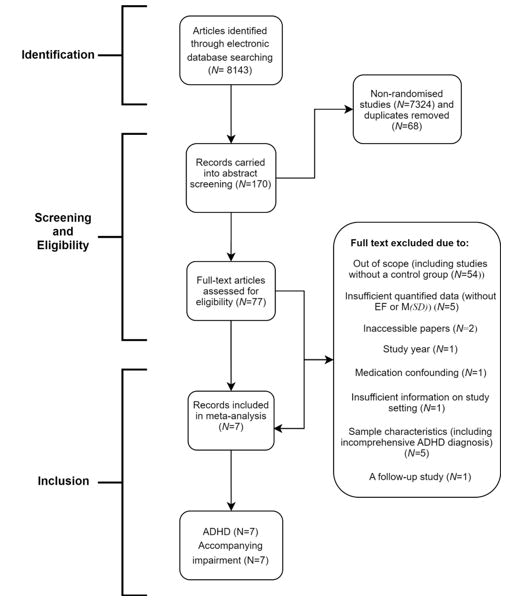
Figure 1. PRISMA flow diagram.
Study characteristics
The characteristics of the included studies are summarised here in brief. Detailed information is shown in Table S1.
Randomisation: Of the seven included studies, two were clusterrandomised, two were stratified randomised, and three were nonclustered/ non-stratified randomised controlled trials. To note, one study 1 had stratified randomisation for the multiple intervention groups (i.e., high and low intensity), while the control condition was a matched-control.
Baseline equivalence: There were no significant between-group differences at baseline in any of the included interventions for any of the reported outcomes. Hence, post-intervention between-group differences are deemed unaffected by any baseline in equivalence.
ADHD status: The included studies used valid and reliable instruments to screen for ADHD, with some studies using more than one tool. The following instruments were used in the included studies: ADHD rating scale-4/5, behavior assessment system for children– second edition, child symptom inventory, children’s interview for psychiatric syndromes for diagnosis, computerised-diagnostic interview schedule for children, impairment rating scale, and strengths and difficulties questionnaire.
Study location: The majority of the studies were conducted in the USA (N=4), and the rest were from either Canada, China, or Mexico.
Study outcomes: All studies reported core ADHD outcomes, i.e., inattention (N=3), hyperactivity/impulsivity (N=3), or combined ADHD (N=4), as well as various ADHD-accompanying difficulties, for which, the first-reported outcome–or the primary outcome is extracted. These outcomes were as follows: Oppositional Defiant Disorder (ODD), impairment in peer relations (IRS, SAICA), and severity of children’s impairment at home or school (CBC). Further information is provided as supplementary materials (Table S2A and S2B).
Intervention characteristics
In terms of the intervention length, it varied drastically with the shortest being 5 weeks and the longest intervention being 52 weeks. In terms of the delivered interventions, two studies delivered the collaborative life skills. The other delivered interventions were as follows: Executive attention and motor skills, high intensity summer intervention, group executive function training, making socially accepting inclusive classrooms and multicomponent challenging horizons program. Although the main target of these interventions was improving the core ADHD difficulties, namely inattention and hyperactivity/impulsivity, they also aimed to improve other accompanying difficulties such as organisational skills, academic skills (e.g., homework management), interpersonal skills (e.g., peer interactions), cognitive skills (e.g., working memory), and executive functions (e.g., inhibitory control). Finally, the majority of the interventions were mainly delivered by school staff, including teachers and school mental health practitioners (N=4), followed by doctoral or graduate students (N=2), and therapists/clinical psychologists (N=1) health practitioners (N=4), followed by doctoral or graduate students (N=2), and therapists/clinical psychologists (N=1).
Meta-analytic findings
ADHD: The meta-analysis of all included studies revealed a significant pooled effect size (g=.34, .04~.64, Figure 2) suggesting that children with ADHD who received a school-based intervention demonstrated improved attention and hyperactivity/impulsivity at post-treatment compared to their peers who did not receive any treatments. Despite the small to medium effect size, there appeared to be high heterogeneity in the meta-analysis of the ADHD outcomes (I2=84%). Additionally, subgroup analyses revealed that the significant intervention effect was not moderated by the type of the reported outcome, that is inattention vs. hyperactivity/impulsivity vs. overall ADHD (Q=5.47, p=.06; Figure S2A). Moreover, it is important to note that the significant intervention effect was not maintained at the follow-up stage (g=.15, -.16~.54, Figure S2B). Finally, sensitivity analysis with alternative outcomes, where multiple outcomes were reported per domain, indicated no significant intervention effects (g=.30, -.01~.61, Figure S2C), potentially highlighting a selectiveoutcome or reporter-related bias. Implications of this, alongside high heterogeneity and the loss of intervention effect at follow-up are further raised in the discussion section.
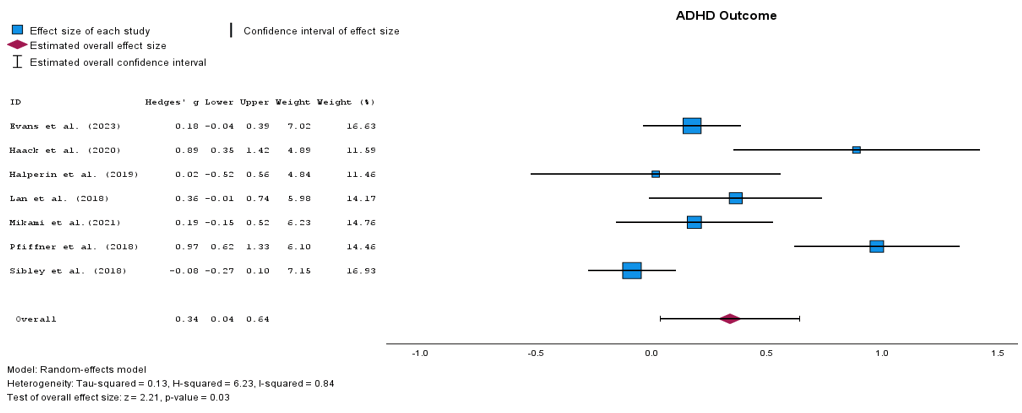
Figure 2. Forest plot showing the effects of interventions on improving ADHD.
ADHD-accompanying impairments: The pooled effect size of extracted quantified outcomes indicated a medium to high positive effect size (g=.47, .07~.86, Figure 3) suggesting that children who received a school-based intervention had improved ADHDaccompanying impairments than those who did not receive any intervention. Again, similar to what was found in the meta-analysis of the core-ADHD difficulties, there were high levels of heterogeneity (I2=87%) in this meta-analysis. Also, despite what was found in the meta-analysis of the core ADHD difficulties, the efficacy of schoolbased interventions on ADHD accompanying difficulties was shown to have lasting effects (g=.30, .13~.47, Figure S3A). Also, there appeared to be no significant selective-outcome or reporter-related bias as replacing the extracted outcomes with alternative outcomes, where multiple outcomes were reported per domain, also indicated a significant positive effect size (g=.33, .09~.58, Figure S3B). Implications of high heterogeneity are further discussed below.
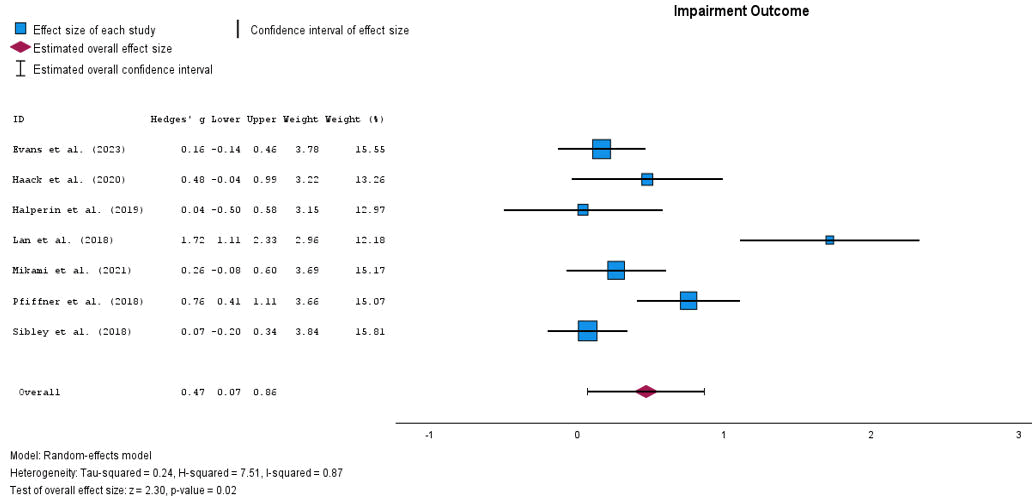
Figure 3. Forest plot showing the effects of interventions on ADHD related impairment.
The current study reports a rapid review and meta-analysis of the effectiveness of the recent school-based interventions on core ADHD symptoms and accompanying impairments. Overall, the current findings suggest that school-based interventions are promising in improving core ADHD difficulties and accompanying impairments in school-aged children with ADHD. However, aligning with the existing literature, the current findings also suffer from heterogeneity in the meta-analyses of both of our reported outcomes, which is concerning. In addition, the current study highlights the potential selectiveoutcome or reporter-related bias in the evaluation of such trials, as found by others, which also needs to be considered in relation to intervention efficacy. Finally, while school-based interventions appear to be promising to improve the quality of life for children with ADHD, their benefits, in terms of the core ADHD difficulties, seem to be short-term. Below, we discuss the implications of the current findings and related warning signs.
Core ADHD difficulties
We found that recent school-based interventions are effective in improving core ADHD difficulties of school-aged children with ADHD. In general, this aligns well with findings from pre-2018 trials that were not included in the current review. Also, our findings match with what past reviews and meta-analyses reported as they also indicated significant positive effect sizes for school-based interventions on the core ADHD difficulties. The past literature, however, consisted of discrepancies. For instance, some reviews reported that some school-based interventions were not effective in improving core ADHD difficulties, mainly arguing this is due to the context and structure of the intervention. Although the current study could not control for the intervention characteristics, taking the high levels of heterogeneity in the current and past reviews into account, we also add that the efficacy of such interventions may as well fluctuate based on other factors, such as the reporter of the outcome, measurement of the outcome, who delivered the intervention, the intervention duration, etc. Hence, recent school-based interventions appear to be promising in improving core ADHD difficulties, though the field, including the current findings, suffer from high heterogeneity issues which significantly limits our understanding on the true effectiveness of such interventions.
Given that we found potential selective-outcome or reporter-related bias, which was also flagged by others, but is contrary to Moore et al. who found large improvements in ADHD-combined symptoms by both raters, i.e., teachers and parents. The discrepancy implies that special attention should be given to the measurements in the design and evaluation of such interventions. One possible explanation for reporter-related bias may be that an observed effect in one setting (i.e., school) may be less observable or obvious in other settings or to others. For instance, parents may have rated higher improvements than teachers as daily-tasks at home may be less demanding to children with ADHD compared to daily tasks at school, or that daily school tasks may get more complicated day by day as children progress through their education while the expected performance from children at home stays stable. This would also apply to the discrepancies between reporters, that is, whether it is child-report, parent-report, or teacher-report, as one may be better reporter than other one depending on the measured phenomenon.
Finally, we found that the intervention effects were somewhat temporary or non-sustainable as there were no significant intervention effects at follow-up. Our finding also aligns with some past reports showing no long-term effects for school-based interventions targeting ADHD or minor sustainability of ADHD treatment in general. Although a more recent study suggested moderate sustainability of behavioural interventions on educational outcomes, the meta-analytic evidence on longevity of non-pharmacological interventions is still limited. This is concerning from multiple perspectives. For instance, policy-makers may be reluctant to promote the development, implementation, and sustainment of interventions without long-lasting effects. Additionally, although temporary improvement in ADHD difficulties is still valuable and beneficial, investment in interventions that lack long-term effects may delay exploring alternative methods that could provide more substantial or long-lasting effects. Hence, immediate attention needs to be given to improve the longevity of the effects of the school-based interventions.
An interesting finding of this review is that there were no significant differences in the effectiveness of school-based interventions on subtypes versus overall core difficulties of ADHD. There may be several reasons, as also previously suggested by Sokolova, et al. one of which is the interdependency between inattention and hyperactivity/impulsivity. They suggested, and we agree that, interventions that improve inattention will also have positive effects on individuals’ hyperactivity/impulsivity, yet the evidence in the literature is contradictory. For instance, a past review and meta-analysis has shown that school-based psychosocial interventions may be more effective in improving inattention difficulties than hyperactivity. Also, previous meta-analysis indicated unclear evidence from multimodal school-based interventions, as they did not find a strong improvement across raters on either inattention or hyperactivity symptoms. It is not yet clear to understand whether school-based interventions are more effective at improving certain ADHD difficulties (i.e., inattention vs. hyperactivity/ impulsivity). Therefore, more evidence is needed for further clarification in this regard.
ADHD accompanying impairments
Apart from improving core ADHD difficulties, recent school-based interventions also appear to have a knock-on effect on ADHD accompanying difficulties such as organisational problems, oppositional defiant disorder, and peer relations, which seems to be a long-lasting effect. Pre-2018 trials also support our findings as the majority reported significant effect sizes for school-based interventions on various ADHD accompanying impairments, such as disruptive behaviours, and social and cognitive skills. Moore, et al.’s study also showed a positive impact of multimodal interventions on conduct problems, which constituted the majority of our ADHD-accompanying impairment analysis. It is important to take into account the high levels of statistical heterogeneity in this meta-analysis. High heterogeneity is a common issue in the field as previous meta-analyses in the same subgroup and other subgroups of the population have also shown similar issues. However, the statistical heterogeneity may be driven by the clinical heterogeneity, which would indicate that the collective evaluation of such interventions may not make clinical sense. Taken together, while present school-based interventions are effective in improving ADHD accompanying difficulties, this understanding is significantly challenged by high heterogeneity issues, which is a common problem in the field.
Despite what was found for the core ADHD difficulties, there were no selective outcome or reporter-related bias in the efficacy of such interventions on ADHD accompanying difficulties. There may be several reasons for this difference. First, ADHD accompanying difficulties reported in this review were mostly related to externalising difficulties (i.e., organisational skills, oppositional defiant disorder), which are more obvious to the outside world compared to internalised difficulties such as inattention. Second, there may be better interrater agreement between different reporters when it comes to ADHD accompanying impairments compared to core ADHD difficulties; for instance, Langberg and colleagues reported poorer mother-father agreement on ADHD symptom-specific ratings compared to broad externalising behaviours and ODD symptoms. Hence, the efficacy of school-based interventions on the behavioural and social impairments accompanying ADHD appears to be stable and consistent across different raters, but more research is needed to understand the reason for why this does not apply to the core ADHD difficulties.
Taken together, school-based interventions are promising to improve the quality of life for children with ADHD. Therefore, educational settings could be more commonly used, or targeted by intervention designers and policy makers, to deliver such interventions to support children with ADHD. The literature suffers from inconsistent practices, therefore, it would benefit from a new set of guidelines, potentially set by evaluators and established researchers, to improve the homogenous practices in the design and implementation of such interventions. The short-term efficacy of such trials sends additional warning signs in terms of the cost- effectiveness of such interventions, therefore, the emerging literature should focus on improving the longlasting efficacy of such interventions.
This review and meta-analysis holds several strengths. One of the most critical contributions of this study is the inclusion of interventions that were not studied by the previous meta-analysis (e.g., TEAMS), as well as cultural adaptations of some interventions, such as the CLSFUERTE version in Mexico, which also meant that the participant cohorts were multicultural. Our study, in this aspect, stands out from the diversity and inclusivity problem in most psychological research, potentially indicating a higher generalisability of the findings. In terms of the analyses, the methodology in reviewing and reporting the included studies is guided by PRISMA, which improves the overall quality of the reported findings. Second, there were no significant baseline differences in the reported outcomes between intervention and control groups in the included studies, which also improves the validity of the reported effect sizes. Third, double data extraction in the current study ensures the accuracy of the extracted and reported quantified outcomes. Finally, reporting sensitivity models is another strength to detect potential selective outcome or reporter-related bias in the reported outcomes.
There were also some limitations. One major limitation is the high heterogeneity in the meta-analyses of the included studies. This is a major problem and a common issue in the meta-analysis of interventions that target a specific subgroup of the population, e.g., autistic population and in the target population of this study. Additionally, the small sample size of the papers induced many challenges in evaluating the efficacy of such trials. For instance, the number of papers limited us in performing additional statistical analyses which could have provided more detailed information in terms of potential moderators of the reported effect sizes, such as intervention components, intervention duration, or reporters of the outcome. Similarly, it also increases the likelihood of publication bias, as this could not be tested.
Quantified outcomes from the included studies were obtained from several different reporters, i.e., parent, teacher, child, which may be problematic as reporters might have different levels of understanding and knowledge of ADHD. This might also imply cognitive biases, such as the observer-expectancy effect (i.e., observer interprets the results favouring the treatment group, as most of the time reporters were aware of the intervention in place, which may have impacted the pooled effect sizes. Also, we did not control for medication use, which is commonly prescribed to children with ADHD and could impact reported findings. Finally, it should be acknowledged that only evaluating the post-treatment effect sizes might ignore more significant within-group improvements, which was previously documented.
In terms of implications, schools would benefit from adapting evidence-based school-based interventions into their curriculum, which is likely to benefit children with ADHD and other children experiencing similar difficulties, while improving schools’ inclusion practices. Also, teacher training programmes could focus on integrating such evidence-based interventions into their curriculum which would further boost teachers’ skills in the implementation of such interventions. Moreover, policy-makers could consider allocating more resources into developing and sustaining such evidence-based practices to promote various developmental skills of school children with ADHD and similar difficulties.
We also propose some suggestions for future trial designers and evaluators. For trial designers, we suggest paying attention to coherence and homogeneity in the design of the future interventions such as characteristics of the intervention, intervention setting, who delivers the intervention, measurement tools, and reported outcomes. For evaluators, we advise taking into account a broad range of potential moderator factors when reporting the effectiveness of school-based interventions on various outcomes of children with ADHD. An increased homogeneity or better-controlled heterogeneity in such trials will indicate more reliable evidence in regard to their efficacy on various outcomes of children with ADHD, hence, will provide better opportunities to improve the quality of life for children with ADHD.
This study was initially conducted for a master’s study as an empirical dissertation.
The authors have no financial disclosure relevant to this article.
The authors declared no potential conflicts of interest with respect to the research, authorship, and/or publication of this article.
[Crossref] [Google Scholar] [PubMed]
[Crossref] [Google Scholar] [PubMed]
[Crossref] [Google Scholar] [PubMed]
[Crossref] [Google Scholar] [PubMed]
[Crossref] [Google Scholar] [PubMed]
[Crossref] [Google Scholar] [PubMed]
[Crossref] [Google Scholar] [PubMed]
[Crossref] [Google Scholar] [PubMed]
[Crossref] [Google Scholar] [PubMed]
[Crossref] [Google Scholar] [PubMed]
[Crossref] [Google Scholar] [PubMed]
[Crossref] [Google Scholar] [PubMed]
[Crossref] [Google Scholar] [PubMed]
[Crossref] [Google Scholar] [PubMed]
[Crossref] [Google Scholar] [PubMed]
Neurological Disorders received 1343 citations as per Google Scholar report