Phytoplankton are the autotrophic components of the plankton community. There are the key part of oceans, seas and freshwater basin ecosystems. Phytoplankton are also known as microalgae, similar to terrestrial plants which contain chlorophyll and requires sunlight in order to live and grow. Phytoplankton also require inorganic nutrients such as nitrates, sulfur, and phosphates which they convert into proteins, carbohydrates, and fats. The main classes of phytoplankton are dinoflagellates and diatoms. Dinoflagellates use flagella, to move through the water and their bodies are covered with complex shells. Diatoms also have shells, but are made of a different substance and their structure is rigid which are made of interlocking parts. Diatoms do not rely on flagella to move and instead rely on ocean currents to travel through the water. Phytoplankton open access journals are freely available on the public internet domain, allowing any end users to read, download, copy, distribute, prink, search or link to the full texts of the articles.
Research Article: Environmental & Analytical Toxicology
Research Article: Environmental & Analytical Toxicology
Research Article: Environmental & Analytical Toxicology
Research Article: Environmental & Analytical Toxicology
Research Article: Environmental & Analytical Toxicology
Research Article: Environmental & Analytical Toxicology
Research Article: Environmental & Analytical Toxicology
Research Article: Environmental & Analytical Toxicology
Review Article: Environmental & Analytical Toxicology
Review Article: Environmental & Analytical Toxicology
Accepted Abstracts: Environmental & Analytical Toxicology
Accepted Abstracts: Environmental & Analytical Toxicology
Posters-Accepted Abstracts: Environmental & Analytical Toxicology
Posters-Accepted Abstracts: Environmental & Analytical Toxicology
Accepted Abstracts: Hydrology: Current Research
Accepted Abstracts: Hydrology: Current Research
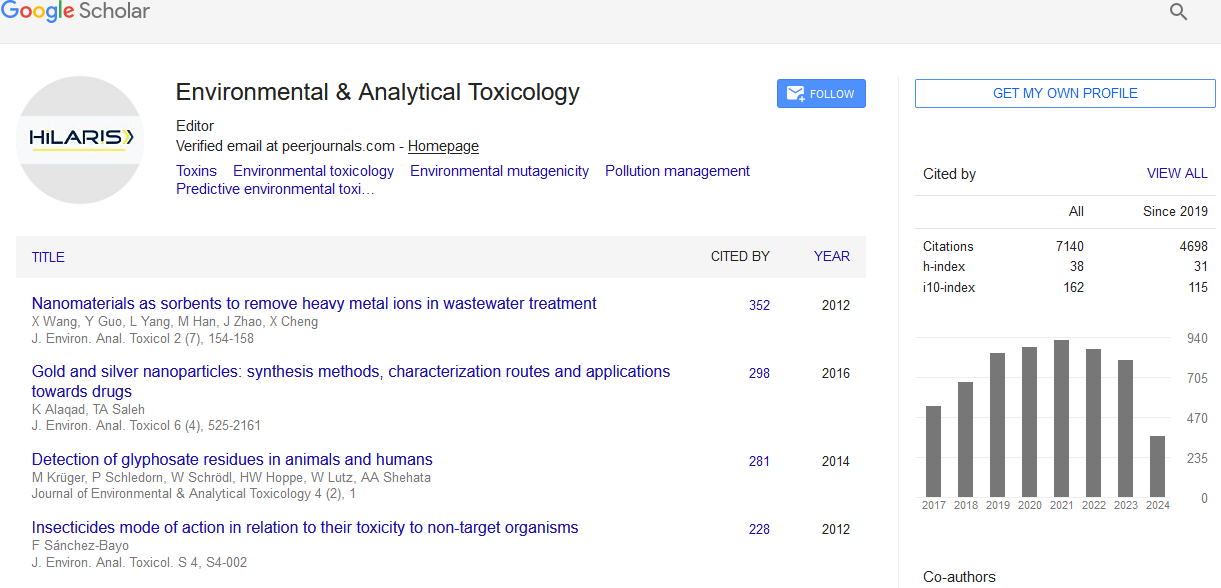
Environmental & Analytical Toxicology received 6818 citations as per Google Scholar report
 Spanish
  Chinese
  Russian
  German
  French
  Japanese
  Portuguese
  Hindi
Hindi 