To describe validation of the 9-hole peg test (9HPT) component of the Multiple Sclerosis Performance Test (MSPT) BACKGROUND: MSPT is an iPad®-based performance assessment tool designed to simulate the Multiple Sclerosis Functional Composite (MSFC). MSPT includes two versions of the 9HPT. DESIGN/METHODS: In the “dish 9HPT”, 9 pegs are moved from a dish to holes, then returned to the dish. In the “row 9HPT”, 9 pegs are moved from a row to holes, then returned to the dish. Scores from these iPad-based 9HPTs were derived from 51 MS patients, and 40 age and gender-matched healthy controls (HC’s), and compared with the traditional technician-administered 9HPT (“technician 9HPT”). A novel metric was defined from MSPT 9HPT data - the “reversal latency”, defined as the elapsed time between inserting the last peg and initiating return of the pegs to the dish. Reversal latency was tested for correlation with disease variables. RESULTS: Test-retest Concordance Correlation Coefficients were 0.897 for dish MSPT 9HPT; 0.877 for row MSPT 9HPT, and 0.857 for technician 9HPT. Pearson Correlation Coefficients comparing the tests were 0.92 for dish vs technician 9HPT, and 0.82 for row vs technician 9HPT. MSPT 9HPT scores distinguished MS from HCs better than technician 9HPT, and correlated better with patient reports of arm function. Reversal latency correlated with disease factors, and also correlated with mental processing speed. CONCLUSIONS: MSPT provides reliable, sensitive, clinically-meaningful data on manual dexterity in MS patients. MSPT manual dexterity testing demonstrates favorable performance characteristics compared with technician 9HPT, and allows exploration of novel metrics. MSPT is an attractive new tool for measuring MS-related impairments in research and clinical settings, with the potential to provide reliable data at lower cost, more frequent intervals, in the patient’s home environment, and to integrate directly into research databases or the electronic health record. Study Supported by: Novartis Pharmaceuticals
Market Analysis: Advances in Robotics & Automation
Market Analysis: Advances in Robotics & Automation
Research Article: Advances in Robotics & Automation
Research Article: Advances in Robotics & Automation
Research Article: Advances in Robotics & Automation
Research Article: Advances in Robotics & Automation
Research Article: Advances in Robotics & Automation
Research Article: Advances in Robotics & Automation
Research Article: Advances in Robotics & Automation
Research Article: Advances in Robotics & Automation
Posters & Accepted Abstracts: Journal of Material Sciences & Engineering
Posters & Accepted Abstracts: Journal of Material Sciences & Engineering
Posters & Accepted Abstracts: Journal of Material Sciences & Engineering
Posters & Accepted Abstracts: Journal of Material Sciences & Engineering
Scientific Tracks Abstracts: Journal of Material Sciences & Engineering
Scientific Tracks Abstracts: Journal of Material Sciences & Engineering
: International Journal of Sensor Networks and Data Communications
: International Journal of Sensor Networks and Data Communications
Scientific Tracks Abstracts: Journal of Material Sciences & Engineering
Scientific Tracks Abstracts: Journal of Material Sciences & Engineering
Accepted Abstracts: Journal of Material Sciences & Engineering
Accepted Abstracts: Journal of Material Sciences & Engineering
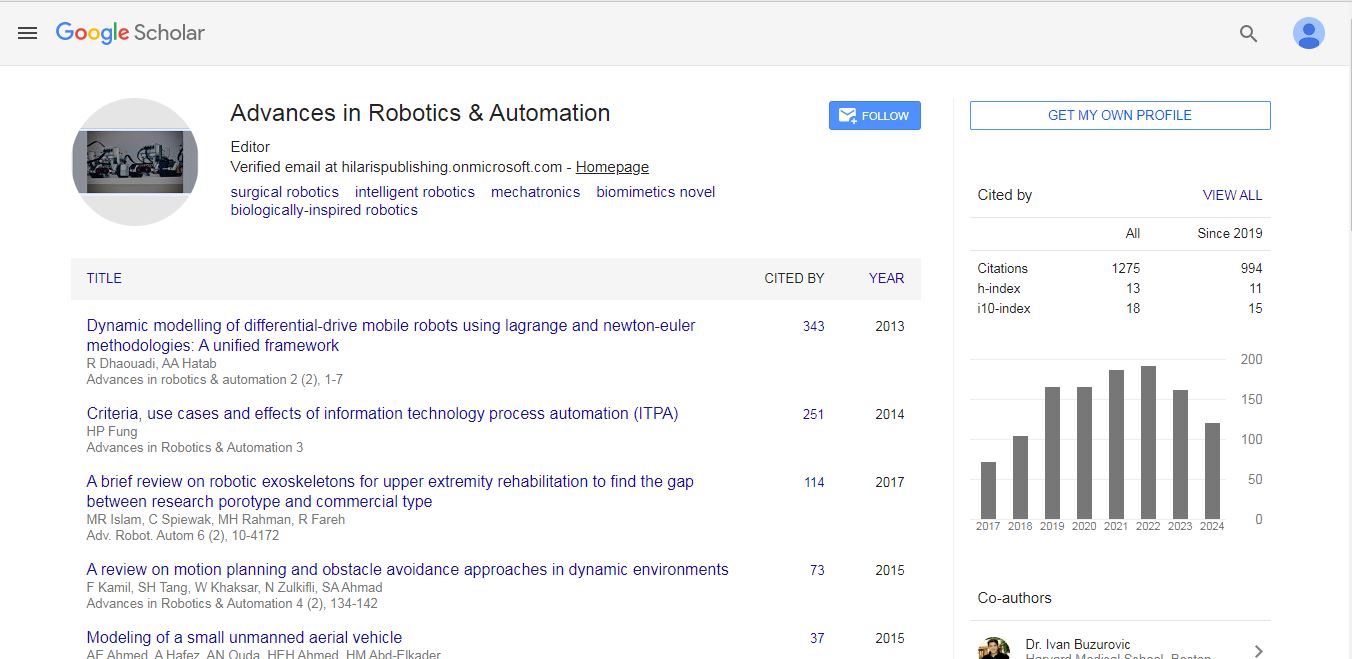
Advances in Robotics & Automation received 1275 citations as per Google Scholar report

 Spanish
  Chinese
  Russian
  German
  French
  Japanese
  Portuguese
  Hindi
Hindi 