The most effective whole-body screening test for bone metastases is radionuclide bone scans. Conventional radiography is the best method for characterizing metastatic lesions. In addition, conventional radiographs are useful for representing imminent or early pathological fractures. Radiographic sensitivity depends on the extent, location and type of bone metastases. Therefore, normal radiographs in patients with positive bone scans or persistent and unexplained pain should be suspicious. In these cases, the CT scan can establish the diagnosis. However, metastatic lesions in the medullary space without architectural changes to the surrounding bone can only be detected by MRI. The use of computed tomography is also useful in determining the local extent of bone destruction and its extent in the surrounding soft tissue when planning surgery or radiation therapy.
Research Article: Nuclear Medicine & Radiation Therapy
Research Article: Nuclear Medicine & Radiation Therapy
Research Article: Nuclear Medicine & Radiation Therapy
Research Article: Nuclear Medicine & Radiation Therapy
Review Article: Nuclear Medicine & Radiation Therapy
Review Article: Nuclear Medicine & Radiation Therapy
Research Article: Nuclear Medicine & Radiation Therapy
Research Article: Nuclear Medicine & Radiation Therapy
Rapid Communication: Nuclear Medicine & Radiation Therapy
Rapid Communication: Nuclear Medicine & Radiation Therapy
Scientific Tracks Abstracts: Journal of Forensic Research
Scientific Tracks Abstracts: Journal of Forensic Research
Scientific Tracks Abstracts: Cancer Science & Therapy
Scientific Tracks Abstracts: Cancer Science & Therapy
Accepted Abstracts: Journal of Forensic Research
Accepted Abstracts: Journal of Forensic Research
ScientificTracks: Cancer Science & Therapy
ScientificTracks: Cancer Science & Therapy
AcceptedAbstracts: Journal of Forensic Research
AcceptedAbstracts: Journal of Forensic Research
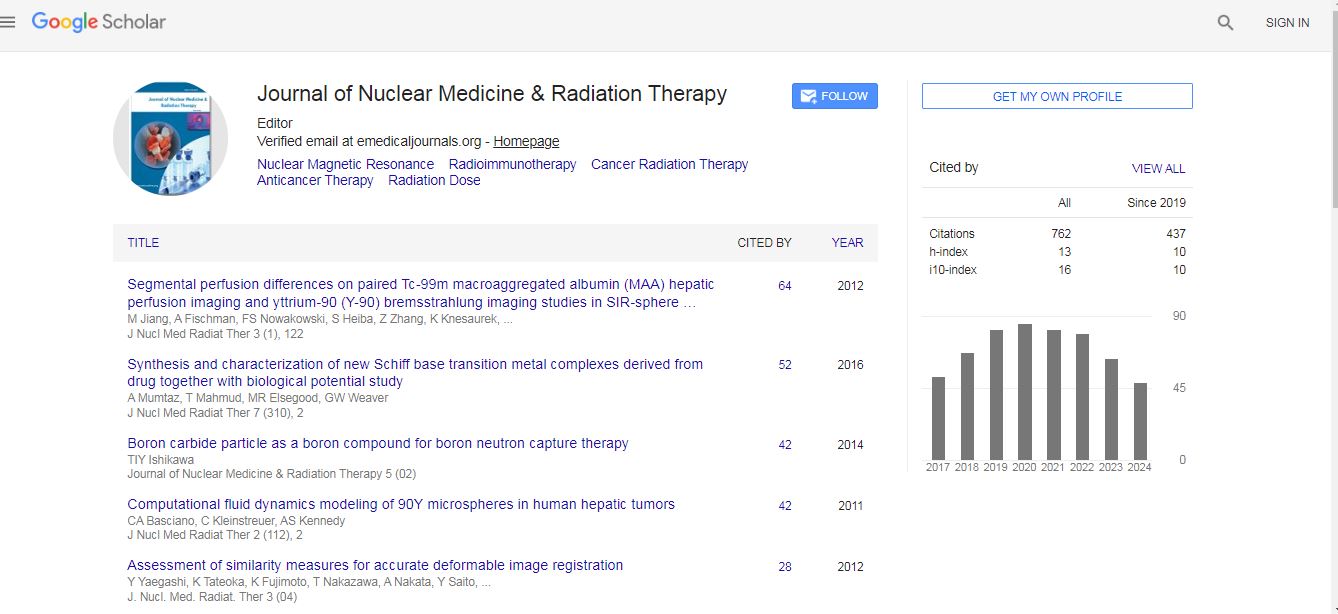
Nuclear Medicine & Radiation Therapy received 706 citations as per Google Scholar report
 Spanish
  Chinese
  Russian
  German
  French
  Japanese
  Portuguese
  Hindi
Hindi 