Leukemias are monoclonal diseases that arise from cells in the hematopoietic stem compartment and from progenitor cells. In accordance with emerging models of carcinogenesis, leukemogenesis is an evolutionary process that involves multiple independent genetic and epigenetic events. Over the past half-century, a predominant paradigm has emerged to describe a developing leukemia secondary to alkylating drug therapy or exposure to benzene in which progressive dysplastic changes, accompanied by a distinct pattern of clonal cytogenetic abnormalities, give rise to acute myeloid leukemia. The characterization of these clonal chromosomal aberrations, as well as the alterations observed in other growth-promoting genes, provide a useful framework for the study of chemical leukemogenesis and for use in understanding the origins and development of leukemia in general.
Research Article: Journal of Blood & Lymph
Research Article: Journal of Blood & Lymph
Research Article: Journal of Blood & Lymph
Research Article: Journal of Blood & Lymph
Case Report: Journal of Blood & Lymph
Case Report: Journal of Blood & Lymph
Case Report: Journal of Blood & Lymph
Case Report: Journal of Blood & Lymph
Editorial: Journal of Blood & Lymph
Editorial: Journal of Blood & Lymph
Scientific Tracks Abstracts: Alternative & Integrative Medicine
Scientific Tracks Abstracts: Alternative & Integrative Medicine
Scientific Tracks Abstracts: Cancer Science & Therapy
Scientific Tracks Abstracts: Cancer Science & Therapy
Keynote: Cancer Science & Therapy
Keynote: Cancer Science & Therapy
Scientific Tracks Abstracts: Alternative & Integrative Medicine
Scientific Tracks Abstracts: Alternative & Integrative Medicine
Scientific Tracks Abstracts: Journal of Surgery
Scientific Tracks Abstracts: Journal of Surgery
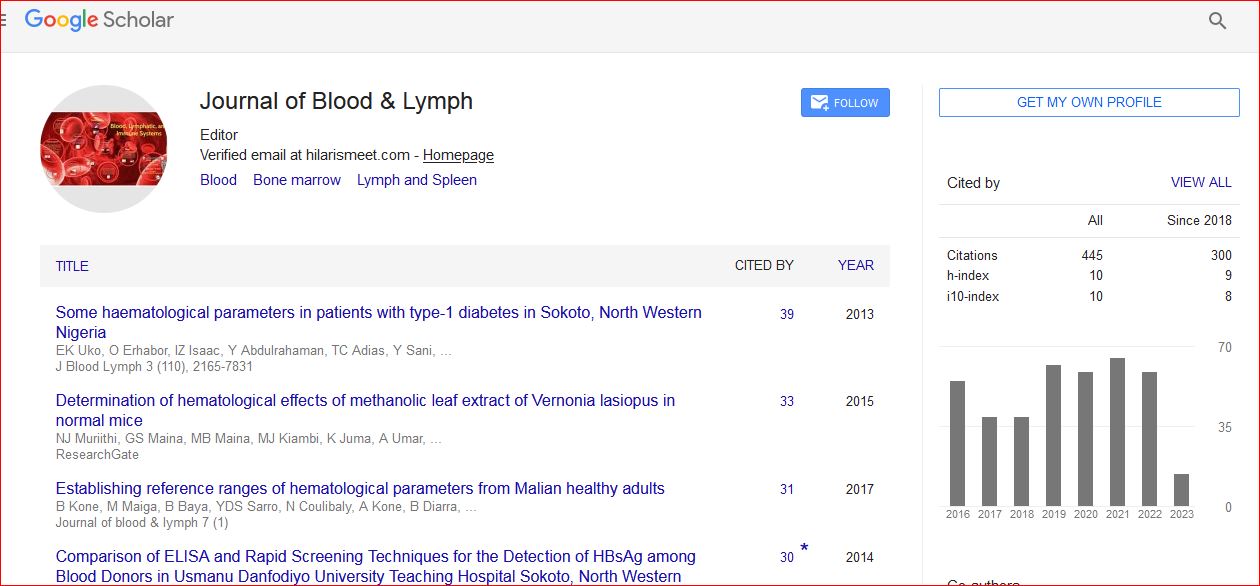
Journal of Blood & Lymph received 443 citations as per Google Scholar report
 Spanish
  Chinese
  Russian
  German
  French
  Japanese
  Portuguese
  Hindi
Hindi 