Hakima Amri
The deluge of high throughput data generated by the microarray technologies and mass spectrometry of proteomics and metabolomics has added another level of complexity to biomedical research; reflected mainly in the mining of massively heterogeneous data for biological significance. Two major issues could be considered as contributing factors: (i) the researchers� underestimation of populational heterogeneity and (ii) the lack of adequate bioinformatics paradigms. Consequently, we are still struggling with many unsolved issues, such as the molecular boundaries of disease, class discovery, early detection, treatment response, biomarkers discovery, specimen profiling, unraveling of clonal from non-expanded mutations, genetic versus epigenetic driving events, post-treatment evaluation, and fathoming the primary origin of some cancers. Current analytical methods are unsuitable for the analysis of heterogeneity; they hide intra-populational diversity and homogenizes otherwise heterogeneous subpopulations. Researchers are unaware of alternative biological methods of analysis that take into account individuals� variations. Thus, our phylogenetics model of systems biology offers a universal bioinformatic tool, which meaningfully integrates the heterogeneity of the omics expressions. By modeling cancer types, we revealed developmental pathways, response patterns to cancer therapy, and distinguished aggressive from indolent tumors. It is noteworthy to highlight that phylogenetics offers a dynamic analysis that could lead to early detection, diagnosis, prognosis, as well as to real-time follow-up of the patients� response to treatment, and susceptibility to side effects within each stratum. This data-based modeling paradigm that enables a priori molecular stratification of the study cohort(s) will be presented and its implication for clinical trials design will be emphasized.
Hakima Amri holds a Ph.D. in Biochemistry and MS in Reproductive Biology from Pierre and Marie Curie University, Paris, France. After completing her post-doctoral training in Molecular Endocrinology at the department of Cell Biology, she joined the department of Biochemistry and Cellular and Molecular Biology at Georgetown University to research natural therapeutics for cancer. Dr. Amri?s background in developmental biology and her interest and work in cancer research led to the creative application of phylogenetics to mutation-based diseases, such as cancer. This multi- disciplinary background provides Dr. Amri with a profound understanding of the disease biochemical pathways and the limitations facing biomedical research. Most recently, she has been advocating the application of phylogenetics analysis to high-throughput omics data. Dr. Amri shows that parsimony phylogenetics is a multidimensional dynamic analytical tool that is useful for disease modeling, profiling, and subtyping as well as biomarker discovery.
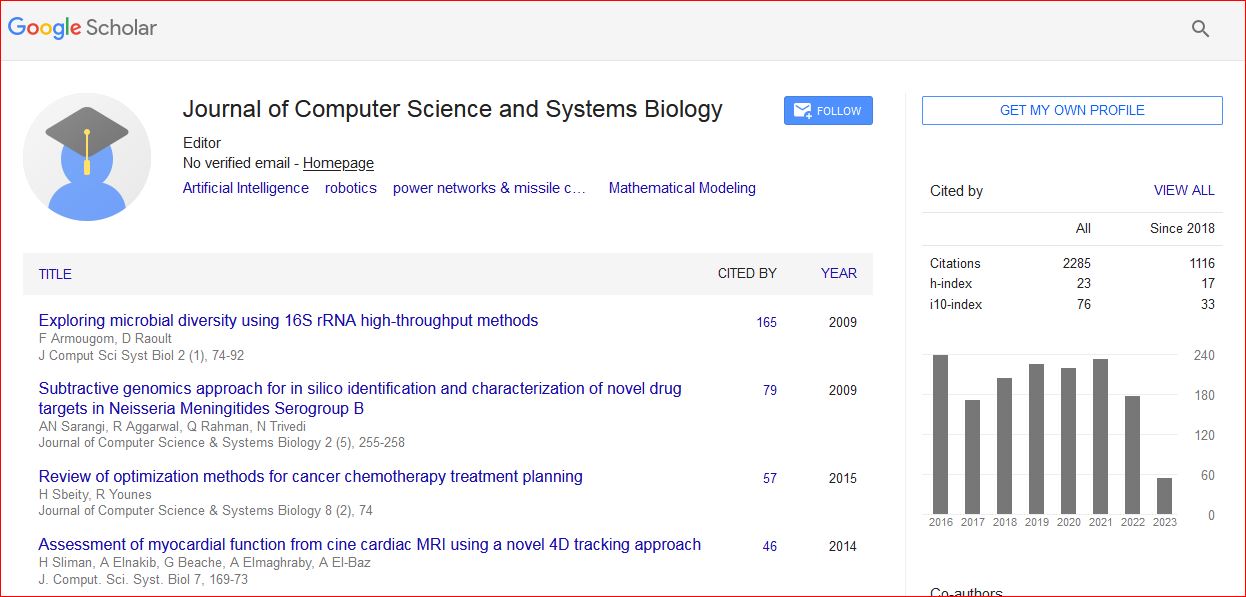
Journal of Computer Science & Systems Biology received 2279 citations as per Google Scholar report


 Spanish
  Chinese
  Russian
  German
  French
  Japanese
  Portuguese
  Hindi
Hindi 