P Chiranjeevi, T Srikanth, G Rajesh Kumar, K Mrudula Spurthi and H Surekha Rani
: J Bioengineer & Biomedical Sci
BiotechnologyIntroduction: Breast carcinoma is one of the most common neoplasms in women and is a leading cause of cancer-related deaths worldwide. The aetiology of breast cancer is multifactorial. It is a complex disorder in which gene-environment interactions play a significant role and oxidative stress may be an excellent model for exploring mechanisms mediating gene-environment interactions. Oxidative stress arises when there is an imbalance between oxygen free radicals (OFR) formation and scavenging by antioxidants. Excess generation of OFR can cause oxidative damage to bimolecular resulting in lipid peroxidation, mutagenesis and carcinogenesis. OFR-induced lipid peroxidation has been implicated in neoplastic transformation, the control of cell proliferation, and the induction of differentiation, maturation, and apoptosis.Nitric oxide (NO) is a pleiotropic regulator, critical to numerous biological processes, including vasodilatation, neurotransmission and macrophage-mediated immunity. It also has both genotoxic and angiogenic properties. Increased NO generation in cancer cells may contribute to tumor angiogenesis and increases the tumors? metastatic ability. NO and NO-derived reactive nitrogen species induce oxidative and nitrosative stress which results in DNA damage and inhibition of DNA repair enzymes. Objective: The objective of the present is to evaluate the role of oxidative and nitrosative stress in Breast cancer.Materials and methods: Blood samples for the study were collected from MNJ Cancer Hospital, Hyderabad. The study population consisted of (50) patients with Breasts cancer and age matched healthy controls. Estimation of plasma malondialdehyde (Gavino et., al 1981) and Nitrate/Nitrite (Lepoivr 1990) was carried out.Results and conclusions: we found that there are higher levels of MDA, and Nitrate/Nitrite, in Breast cancer patients compared to the controls indicating the role of oxidative stress and inflammation in the breast cancer patients and suggests the importance of antioxidant therapy. Epidemiological studies also suggest that a diet rich in antioxidants may prevent the development of Breast carcinoma
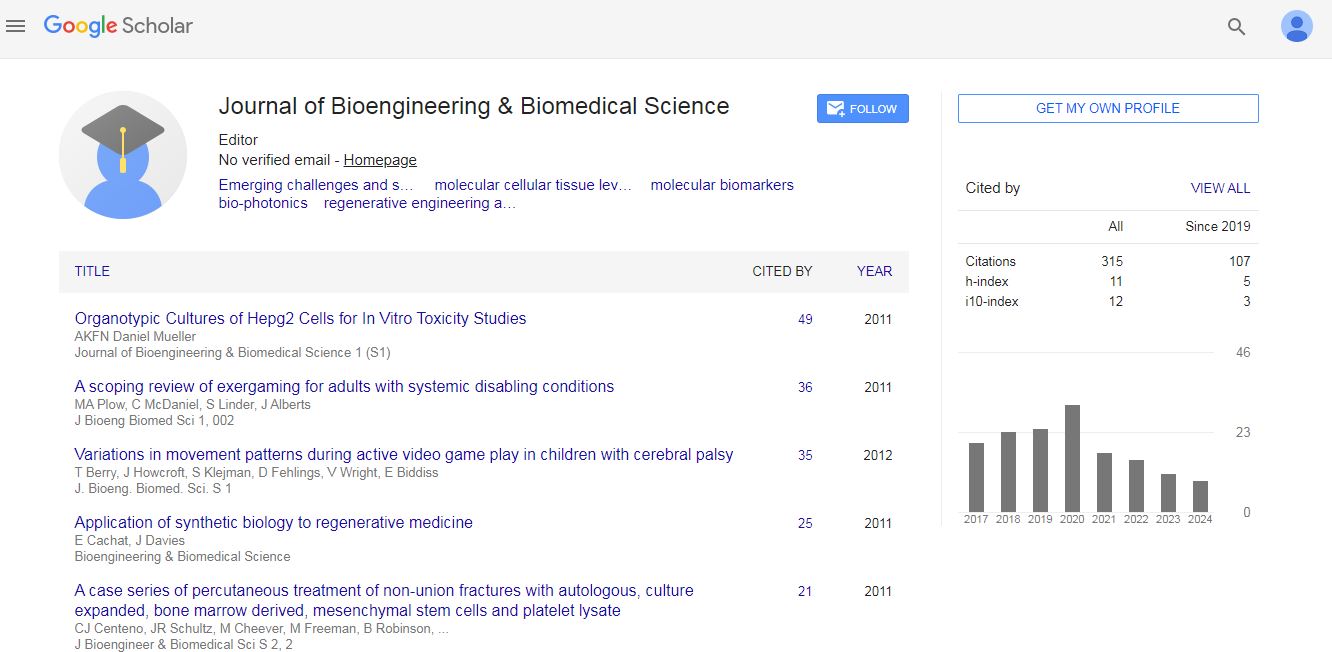
Journal of Bioengineering & Biomedical Science received 307 citations as per Google Scholar report
 Spanish
  Chinese
  Russian
  German
  French
  Japanese
  Portuguese
  Hindi
Hindi 