Peter Minarik1, Jiri Kubasek2, Anna Boukalova3 and David Necas4
1Charles University, Czech Republic 2University of Chemistry and Technology, Czech Republic 3University of Chemistry and Technology, Czech Republic 4University of Chemistry and Technology, Czech Republic
Scientific Tracks Abstracts: J Biomed Sci
Zinc alloys are increasingly recognized for their potential in bioabsorbable implant applications due to their excellent biocompatibility and favourable corrosion behaviour. However, their mechanical performance, corrosion resistance, and biological response must be simultaneously optimised to meet the demanding requirements of biomedical devices. In this study, we investigated advanced zinc-based composites with pseudoharmonic structures, prepared through a combination of mechanical alloying, spark plasma sintering, and hot extrusion. This processing route enabled the formation of a distinctive microstructure characterised by a ductile zinc-rich core enveloped in a continuous, ultrafine-grained hard shell. However, due to some irregularities, the structure is considered as a pseudo-harmonic rather than a fully harmonic structure. Two alloy systems, Zn-1Mg and Zn-1Mg-1Si, were examined, incorporating biologically acceptable alloying elements with the potential to strengthen the zinc matrix. The blending of pure zinc with Zn-1Mg powder produced regions of ductile zinc and finely grained Zn-1Mg, while the addition of silicon further contributed to microstructural refinement. The resulting materials exhibited relatively homogeneous nanograined structures and significantly improved mechanical properties. In particular, the presence of the Mgâ??Znâ?�â?� intermetallic phase enhanced tensile strength. On the other hand, the oxide shells, initially detrimental to mechanical integrity, were effectively removed through hot extrusion. This process improvement led to a marked increase in tensile strength, especially in the optimised Zn-1Mg-1Si composition. These findings highlight the synergistic effect of chemical composition and advanced powder metallurgy techniques in optimising the structural and functional performance of zincbased alloys. This study presents a viable pathway for developing next-generation bioabsorbable materials with a balanced combination of mechanical strength, corrosion behaviour, and biocompatibility. Recent Publications 1. A. Boukalová et al., Harmonizing microstructures and enhancing mechanical resilience: Novel powder metallurgy approach for Zn–Mg alloys, J. Mater. Res. Technol. 31 (2024) 2807–2819. https://doi. org/10.1016/j.jmrt.2024.06.223. 2. D. NeÄ�as et al., Advanced Zinc–Magnesium Alloys Prepared by Mechanical Alloying and Spark Plasma Sintering, Materials 15 (2022) 5272. https://doi.org/10.3390/ma15155272. 3. D. NeÄ�as et al., Exploring the microstructure, mechanical properties, and corrosion resistance of innovative bioabsorbable Zn-Mg-(Si) alloys fabricated via powder metallurgy techniques, J. Mater. Res. Technol. 29 (2024) 3626–3641. https://doi.org/10.1016/j.jmrt.2024.02.066. 4. K. Ameyama et al., Harmonic structure, a promising microstructure design, Mater. Res. Lett. 10 (2022) 440–471. https://doi.org/10.1080/21663831.2022.2057203. 5. W. Pachla et al., Structural and mechanical aspects of hypoeutectic Zn–Mg binary alloys for biodegradable vascular stent applications, Bioact. Mater. 6 (2021) 26–44. https://doi.org/10.1016/j. bioactmat.2020.07.004.
Peter Minarik is an expert in the microscopy-based characterization of metallic materials using scanning electron microscopy. One of his major areas of interest is biodegradable metallic materials. For more than a decade, he has focused on various biodegradable alloys, particularly magnesium-based systems. His research has explored the interrelationships between composition, microstructure, and the physical properties of these materials. More recently, his attention has shifted toward modern powder metallurgy techniques, which offer precise control over the final microstructure of materials.
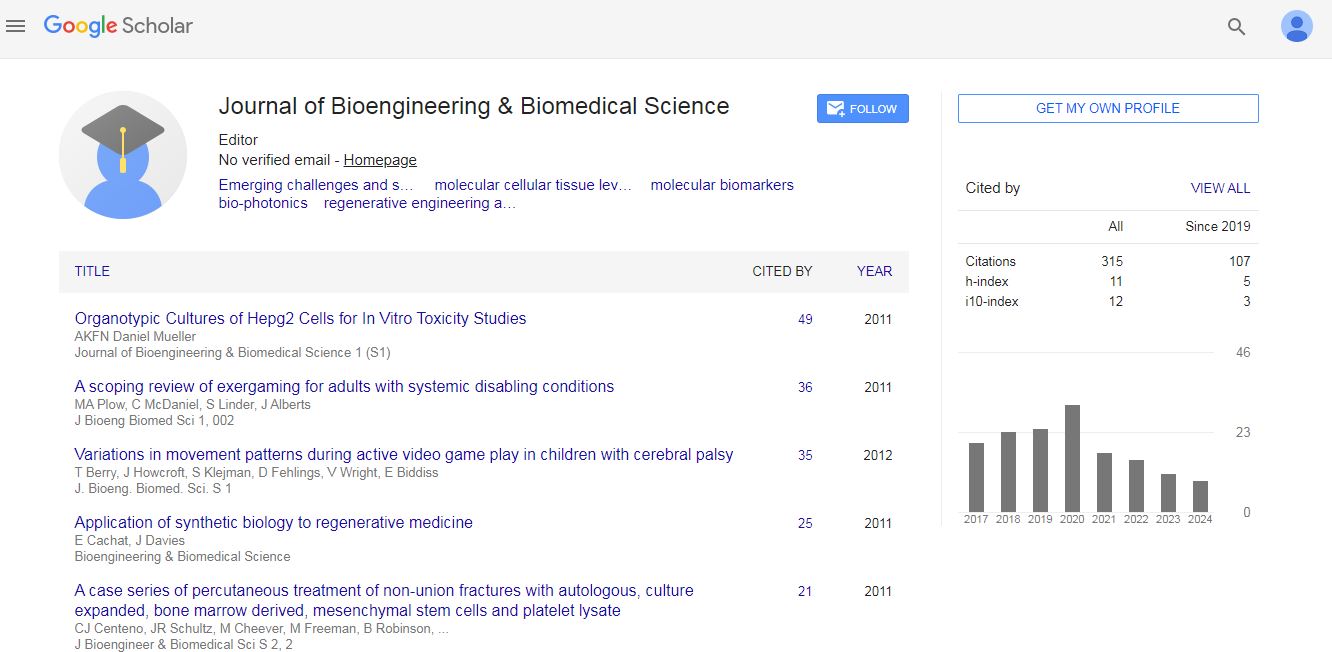
Journal of Bioengineering & Biomedical Science received 307 citations as per Google Scholar report
 Spanish
  Chinese
  Russian
  German
  French
  Japanese
  Portuguese
  Hindi
Hindi 