Pilar Garrido-Martín
Patricia Rodríguez-Fortúnez, Estefanía Pérez-Carreño, Nayra Delgado-Morales, Alejandro Jimenez- Sosa, Celia Miranda-Barrero, Soraya Stella- Gónzalez, Guadalupe Sauchelli-Faas, Mónica García-Bouza, Javier Montoto-López, Pablo Prada-Arrondo, Nora Garcia-Borges, Spain.
Scientific Tracks Abstracts: Surgery
Surgical wound infections (SWIs) remain a relevant problem within the field of Cardiac Surgery (CS). The objective of this Clinical Trial (CT) is to compare the efficacy of the use of portable single-use negative pressure therapy in the prevention of SWI of cardiac surgery, compared to single-use hydrocolloid dressings. Methods: CT randomized in a 1:1 ratio and two parallel groups (PICO vs hydrocolloid), This CT, ClinicalTrials.gov identifier is NCT04265612. Results: A total of 252 patients were included in the CT (125 in the PICO dressing group and 127 in the hydrocolloid group), the groups being homogeneous and comparable During the ICU stay, a higher proportion of patients in the hydrocolloid group (13.3%) had bacteremia compared to those in the PICO group (7.3%), although the differences observed were not statistically significant (p=0.123). Likewise, a greater occurrence of renal failure was observed in 38.3% of patients treated with hydrocolloid vs PICO (23.8%), (p=0.014). No statistically significant differences were observed between treatment groups with regard to the number of surgical wound infections, wound exudate or skin dehiscence. However, at visit 4 (hospital discharge), 20.6% of patients with hydrocolloid vs. 9.4% with PICO presented a complicated postoperative process (p=0.023). It should be noted that, during visit 3 (ward), a statistically significant higher proportion of patients in the hydrocolloid group had a good sternal dressing condition compared to those in the PICO group (95.9% vs. 87.9%; p=0.036). No statistically significant differences were observed between groups with regard to the occurrence of adverse events, days of stay in the ICU, on the ward or total postoperative stay. Conclusions: No statistically significant results were observed between the use of portable single-use negative pressure therapy “PICO®” in the prevention of SWI in cardiac surgery under CPB, compared to single-use hydrocolloid dressings, nor in terms of hospital stays.
Pilar Garrido MD PhD is a cardiovascular surgeon with over 30 years of surgical experience. She has study the evolution of surgical wound infections and changed wound care models, with the goal of reducing the incidence of sternal wound complications. It has been shown that negative pressure therapy dressings and hydrocolloids can reduce SSIs after cardiac surgery. However, to date, the comparative efficacy of these two types of dressings in CC has not been evaluated. An experienced clinical trial investigator. Dr. Garrido have designed this (CT) to evaluate the efficacy of PICO® single-use portable negative pressure dressings versus Aquacel Surgical® single-use hydrocolloid dressings in the postoperative management of surgical wounds in patients undergoing cardiac surgery under extracorporeal circulation. This CT has been approved in October 2019 by the AEMPs and CEIm of the University Hospital of the Canary Islands. Its ClinicalTrials.
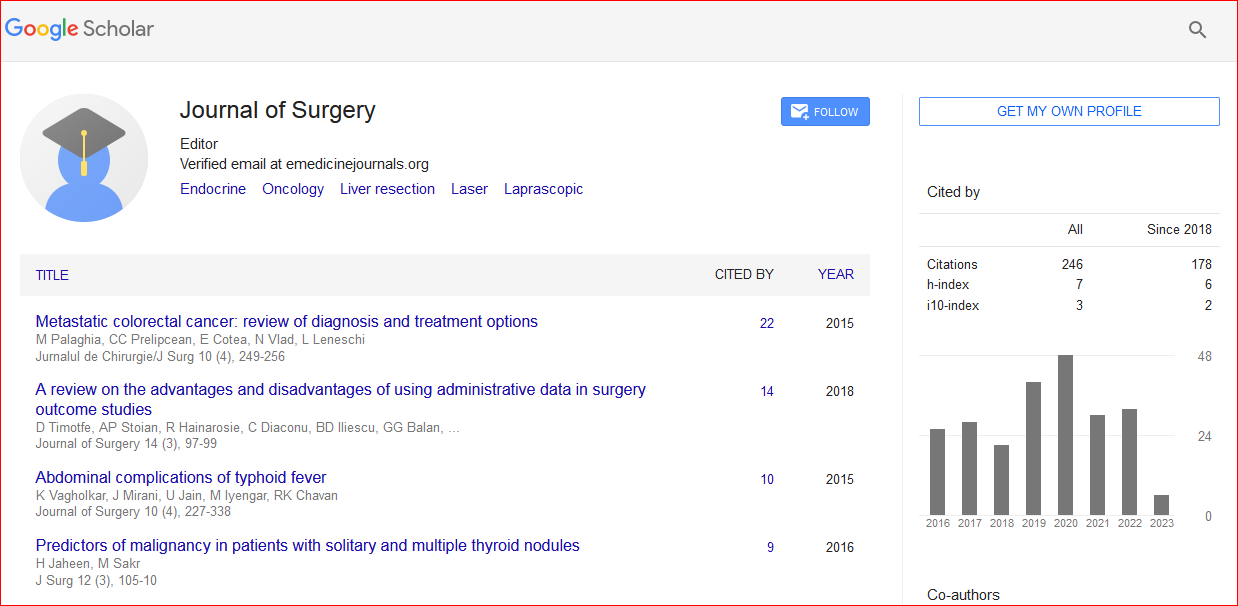
Journal of Surgery received 288 citations as per Google Scholar report
 Spanish
  Chinese
  Russian
  German
  French
  Japanese
  Portuguese
  Hindi
Hindi 