Jian-Xin Wang, Mohamed Eddaoudi and Omar F. Mohammed
KAUST Foundation, KSA
Scientific Tracks Abstracts: J Biomed Sci
Metal–organic frameworks (MOFs) combine exceptional structural modularity with highly ordered architectures, making them promising candidates to bridge the gap between organic and inorganic X-ray energy converters. However, achieving efficient emission from the organic linker typically requires large π-conjugated systems, which inherently limit the incorporation of heavy atoms and thus result in weak X-ray absorption and poor sensitivity. Conversely, metalcentered emission often relies on rare-earth elements, which are costly and produce narrow emission bands, ultimately reducing the overall light yield. In this work, we strategically design and integrate a small organic linker with intrinsic room-temperature phosphorescence into a MOF matrix. The strong coordination and optimal spatial proximity between the linker and heavy-metal centers, together with the unique arrangement of the linker, significantly enhance intersystem crossing and phosphorescence while suppressing the detrimental π–π stacking interactions commonly found in organic materials, thereby mitigating aggregation-induced quenching. This synergistic design enables highly efficient triplet exciton harvesting and yields a ~50-fold increase in radiative release. As a result, the MOF exhibits over a 50-fold enhancement in radioluminescence efficiency relative to the organic linker alone, while achieving a high X-ray imaging resolution of 20 lp mm⁻¹—surpassing most reported X-ray energy converters. These findings provide a new molecular design paradigm for advancing MOF-based X-ray scintillators and highlight their potential as efficient, high-resolution energy-conversion materials. Recent Publications 1. 1. Wang, J.-X.; Nadinov, I.; Thomas, S.; Shekhah, O.; Zhu, X.; He, T.; He, T.; Yuan, X.; Wang, S.; Jiang,H.; Bakr, O. M.; Alshareef, H. N.; Eddaoudi, M.; Mohammed, O. F. (2025) An Efficient Metal-Organic Framework X-ray Energy Converter. Chem 11: 102646. 2. 2. Wang, J.-X.; Shekhah, O.; Bakr, O. M.; Eddaoudi, M.; Mohammed, O. F. (2025) Energy Transferbased X-ray Imaging Scintillators. Chem 11: 102273. 3. 3. Wang, J.-X.; He, T.; Shekhah, O.; Gutiérrez-Arzaluz, L.; Ugur, E.; Thomas, S.; Cheng, Y.; Zhu, X.; Jiang, H.; He, T.; Wang, L.; Jia, J.; Wolf, S. D.; Alshareef, H. N.; Bakr, O. M.; Eddaoudi, M.; Mohammed, O. F. (2025) In situ Electrochemical Deposition of Compact Metal-Organic Framework Thin Films for High-Resolution X-ray Imaging. Matter 8: 101936. 4. 4. Wang, J.-X.; Dutta, I.; Yin, J.; He, T.; Gutiérrez-Arzaluz, L.; Bakr, O. M.; Eddaoudi, M.; Huang, K.-W.; Mohammed, O. F. (2023) TripletTriplet Energy Transfer-based Transparent X-ray Imaging Scintillators. Matter 6: 217-225. 5. 5. Wang, J.-X.; Gutiérrez-Arzaluz, L.; Wang, X.; Almalki, M.; Yin, J.; Czaban-Jóźwiak, J.; Shekhah, O.; Zhang, Y.; Bakr, O. M.; Eddaoudi, M.; Mohammed, O. F. (2022) Nearly 100% Energy Transfer at the Interface of Metal-Organic Frameworks for X-ray Imaging Scintillators. Matter 5: 253-265.
Jianxin Wang focuses his research on the design of metal–organic framework (MOF)–based scintillators for advanced X-ray imaging. His work centers on developing innovative materials and architectures that enable high sensitivity and low-dose detection, thereby improving imaging resolution and safety. Drawing on expertise in materials chemistry, photophysics, and device engineering, he explores how the structural tunability and functional versatility of MOFs can be harnessed to overcome the limitations of conventional scintillators. His research not only advances fundamental understanding of MOF-based energy conversion but also opens pathways toward practical applications in next-generation medical and industrial imaging technologies.
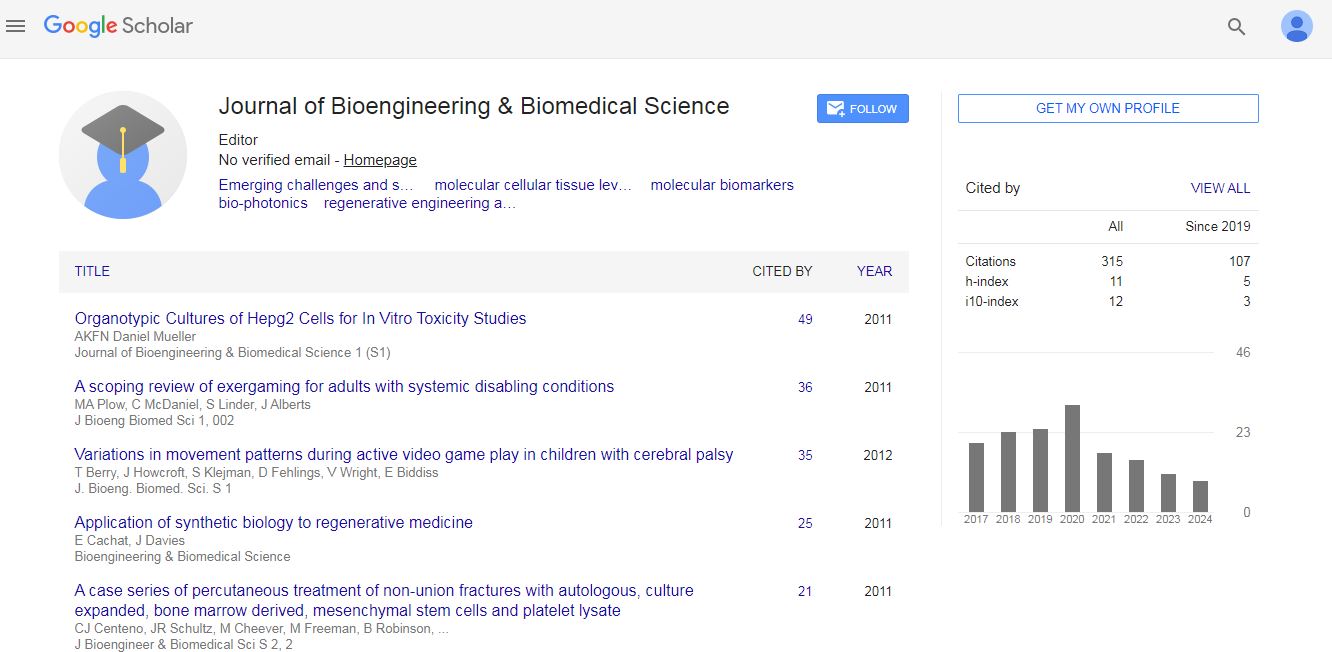
Journal of Bioengineering & Biomedical Science received 307 citations as per Google Scholar report
 Spanish
  Chinese
  Russian
  German
  French
  Japanese
  Portuguese
  Hindi
Hindi 