Xin Zhu, Boon S. Ooi, Mohamed Eddaoudi and Omar F. Mohammed
KAUST Foundation, KSA
Scientific Tracks Abstracts: J Biomed Sci
With the rapid development of digital society, the explosive growth of wireless communication devices is creating unprecedented demands on data transmission speed and capacity. Traditional radio frequency (RF)-based wireless networks are increasingly constrained by limited spectrum resources and severe congestion, motivating the exploration of optical wireless communications (OWCs) as a promising alternative. OWCs exploit the unlicensed optical spectrum to deliver high-speed, secure, and interference-free data transmission, but their performance critically depends on the availability of efficient color converters. To address this challenge, lanthanide-based metal-organic frameworks (MOFs) were integrated with an energy transfer strategy by incorporating chromophores into the MOF cavities and surfaces. This design enabled a substantial reduction in the photoluminescence (PL) lifetime, from 1.3 ms in pristine MOFs to 4.6 ns in the MOF-chromophore composite, achieved through efficient energy transfer processes occurring within the cavity and at the surface of the frameworks. This significant reduction in PL lifetime led to a dramatic increase in the –3-dB bandwidth, rising from less than 0.1 MHz to 65.7 MHz. Most importantly, a net data rate of 1.076 Gb/s was achieved, marking the first successful demonstration of lanthanide-based MOFs as color converters that facilitate data transmission rates exceeding 1 Gb/s. Notably, both the –3-dB bandwidth and net data rate surpass those of most reported organic and inorganic materials, underscoring the exceptional potential of lanthanidebased MOFs when combined with an efficient energy transfer strategy. These findings provide a pathway for the design of next-generation OWC technologies with Gb-level transmission, meeting the urgent demand for faster and more reliable wireless communication systems. Recent Publications 1. Zhu X, Wang Y, He T, Thomas S, Jiang H, Shekhah O, et al. (2025) Efficient Color Conversion in Metal– Organic Frameworks Boosts Optical Wireless Communications beyond 1 GB/s Data Rate. Journal of the American Chemical Society 147:6805-6812. 2. Zhu X, Wang Y, Nadinov I, Thomas S, Gutierrez-Arzaluz L, He T, et al. (2024) Leveraging Intermolecular Charge Transfer for High-Speed Optical Wireless Communication. The Journal of Physical Chemistry Letters 15:2988-2994. 3. Zhu X, He T, Song X, Shekhah O, Thomas S, Jiang H, et al. (2024) Large-Area Metal-Organic Framework Glasses for Efficient X-Ray Detection. Advanced Materials 36:e2412432. 4. Zhu X, Zhou R, Wang Z, Thomas S, Maity P, Gutiérrez-Arzaluz L, et al. (2024) Lanthanide-Metal- Doped Light-Harvesting Quantum Dots for Exceptional X-ray Imaging Scintillators. ACS Energy Letters 9:5137-5144. 5. Wang J-X, Nadinov I, Thomas S, Shekhah O, Zhu X, He T, et al. (2025) An efficient metal-organic framework X-ray energy converter. Chem 11:102646
Xin Zhu’s research focuses on developing advanced materials to enhance the performance of optical wireless communication (OWC) and X-ray detection. By employing energy transfer strategies, she tailors the photophysical properties of materials to improve data transmission rates and imaging resolution. Drawing on her expertise in materials design, mechanism, and device engineering, she investigates how structural and functional design can address the limitations of conventional materials. This integrated approach not only advances the fundamental understanding of structure–property relationships but also opens avenues for next-generation communication systems and medical imaging technologies
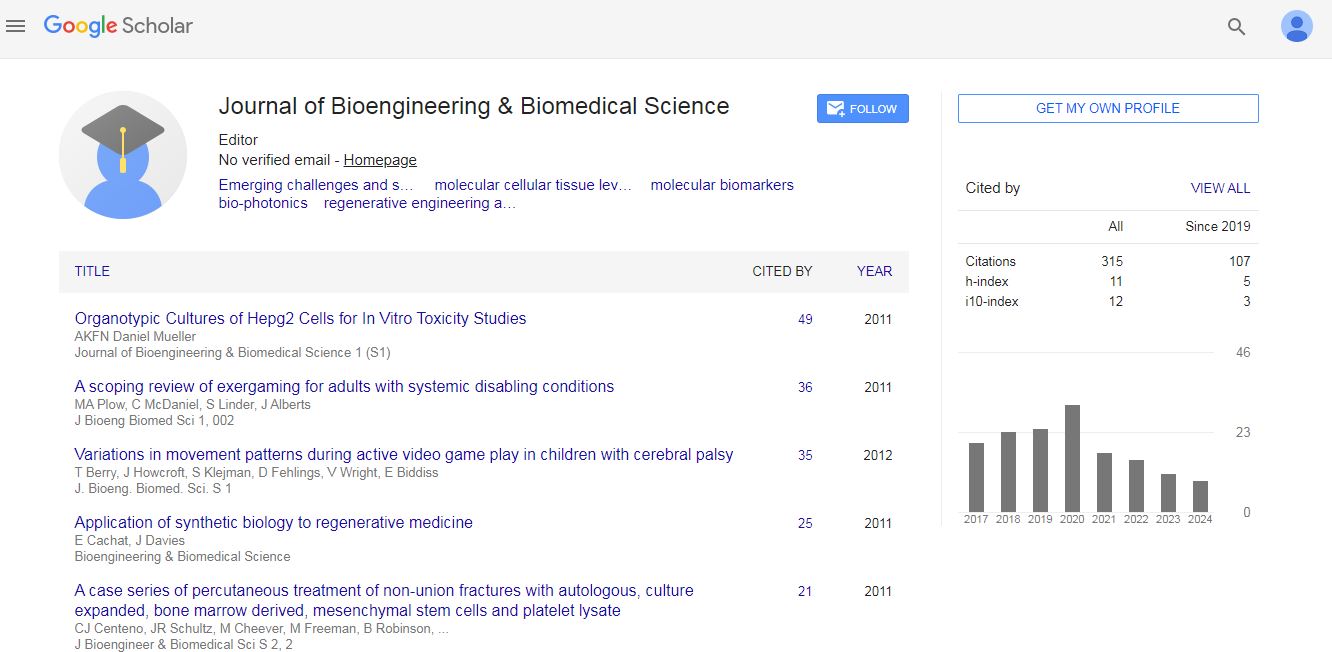
Journal of Bioengineering & Biomedical Science received 307 citations as per Google Scholar report
 Spanish
  Chinese
  Russian
  German
  French
  Japanese
  Portuguese
  Hindi
Hindi 