Ting Wang
W ith the prevalence of antiviral therapy in the developed world, many HIV-1-infected people die of diseases other than AIDS. One of the emerging major causes is cardiovascular disease, leading to the prediction that the majority of HIV- 1 patients are expected to develop cardiovascular complications.Endothelial dysfunction is thought to be a key event in the development of cardiovascular diseases, particularly atherosclerosis. Assays testing the effect of HIV-1 on endothelial activation shows that direct contact with HIV-1 infected T cells enhance endothelial cell activation to a greater extent than HIV-1 alone, suggesting an intracellular HIV-1 protein is responsible for endothelial activation. The HIV-1 viral protein Nef, which is responsible for T cell activation and maintenance of high viral loads in vivo, has been shown to mediate its own transfer to bystander cells. We demonstrate here for the first time that Nef induces nanotube-like conduits connecting T cells and endothelial cells. We also show that Nef is transferred from T cells to endothelial cells via these nanotubes, and is necessary and sufficient for endothelial cell activation. Moreover, we show that SIV-infected macaques exhibit endothelial Nef expression in coronary arteries. Nef expression in endothelial cells causes endothelial apoptosis, ROS and MCP-1 production. Interestingly, a Nef SH3 binding site mutant abolishes Nef-induced apoptosis and ROS formation and reduces MCP-1 production in endothelial cells, suggesting that the Nef SH3 binding site is critical for Nef effects on endothelial cells. Nef induces apoptosis of endothelial cells through an NADPH oxidase- and ROS-dependent mechanism, while Nef-induced MCP-1 production is NF-kB dependent. Taken together, these data suggest that Nef can mediate its transfer from T cells to endothelial cells through nanotubes to enhance endothelial dysfunction in vivo. Thus, Nef is a promising new therapeutic target for reducing the risk for cardiovascular disease in the HIV-1 positive population
Ting Wang is a third year Ph.D student from Indiana University School of Medicine
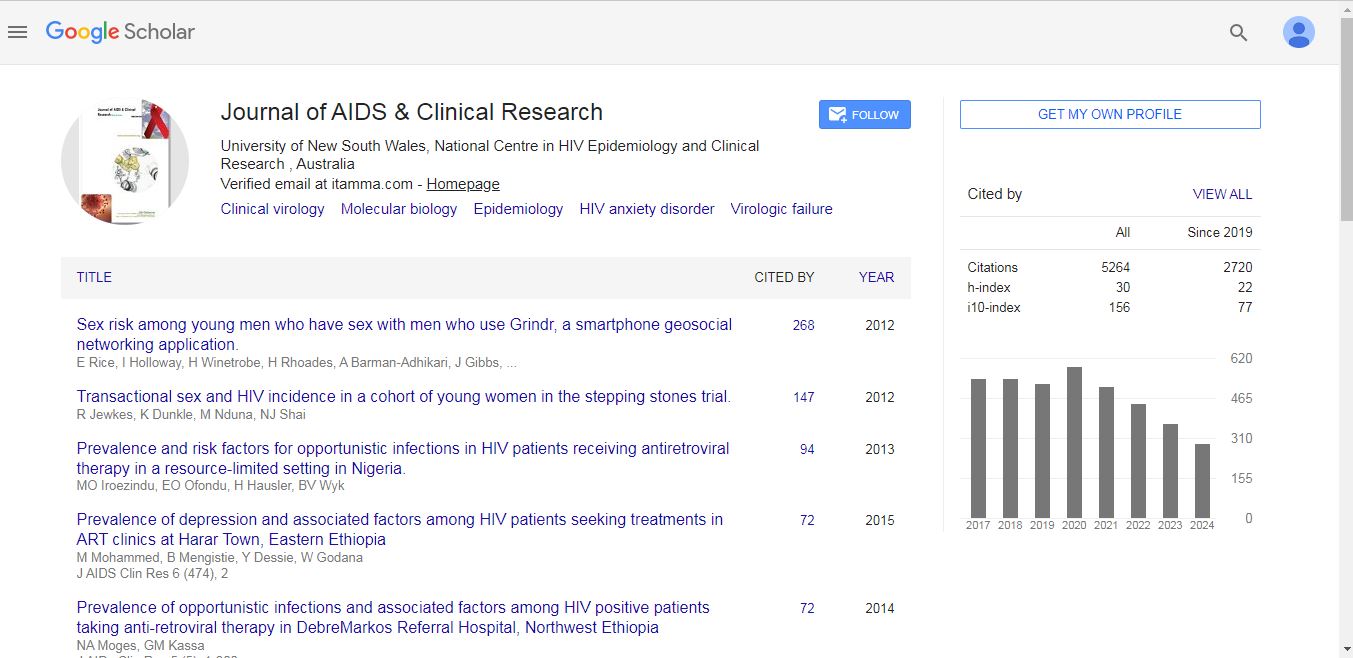
Journal of AIDS & Clinical Research received 5264 citations as per Google Scholar report
 Spanish
  Chinese
  Russian
  German
  French
  Japanese
  Portuguese
  Hindi
Hindi 