Torben Daeneke
RMIT University, Australia
Scientific Tracks Abstracts: J Biomed Sci
Developing efficient and durable electrocatalysts for ethanol electro-oxidation is crucial for enabling the application of direct ethanol fuel cell technology. Herein, it is demonstrated that Pt–Ga liquid metalbased nanodroplets can serve as an efficient electrocatalyst to drive ethanol oxidation. The mass activity of Pt is significantly improved by alloying with liquid gallium. Guided by machine learning neural networks, a low-concentration alkaline electrolyte is specifically formulated to allow electrodes with ultralow Pt loading to demonstrate remarkable activity toward ethanol oxidation with a mass activity as high as 13.47 A mg−1Pt, which is more than 14 times higher than that of commercial Pt/C electrocatalysts (i.e., 0.76 A mg−1Pt). Computational studies reveal that the superior activity is associated with the presence of Ga oxides adjacent to Pt on the catalyst surface, which leads to energetically favorable pathways for the oxidation process. The findings reveal untapped opportunities in the realm of liquid metal catalysis and hold great promise for the future development of highperformance alcohol fuel cells.
Torben Daeneke is a PhD candidate working on the development of liquid metal-based electrocatalysts for oxidation and reduction reactions. His research focuses on gallium-based systems (e.g., PtGa alloys) for applications such as COâ?? reduction, hydrogen evolution, and alcohol oxidation. By integrating material design, electrochemical testing, and surface analysis, he aims to understand and harness the dynamic behavior of liquid metal interfaces under reaction conditions. His work contributes to the advancement of adaptable and efficient catalysts for sustainable electrochemical technologies.
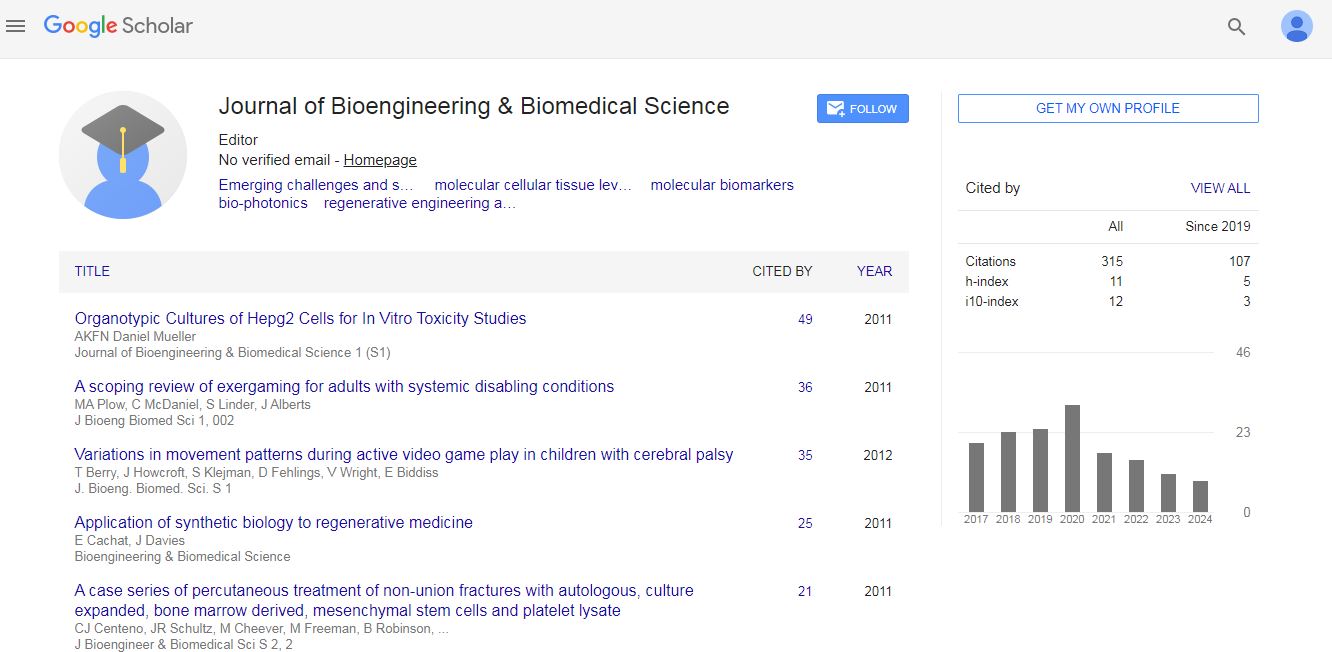
Journal of Bioengineering & Biomedical Science received 307 citations as per Google Scholar report
 Spanish
  Chinese
  Russian
  German
  French
  Japanese
  Portuguese
  Hindi
Hindi 